QUESTION IMAGE
Question
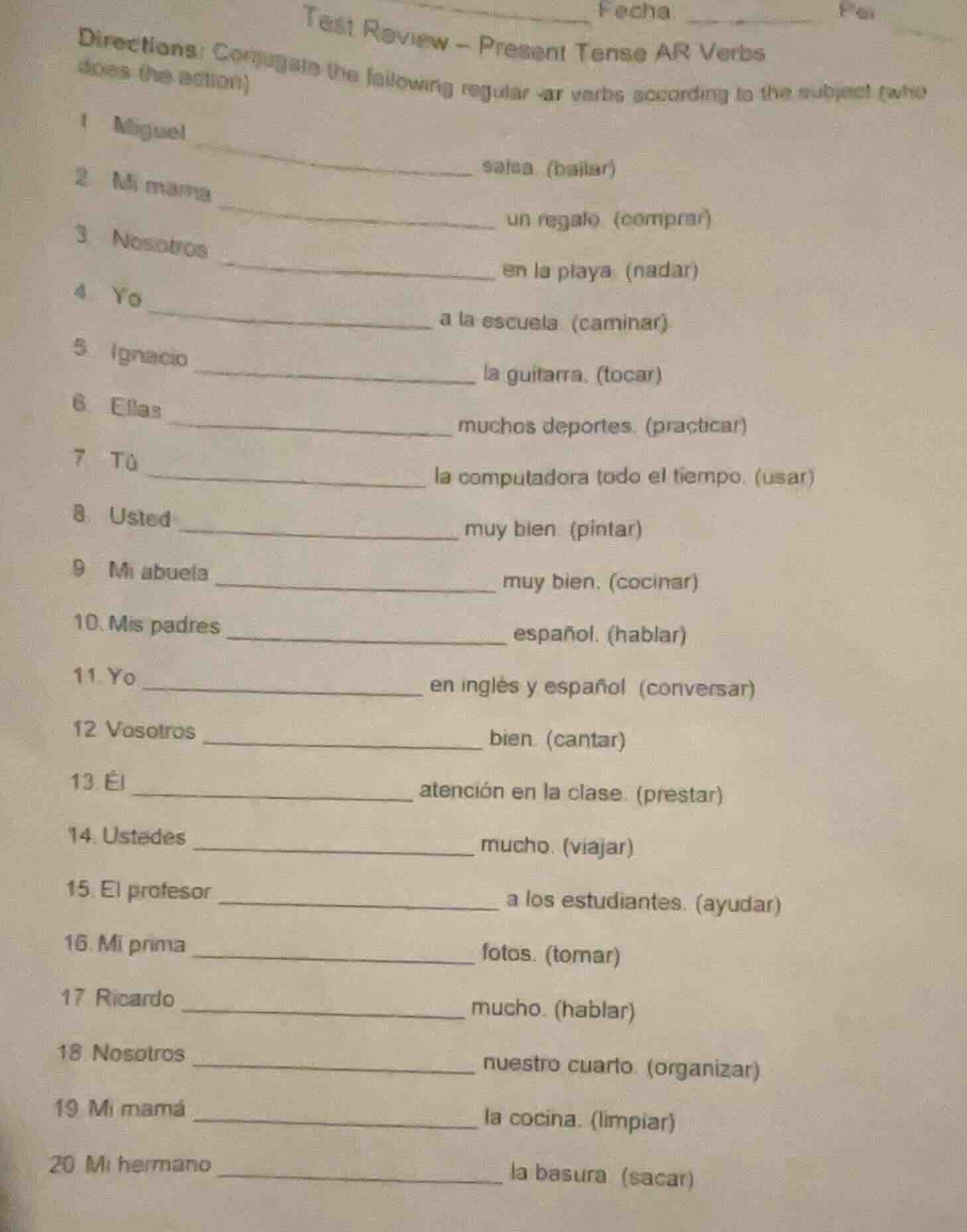
test review - present tense ar verbs
directions: conjugate the following regular -ar verbs according to the subject (who does the action)
1 miguel ____ salsa. (bailar)
2 mi mama ____ un regalo. (comprar)
3 nosotros ____ en la playa. (nadar)
4 yo ____ a la escuela. (caminar)
5 ignacio ____ la guitarra. (tocar)
6 ellas ____ muchos deportes. (practicar)
7 tú ____ la computadora todo el tiempo. (usar)
8 usted ____ muy bien. (pintar)
9 mi abuela ____ muy bien. (cocinar)
- mis padres ____ español. (hablar)
- yo ____ en inglés y español. (conversar)
12 vosotros ____ bien. (cantar)
13 él ____ atención en la clase. (prestar)
- ustedes ____ mucho. (viajar)
- el profesor ____ a los estudiantes. (ayudar)
- mi prima ____ fotos. (tomar)
17 ricardo ____ mucho. (hablar)
- nosotros ____ nuestro cuarto. (organizar)
- mi mamá ____ la cocina. (limpiar)
20 mi hermano ____ la basura. (sacar)
To conjugate regular - ar verbs in the present tense in Spanish, we follow these rules:
- For yo (I), we replace the - ar ending with - o.
- For tú (you, informal singular), we replace the - ar ending with - as.
- For él/ella/usted (he/she/you, formal singular), we replace the - ar ending with - a.
- For nosotros/nosotras (we), we replace the - ar ending with - amos.
- For vosotros/vosotras (you, informal plural - used mainly in Spain), we replace the - ar ending with - áis.
- For ellos/ellas/ustedes (they/you, formal plural), we replace the - ar ending with - an.
Question 1: Miguel ______ salsa. (bailar)
- Miguel is a singular masculine subject, so we use the él form.
- Replace - ar in bailar with - a.
- Conjugated form: baila
Question 2: Mi mamá ______ un regalo. (comprar)
- Mi mamá is a singular feminine subject, so we use the ella form.
- Replace - ar in comprar with - a.
- Conjugated form: compra
Question 3: Nosotros ______ en la playa. (nadar)
- Nosotros is the first - person plural subject, so we use the nosotros form.
- Replace - ar in nadar with - amos.
- Conjugated form: nadamos
Question 4: Yo ______ a la escuela. (caminar)
- Yo is the first - person singular subject, so we use the yo form.
- Replace - ar in caminar with - o.
- Conjugated form: camino
Question 5: Ignacio ______ la guitarra. (tocar)
- Ignacio is a singular masculine subject, so we use the él form.
- Replace - ar in tocar with - a.
- Conjugated form: toca
Question 6: Ellas ______ muchos deportes. (practicar)
- Ellas is the third - person plural feminine subject, so we use the ellas form.
- Replace - ar in practicar with - an.
- Conjugated form: practican
Question 7: Tú ______ la computadora todo el tiempo. (usar)
- Tú is the second - person singular informal subject, so we use the tú form.
- Replace - ar in usar with - as.
- Conjugated form: usas
Question 8: Usted ______ muy bien. (pintar)
- Usted is the second - person singular formal subject, so we use the usted form (same as él/ella form).
- Replace - ar in pintar with - a.
- Conjugated form: pinta
Question 9: Mi abuela ______ muy bien. (cocinar)
- Mi abuela is a singular feminine subject, so we use the ella form.
- Replace - ar in cocinar with - a.
- Conjugated form: cocina
Question 10: Mis padres ______ español. (hablar)
- Mis padres is a plural subject, so we use the ellos form.
- Replace - ar in hablar with - an.
- Conjugated form: hablan
Question 11: Yo ______ en inglés y español. (conversar)
- Yo is the first - person singular subject, so we use the yo form.
- Replace - ar in conversar with - o.
- Conjugated form: converso
Question 12: Vosotros ______ bien. (cantar)
- Vosotros is the second - person plural informal subject (used in Spain), so we use the vosotros form.
- Replace - ar in cantar with - áis.
- Conjugated form: cantáis
Question 13: Él ______ atención en la clase. (prestar)
- Él is a singular masculine subject, so we use the él form.
- Replace - ar in prestar with - a.
- Conjugated form: presta
Question 14: Ustedes ______ mucho. (viajar)
- Ustedes is the second - person plural formal subject (used in most Spanish - speaking regions except Spain), so we use the ustedes form (same as ellos/ellas form).
- Replace - ar in viajar with - an.
- Conjugated form: viajan
Question 15: El profesor ______ a los estudiantes. (ayudar)
- El profesor is a singular masculine subject, so we use the él form.
- Replace - ar in ayudar with - a.
- Co…

Snap & solve any problem in the app
Get step-by-step solutions on Sovi AI
Photo-based solutions with guided steps
Explore more problems and detailed explanations
To conjugate regular - ar verbs in the present tense in Spanish, we follow these rules:
- For yo (I), we replace the - ar ending with - o.
- For tú (you, informal singular), we replace the - ar ending with - as.
- For él/ella/usted (he/she/you, formal singular), we replace the - ar ending with - a.
- For nosotros/nosotras (we), we replace the - ar ending with - amos.
- For vosotros/vosotras (you, informal plural - used mainly in Spain), we replace the - ar ending with - áis.
- For ellos/ellas/ustedes (they/you, formal plural), we replace the - ar ending with - an.
Question 1: Miguel ______ salsa. (bailar)
- Miguel is a singular masculine subject, so we use the él form.
- Replace - ar in bailar with - a.
- Conjugated form: baila
Question 2: Mi mamá ______ un regalo. (comprar)
- Mi mamá is a singular feminine subject, so we use the ella form.
- Replace - ar in comprar with - a.
- Conjugated form: compra
Question 3: Nosotros ______ en la playa. (nadar)
- Nosotros is the first - person plural subject, so we use the nosotros form.
- Replace - ar in nadar with - amos.
- Conjugated form: nadamos
Question 4: Yo ______ a la escuela. (caminar)
- Yo is the first - person singular subject, so we use the yo form.
- Replace - ar in caminar with - o.
- Conjugated form: camino
Question 5: Ignacio ______ la guitarra. (tocar)
- Ignacio is a singular masculine subject, so we use the él form.
- Replace - ar in tocar with - a.
- Conjugated form: toca
Question 6: Ellas ______ muchos deportes. (practicar)
- Ellas is the third - person plural feminine subject, so we use the ellas form.
- Replace - ar in practicar with - an.
- Conjugated form: practican
Question 7: Tú ______ la computadora todo el tiempo. (usar)
- Tú is the second - person singular informal subject, so we use the tú form.
- Replace - ar in usar with - as.
- Conjugated form: usas
Question 8: Usted ______ muy bien. (pintar)
- Usted is the second - person singular formal subject, so we use the usted form (same as él/ella form).
- Replace - ar in pintar with - a.
- Conjugated form: pinta
Question 9: Mi abuela ______ muy bien. (cocinar)
- Mi abuela is a singular feminine subject, so we use the ella form.
- Replace - ar in cocinar with - a.
- Conjugated form: cocina
Question 10: Mis padres ______ español. (hablar)
- Mis padres is a plural subject, so we use the ellos form.
- Replace - ar in hablar with - an.
- Conjugated form: hablan
Question 11: Yo ______ en inglés y español. (conversar)
- Yo is the first - person singular subject, so we use the yo form.
- Replace - ar in conversar with - o.
- Conjugated form: converso
Question 12: Vosotros ______ bien. (cantar)
- Vosotros is the second - person plural informal subject (used in Spain), so we use the vosotros form.
- Replace - ar in cantar with - áis.
- Conjugated form: cantáis
Question 13: Él ______ atención en la clase. (prestar)
- Él is a singular masculine subject, so we use the él form.
- Replace - ar in prestar with - a.
- Conjugated form: presta
Question 14: Ustedes ______ mucho. (viajar)
- Ustedes is the second - person plural formal subject (used in most Spanish - speaking regions except Spain), so we use the ustedes form (same as ellos/ellas form).
- Replace - ar in viajar with - an.
- Conjugated form: viajan
Question 15: El profesor ______ a los estudiantes. (ayudar)
- El profesor is a singular masculine subject, so we use the él form.
- Replace - ar in ayudar with - a.
- Conjugated form: ayuda
Question 16: Mi prima ______ fotos. (tomar)
- Mi prima is a singular feminine subject, so we use the ella form.
- Replace - ar in tomar with - a.
- Conjugated form: toma
Question 17: Ricardo ______ mucho. (hablar)
- Ricardo is a singular masculine subject, so we use the él form.
- Replace - ar in hablar with - a.
- Conjugated form: habla
Question 18: Nosotros ______ nuestro cuarto. (organizar)
- Nosotros is the first - person plural subject, so we use the nosotros form.
- Replace - ar in organizar with - amos.
- Conjugated form: organizamos
Question 19: Mi mamá ______ la cocina. (limpiar)
- Mi mamá is a singular feminine subject, so we use the ella form.
- Replace - ar in limpiar with - a.
- Conjugated form: limpia
Question 20: Mi hermano ______ la basura. (sacar)
- Mi hermano is a singular masculine subject, so we use the él form.
- Replace - ar in sacar with - a.
- Conjugated form: saca
Final Answers:
- baila
- compra
- nadamos
- camino
- toca
- practican
- usas
- pinta
- cocina
- hablan
- converso
- cantáis
- presta
- viajan
- ayuda
- toma
- habla
- organizamos
- limpia
- saca