QUESTION IMAGE
Question
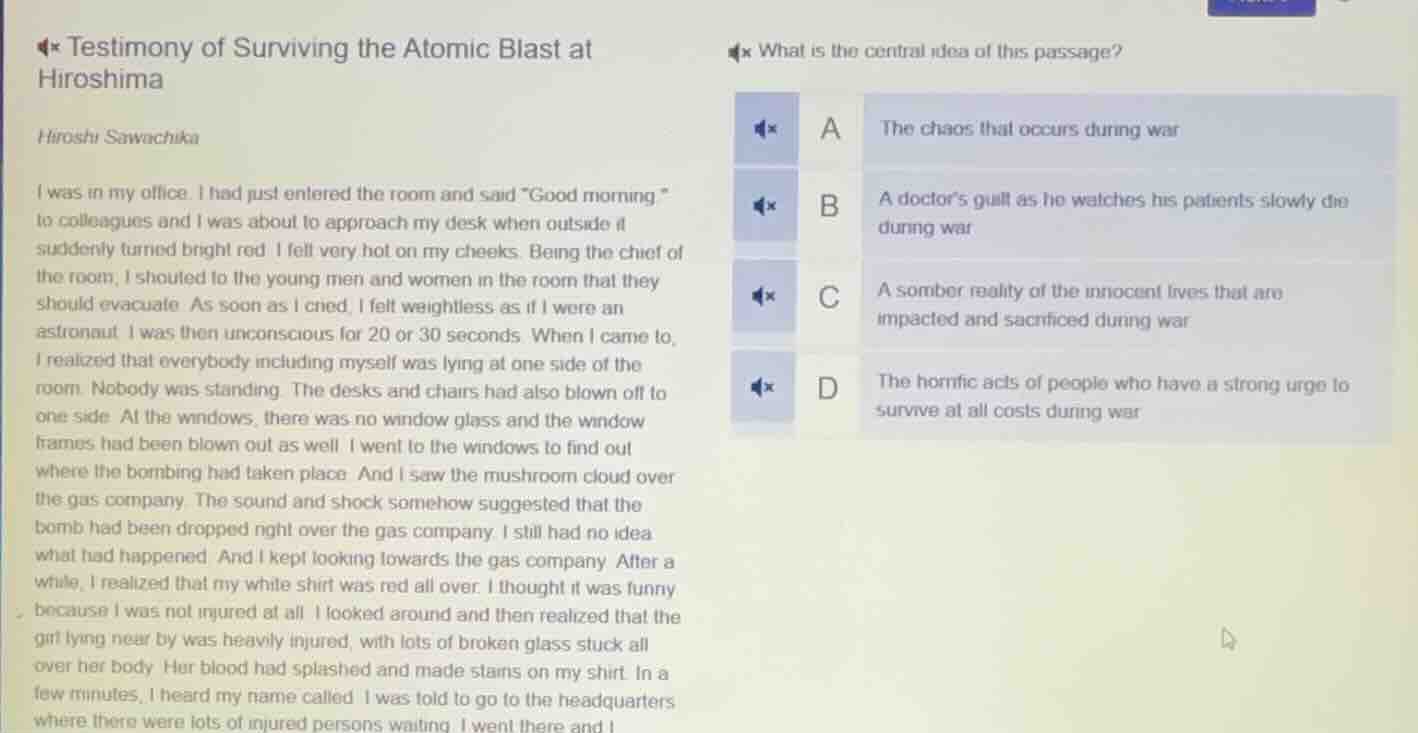
testimony of surviving the atomic blast at hiroshima
hiroshi sawachika
i was in my office. i had just entered the room and said \good morning\ to colleagues and i was about to approach my desk when outside it suddenly turned bright red. i felt very hot on my cheeks. being the chief of the room, i shouted to the young men and women in the room that they should evacuate. as soon as i cried, i felt weightless as if i were an astronaut. i was then unconscious for 20 or 30 seconds. when i came to, i realized that everybody including myself was lying at one side of the room. nobody was standing. the desks and chairs had also blown off to one side. at the windows, there was no window glass and the window frames had been blown out as well. i went to the windows to find out where the bombing had taken place. and i saw the mushroom cloud over the gas company. the sound and shock somehow suggested that the bomb had been dropped right over the gas company. i still had no idea what had happened. and i kept looking towards the gas company. after a while, i realized that my white shirt was red all over. i thought it was funny because i was not injured at all. i looked around and then realized that the girl lying near by was heavily injured, with lots of broken glass stuck all over her body. her blood had splashed and made stains on my shirt. in a few minutes, i heard my name called. i was told to go to the headquarters where there were lots of injured persons waiting. i went there and i
what is the central idea of this passage?
a the chaos that occurs during war
b a doctor’s guilt as he watches his patients slowly die during war
c a somber reality of the innocent lives that are impacted and sacrificed during war
d the horrific acts of people who have a strong urge to survive at all costs during war
The passage is a firsthand account of the atomic blast in Hiroshima. It describes the immediate chaos of the blast, the narrator's unconsciousness, and the sight of innocent injured people (like the injured girl whose blood stained his shirt) and a mass of injured persons waiting for help. Option A is too broad; the passage focuses on a specific atomic attack's impact, not general war chaos. Option B is incorrect as there is no mention of guilt from a doctor. Option D is wrong because the passage does not depict homicidal acts by people trying to survive. Option C accurately captures the grim, somber reality of innocent people being harmed and affected by the war's violence (the atomic blast).

Snap & solve any problem in the app
Get step-by-step solutions on Sovi AI
Photo-based solutions with guided steps
Explore more problems and detailed explanations
C. A somber reality of the innocent lives that are impacted and sacrificed during war