QUESTION IMAGE
Question
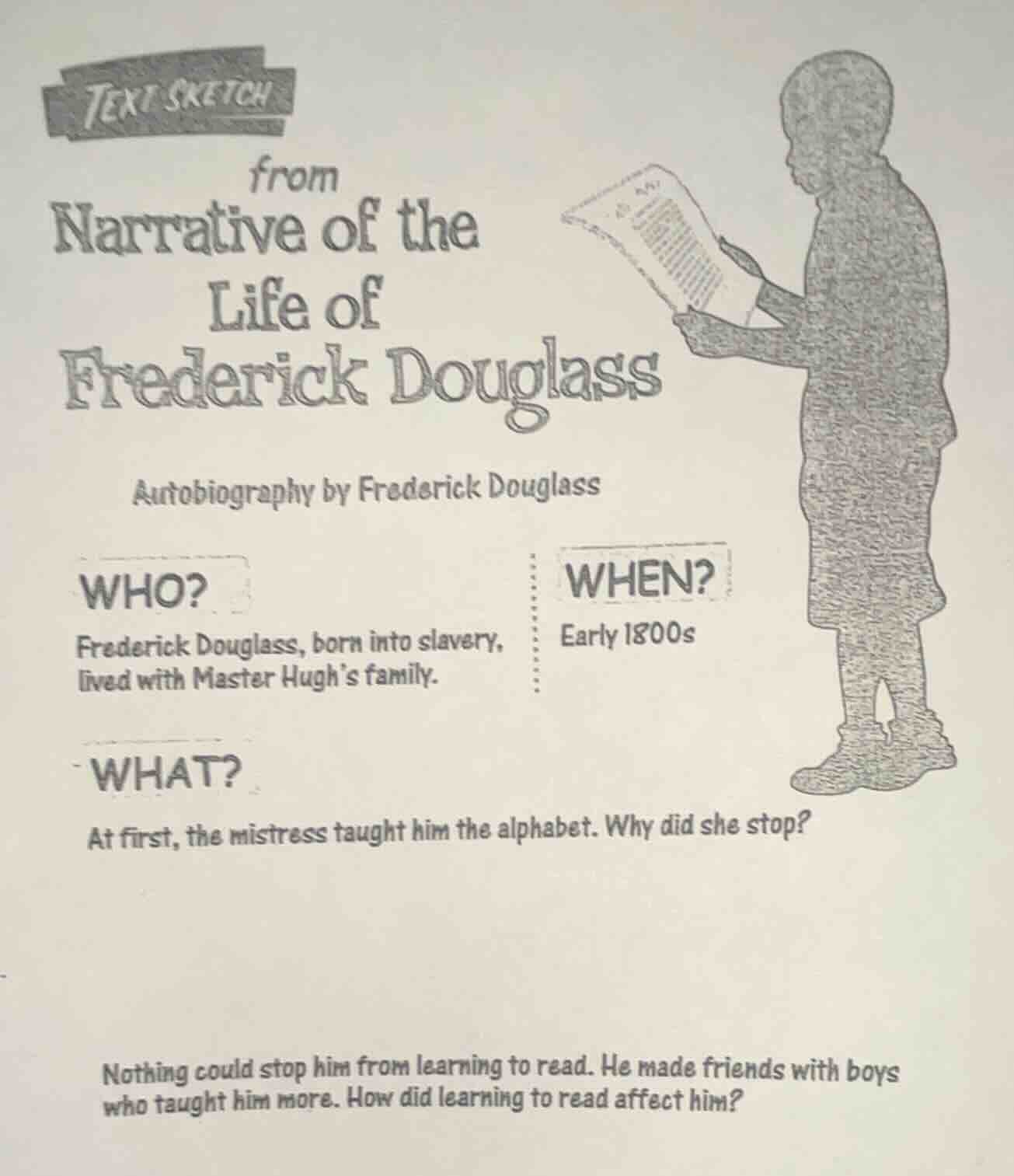
text sketch from narrative of the life of frederick douglass autobiography by frederick douglass who? frederick douglass, born into slavery, lived with master hugh’s family. when? early 1800s what? at first, the mistress taught him the alphabet. why did she stop? nothing could stop him from learning to read. he made friends with boys who taught him more. how did learning to read affect him?
To answer the questions about why the mistress stopped teaching Frederick Douglass the alphabet and how learning to read affected him, we analyze the context of slavery in the early 1800s:
For "Why did she stop?"
In the era of American slavery, slaveholders (including the mistress, Mrs. Hugh) were influenced by the ideology that educating slaves was dangerous. Enslaved people gaining literacy could challenge the system—by understanding their oppression, accessing abolitionist ideas, or asserting their humanity. So, the mistress stopped teaching him to conform to the slaveholding norms that prohibited slave education to maintain control.
For "How did learning to read affect him?"
Literacy empowered Douglass: it let him recognize the injustice of slavery (through reading abolitionist texts, newspapers, or literature), fuel his desire for freedom, and develop the intellectual tools to articulate his struggle. It transformed his self - perception, from a passive slave to an active seeker of liberation, and became a catalyst for his abolitionist work later.
If we were to answer the first sub - question "Why did she stop?":
In the slave - holding society of the early 1800s, slave owners believed that educating slaves (like Frederick Douglass) was a threat to the institution of slavery. Educated slaves could understand their oppression, access ideas of freedom, and challenge the slave system. So the mistress stopped teaching him the alphabet to uphold the norms of slavery and maintain control over the enslaved.
Learning to read allowed Frederick Douglass to recognize the injustice of slavery by accessing abolitionist texts, newspapers, and other written materials. It fueled his desire for freedom, changed his self - perception from a passive slave to an active seeker of liberation, and provided him with the intellectual tools to articulate his struggle against slavery, which later became a catalyst for his abolitionist work.

Snap & solve any problem in the app
Get step-by-step solutions on Sovi AI
Photo-based solutions with guided steps
Explore more problems and detailed explanations
The mistress stopped teaching Frederick Douglass the alphabet because in the slave - holding society of the early 1800s, educating slaves was seen as a threat to the institution of slavery. Slave owners believed that educated slaves could recognize their oppression, access ideas of freedom, and challenge the slave system, so she stopped to uphold the norms of slavery and maintain control.
If we were to answer the second sub - question "How did learning to read affect him?":