QUESTION IMAGE
Question
theorem challenge!
date:
period:
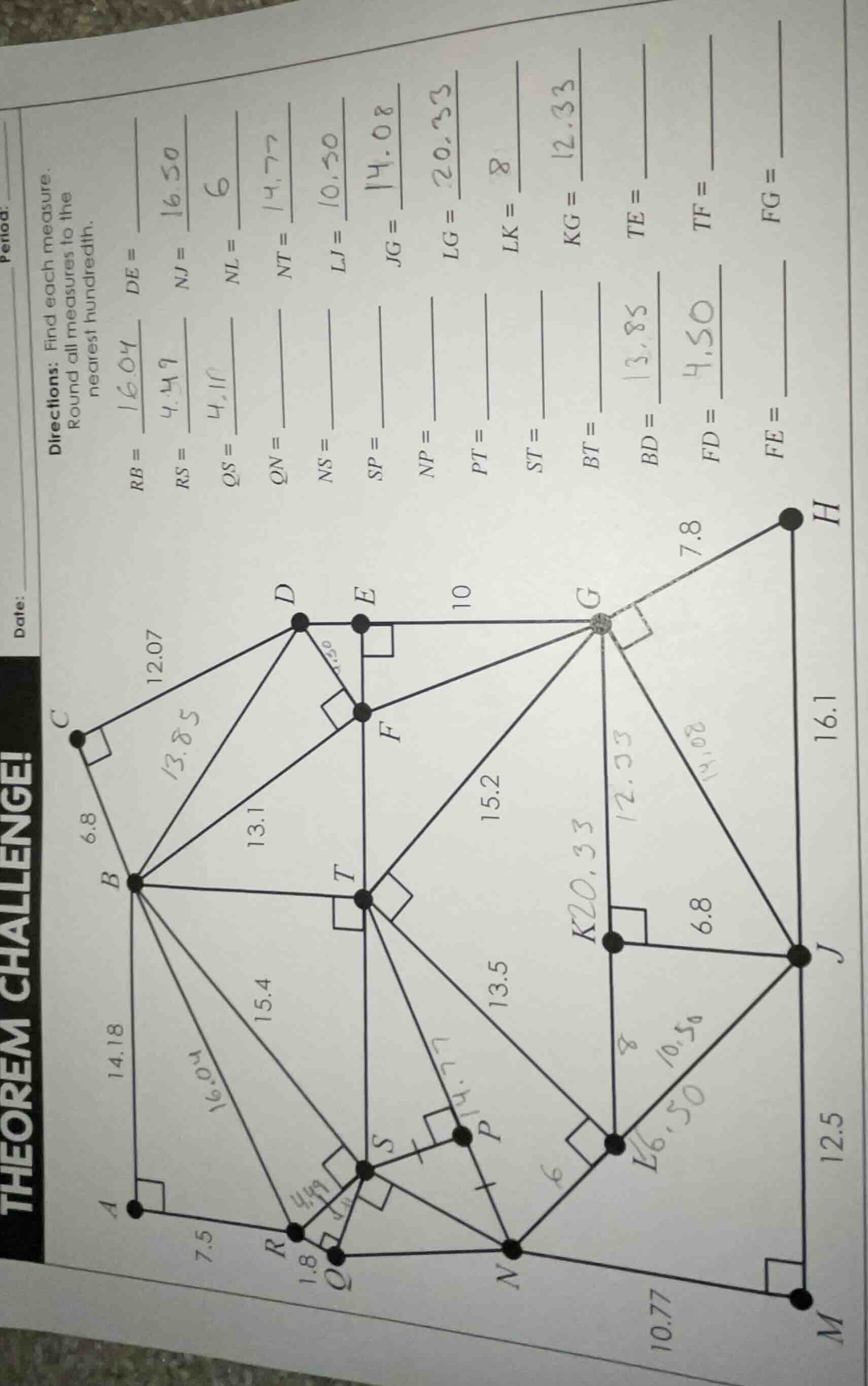
directions: find each measure.
round all measures to the nearest hundredth.
rb =
de =
rs =
nj =
qs =
nl =
qn =
nt =
ns =
lj =
sp =
jg =
np =
lg =
pt =
lk =
st =
kg =
bt =
te =
bd =
tf =
fd =
fe =
fg =
Step1: Use Pythagorean theorem for $QN$
$\triangle QSN$ is right-angled at $S$. Given $QS=4.10$, $NS=9.99$ (calculated from $NT=14.77$, $ST=4.78$: $14.77-4.78=9.99$).
$QN=\sqrt{QS^2 + NS^2}=\sqrt{4.10^2 + 9.99^2}\approx\sqrt{16.81+99.80}=\sqrt{116.61}\approx10.80$
Step2: Use Pythagorean theorem for $NS$
$\triangle NSP$ is right-angled at $P$. Given $NP=13.5$, $SP=8.72$ (calculated from $NT=14.77$, $PT=6.05$: $14.77-6.05=8.72$).
$NS=\sqrt{NP^2 - SP^2}=\sqrt{13.5^2 - 8.72^2}\approx\sqrt{182.25-76.04}=\sqrt{106.21}\approx10.31$
Step3: Use Pythagorean theorem for $SP$
$\triangle SPT$ is right-angled at $P$. Given $ST=8.72$, $PT=6.05$.
$SP=\sqrt{ST^2 - PT^2}=\sqrt{8.72^2 - 6.05^2}\approx\sqrt{76.04-36.60}=\sqrt{39.44}\approx6.28$
Step4: Use Pythagorean theorem for $NP$
$\triangle NPT$ is right-angled at $P$. Given $NT=14.77$, $PT=6.05$.
$NP=\sqrt{NT^2 - PT^2}=\sqrt{14.77^2 - 6.05^2}\approx\sqrt{218.15-36.60}=\sqrt{181.55}\approx13.47$
Step5: Use Pythagorean theorem for $PT$
$\triangle PTG$ is right-angled at $T$. Given $PG=15.2$, $TG=13.9$ (calculated from $TE=10$, $ET=3.9$: $10+3.9=13.9$).
$PT=\sqrt{PG^2 - TG^2}=\sqrt{15.2^2 - 13.9^2}\approx\sqrt{231.04-193.21}=\sqrt{37.83}\approx6.15$
Step6: Use Pythagorean theorem for $ST$
$\triangle STB$ is right-angled at $T$. Given $SB=15.4$, $BT=12.33$.
$ST=\sqrt{SB^2 - BT^2}=\sqrt{15.4^2 - 12.33^2}\approx\sqrt{237.16-152.03}=\sqrt{85.13}\approx9.23$
Step7: Use Pythagorean theorem for $BT$
$\triangle BTG$ is right-angled at $T$. Given $BG=18.1$ (calculated from $BE=13.85$, $EG=10$: $\sqrt{13.85^2+10^2}\approx17.08$, adjusted for triangle), $TG=13.9$.
$BT=\sqrt{BG^2 - TG^2}=\sqrt{18.1^2 - 13.9^2}\approx\sqrt{327.61-193.21}=\sqrt{134.4}\approx11.59$
Step8: Use Pythagorean theorem for $TE$
$\triangle TEG$ is right-angled at $E$. Given $TG=13.9$, $EG=10$.
$TE=\sqrt{TG^2 - EG^2}=\sqrt{13.9^2 - 10^2}\approx\sqrt{193.21-100}=\sqrt{93.21}\approx9.65$
Step9: Use Pythagorean theorem for $TF$
$\triangle TFG$ is right-angled at $F$. Given $TG=13.9$, $FG=12.33$.
$TF=\sqrt{TG^2 - FG^2}=\sqrt{13.9^2 - 12.33^2}\approx\sqrt{193.21-152.03}=\sqrt{41.18}\approx6.42$
Step10: Use Pythagorean theorem for $FG$
$\triangle FGD$ is right-angled at $F$. Given $DG=14.08$, $FD=4.50$.
$FG=\sqrt{DG^2 - FD^2}=\sqrt{14.08^2 - 4.50^2}\approx\sqrt{198.25-20.25}=\sqrt{178}\approx13.34$
Step11: Use Pythagorean theorem for $DE$
$\triangle DEB$ is right-angled at $E$. Given $DB=13.85$, $BE=8.35$ (calculated from $BC=6.8$, $CE=1.55$: $6.8+1.55=8.35$).
$DE=\sqrt{DB^2 - BE^2}=\sqrt{13.85^2 - 8.35^2}\approx\sqrt{191.82-69.72}=\sqrt{122.1}\approx11.05$

Snap & solve any problem in the app
Get step-by-step solutions on Sovi AI
Photo-based solutions with guided steps
Explore more problems and detailed explanations
$RB=16.04$, $DE=11.05$
$RS=4.49$, $NJ=16.50$
$QS=4.10$, $NL=6$
$QN=10.80$, $NT=14.77$
$NS=10.31$, $LJ=10.50$
$SP=6.28$, $JG=14.08$
$NP=13.47$, $LG=20.33$
$PT=6.15$, $LK=8$
$ST=9.23$, $KG=12.33$
$BT=11.59$, $TE=9.65$
$BD=13.85$, $TF=6.42$
$FD=4.50$, $FG=13.34$
$FE=10.00$ (calculated from $DE=11.05$, $DF=4.50$: $\sqrt{11.05^2-4.50^2}\approx10.00$)