QUESTION IMAGE
Question
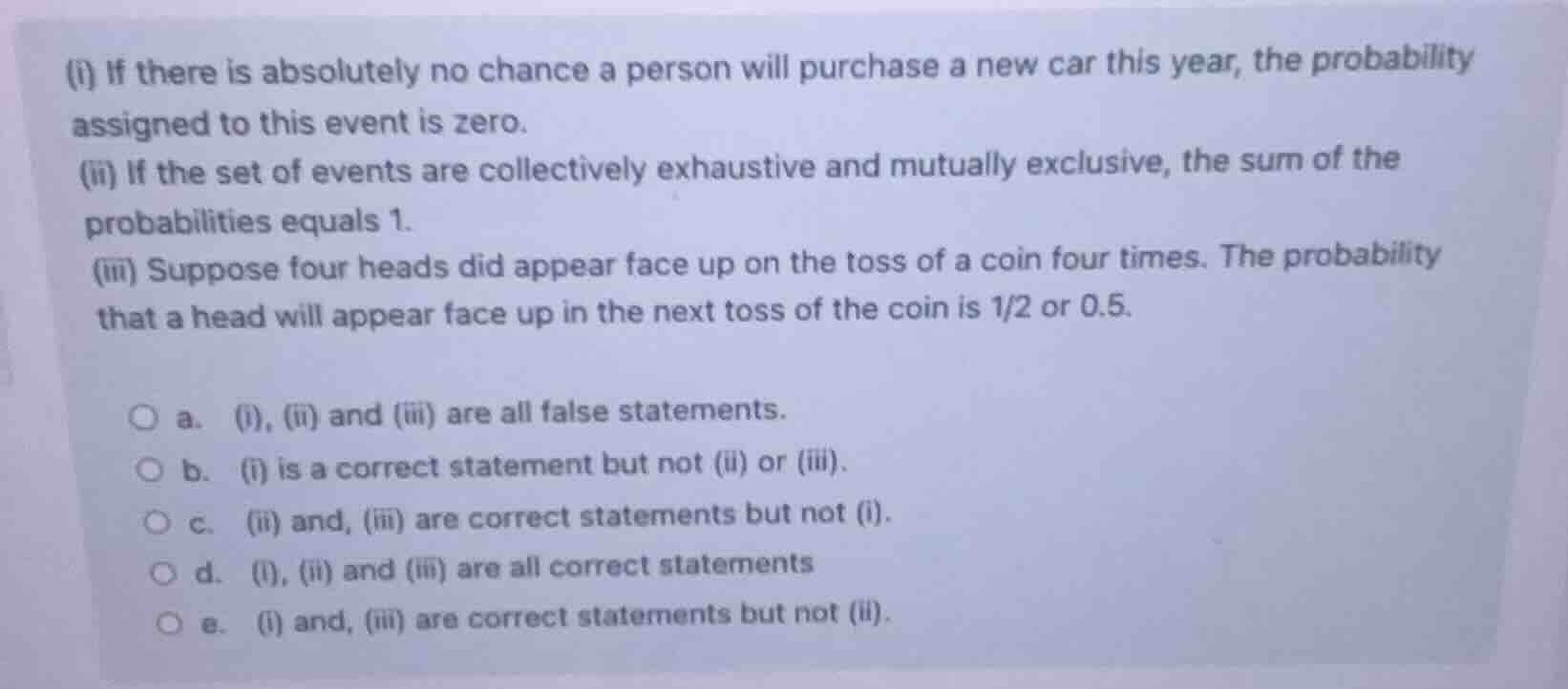
(i) if there is absolutely no chance a person will purchase a new car this year, the probability assigned to this event is zero. (ii) if the set of events are collectively exhaustive and mutually exclusive, the sum of the probabilities equals 1. (iii) suppose four heads did appear face up on the toss of a coin four times. the probability that a head will appear face up in the next toss of the coin is 1/2 or 0.5. a. (i), (ii) and (iii) are all false statements. b. (i) is a correct statement but not (ii) or (iii). c. (ii) and, (iii) are correct statements but not (i). d. (i), (ii) and (iii) are all correct statements e. (i) and, (iii) are correct statements but not (ii).
- For (i): An event with no chance of occurring has a probability of 0, so this is correct.
- For (ii): By definition, a set of mutually exclusive and collectively exhaustive events covers all possible outcomes, so their total probability sums to 1, making this correct.
- For (iii): Coin tosses are independent events; past results do not affect future tosses. The probability of heads on a fair coin is always $\frac{1}{2}$, so this is correct.

Snap & solve any problem in the app
Get step-by-step solutions on Sovi AI
Photo-based solutions with guided steps
Explore more problems and detailed explanations
d. (i), (ii) and (iii) are all correct statements