QUESTION IMAGE
Question
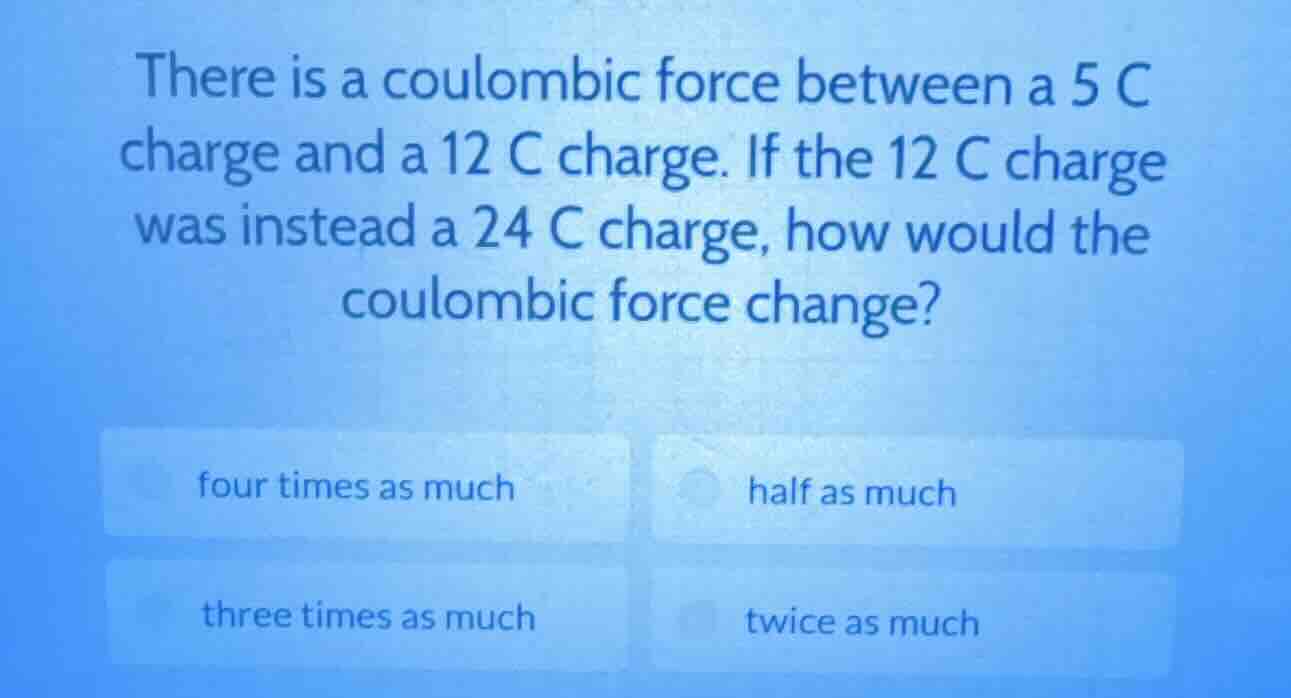
there is a coulombic force between a 5 c charge and a 12 c charge. if the 12 c charge was instead a 24 c charge, how would the coulombic force change? four times as much half as much three times as much twice as much
Step1: Recall Coulomb's Law
Coulomb's Law is given by \( F = k\frac{q_1q_2}{r^2} \), where \( F \) is the force, \( k \) is a constant, \( q_1 \) and \( q_2 \) are the charges, and \( r \) is the distance between them. Assume the distance \( r \) and the first charge \( q_1 = 5\ C \) remain constant. Let the initial charge \( q_{2i}=12\ C \) and the final charge \( q_{2f}=24\ C \).
Step2: Calculate Initial and Final Forces
The initial force \( F_i = k\frac{q_1q_{2i}}{r^2} \). The final force \( F_f = k\frac{q_1q_{2f}}{r^2} \). Now, find the ratio \( \frac{F_f}{F_i} \).
\[
\frac{F_f}{F_i}=\frac{k\frac{q_1q_{2f}}{r^2}}{k\frac{q_1q_{2i}}{r^2}}=\frac{q_{2f}}{q_{2i}}
\]
Substitute \( q_{2i} = 12\ C \) and \( q_{2f}=24\ C \) into the ratio:
\[
\frac{24}{12}=2
\]
So \( F_f = 2F_i \), meaning the force becomes twice as much.

Snap & solve any problem in the app
Get step-by-step solutions on Sovi AI
Photo-based solutions with guided steps
Explore more problems and detailed explanations
twice as much