QUESTION IMAGE
Question
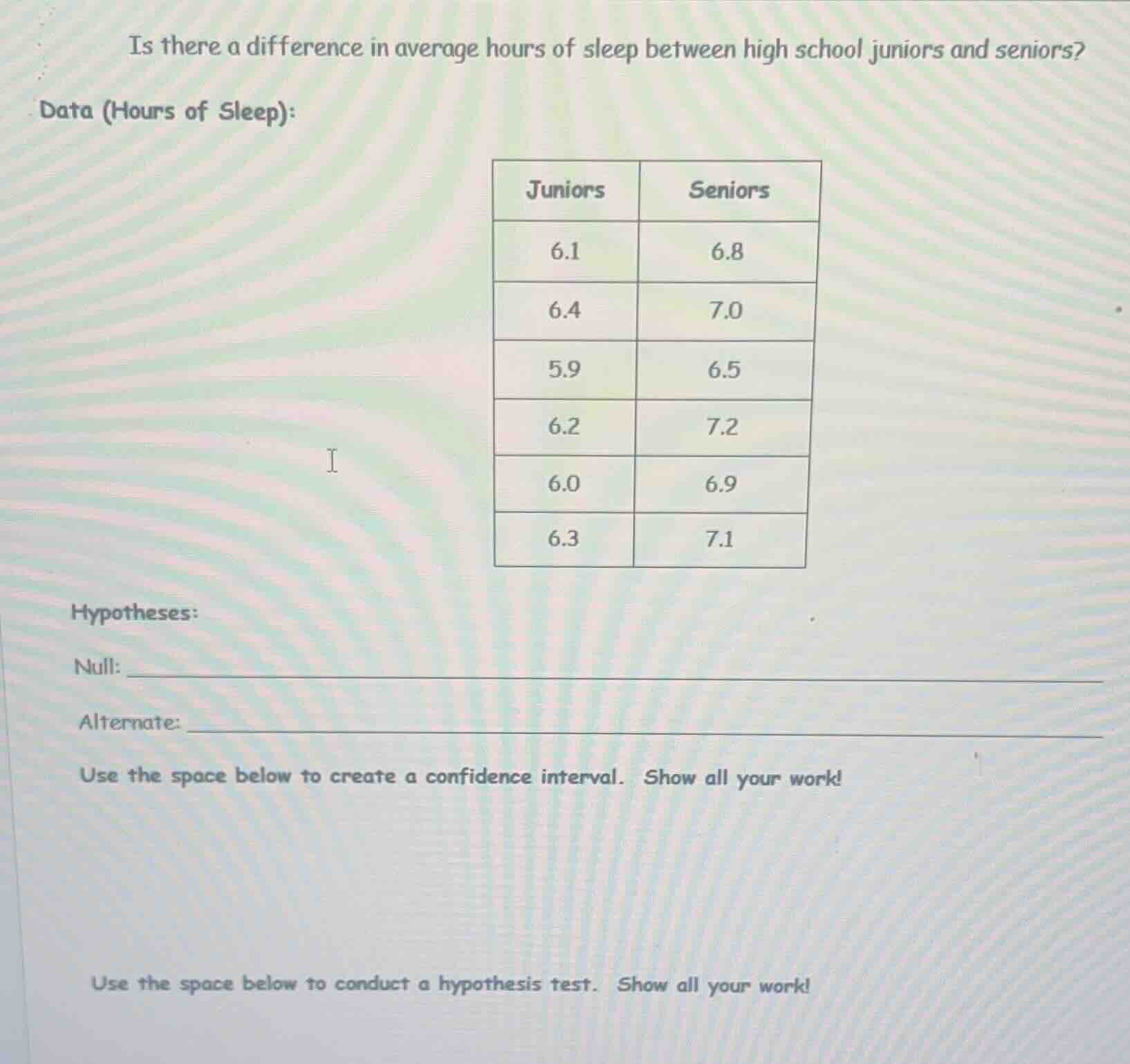
is there a difference in average hours of sleep between high school juniors and seniors?data (hours of sleep):juniors\tseniors6.1\t6.86.4\t7.05.9\t6.56.2\t7.26.0\t6.96.3\t7.1hypotheses:null:alternate:use the space below to create a confidence interval. show all your work!use the space below to conduct a hypothesis test. show all your work!
Step1: State hypotheses
Let $\mu_1$ = average sleep for juniors, $\mu_2$ = average sleep for seniors.
Null Hypothesis: $H_0: \mu_1 = \mu_2$ (no difference in averages)
Alternate Hypothesis: $H_a: \mu_1
eq \mu_2$ (difference in averages)
Step2: Calculate sample means
Juniors:
$\bar{x}_1 = \frac{6.1 + 6.4 + 5.9 + 6.2 + 6.0 + 6.3}{6} = \frac{36.9}{6} = 6.15$
Seniors:
$\bar{x}_2 = \frac{6.8 + 7.0 + 6.5 + 7.2 + 6.9 + 7.1}{6} = \frac{41.5}{6} \approx 6.9167$
Step3: Calculate sample variances
Juniors:
$s_1^2 = \frac{\sum_{i=1}^6 (x_{1i} - \bar{x}_1)^2}{6-1}$
$\sum (x_{1i} - 6.15)^2 = (6.1-6.15)^2 + (6.4-6.15)^2 + (5.9-6.15)^2 + (6.2-6.15)^2 + (6.0-6.15)^2 + (6.3-6.15)^2$
$= 0.0025 + 0.0625 + 0.0625 + 0.0025 + 0.0225 + 0.0225 = 0.175$
$s_1^2 = \frac{0.175}{5} = 0.035$, $s_1 = \sqrt{0.035} \approx 0.1871$
Seniors:
$s_2^2 = \frac{\sum_{i=1}^6 (x_{2i} - \bar{x}_2)^2}{6-1}$
$\sum (x_{2i} - 6.9167)^2 = (6.8-6.9167)^2 + (7.0-6.9167)^2 + (6.5-6.9167)^2 + (7.2-6.9167)^2 + (6.9-6.9167)^2 + (7.1-6.9167)^2$
$\approx 0.0136 + 0.0069 + 0.1736 + 0.0803 + 0.0003 + 0.0340 = 0.3087$
$s_2^2 = \frac{0.3087}{5} = 0.0617$, $s_2 = \sqrt{0.0617} \approx 0.2484$
Step4: Calculate standard error
Assume equal variances, pooled variance:
$s_p^2 = \frac{(n_1-1)s_1^2 + (n_2-1)s_2^2}{n_1+n_2-2} = \frac{5*0.035 + 5*0.0617}{10} = \frac{0.175 + 0.3085}{10} = 0.04835$
Standard Error (SE) = $\sqrt{s_p^2(\frac{1}{n_1} + \frac{1}{n_2})} = \sqrt{0.04835(\frac{1}{6}+\frac{1}{6})} = \sqrt{0.04835*\frac{1}{3}} \approx \sqrt{0.01612} \approx 0.127$
Step5: 95% Confidence Interval
Degrees of freedom $df = 6+6-2=10$, $t_{0.025,10}=2.228$
$\bar{x}_1 - \bar{x}_2 = 6.15 - 6.9167 = -0.7667$
Confidence Interval:
$(\bar{x}_1-\bar{x}_2) \pm t*SE = -0.7667 \pm 2.228*0.127$
$= -0.7667 \pm 0.283$
Lower bound: $-0.7667 - 0.283 = -1.0497$, Upper bound: $-0.7667 + 0.283 = -0.4837$
Step6: Hypothesis test (t-test)
$t = \frac{(\bar{x}_1 - \bar{x}_2) - (\mu_1 - \mu_2)}{SE} = \frac{-0.7667 - 0}{0.127} \approx -6.04$
Two-tailed p-value for $t=-6.04$, $df=10$ is $<0.001$

Snap & solve any problem in the app
Get step-by-step solutions on Sovi AI
Photo-based solutions with guided steps
Explore more problems and detailed explanations
Hypotheses:
Null: $H_0: \mu_1 = \mu_2$ (There is no difference in average hours of sleep between high school juniors and seniors)
Alternate: $H_a: \mu_1
eq \mu_2$ (There is a difference in average hours of sleep between high school juniors and seniors)
95% Confidence Interval:
$(-1.05, -0.48)$ (rounded to two decimal places)
Hypothesis Test Conclusion:
Since the p-value $<0.05$, we reject the null hypothesis. There is sufficient evidence to conclude there is a difference in average hours of sleep between high school juniors and seniors.