QUESTION IMAGE
Question
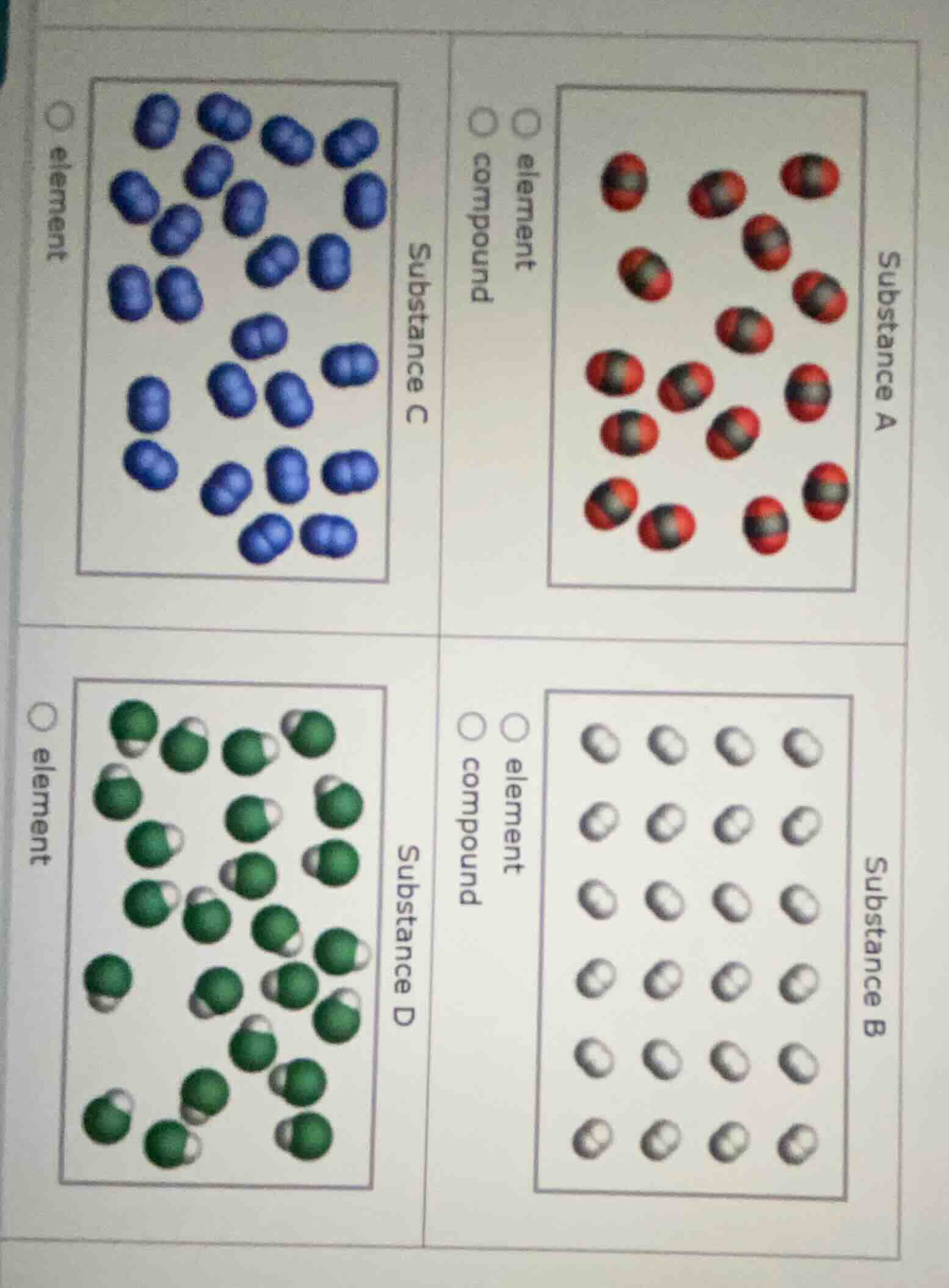
there are four substances (substance a, substance b, substance c, substance d) shown with particle models. for each substance, there are options to classify it as element, compound, etc. the task is likely to classify each substance as element, compound, or other based on the particle diagrams.
To solve this, we analyze each substance:
Substance B
- Step 1: Identify particle type
Substance B has only one type of atom (silver - colored spheres) and each particle is a single atom (not a molecule of multiple atoms).
- Step 2: Classify as element
An element is a pure substance made of only one type of atom. Since Substance B has only one type of atom (single - atom particles), it is an element.
Substance C
- Step 1: Identify particle type
Substance C has molecules made of two identical (blue) atoms.
- Step 2: Classify as element
A diatomic molecule (molecule with two of the same atom) is still an element because it is made of only one type of atom. So Substance C is an element.
Substance A
- Step 1: Identify particle type
Substance A has molecules made of two different atoms (red and black).
- Step 2: Classify as compound
A compound is a pure substance made of two or more different types of atoms chemically bonded. Since Substance A’s molecules have two different atoms, it is a compound.
Substance D
- Step 1: Identify particle type
Substance D has molecules made of two different atoms (green and white).
- Step 2: Classify as compound
Similar to Substance A, Substance D’s molecules have two different atoms, so it is a compound.
If we were to mark the correct classification (e.g., for Substance B as element, Substance A as compound, etc.):
- For Substance B: Mark the “element” option.
- For Substance C: Mark the “element” option.
- For Substance A: Mark the “compound” option.
- For Substance D: Mark the “compound” option.
(Assuming the task was to classify each as element or compound, the above is the breakdown. If a specific substance was targeted, adjust accordingly.)

Snap & solve any problem in the app
Get step-by-step solutions on Sovi AI
Photo-based solutions with guided steps
Explore more problems and detailed explanations
To solve this, we analyze each substance:
Substance B
- Step 1: Identify particle type
Substance B has only one type of atom (silver - colored spheres) and each particle is a single atom (not a molecule of multiple atoms).
- Step 2: Classify as element
An element is a pure substance made of only one type of atom. Since Substance B has only one type of atom (single - atom particles), it is an element.
Substance C
- Step 1: Identify particle type
Substance C has molecules made of two identical (blue) atoms.
- Step 2: Classify as element
A diatomic molecule (molecule with two of the same atom) is still an element because it is made of only one type of atom. So Substance C is an element.
Substance A
- Step 1: Identify particle type
Substance A has molecules made of two different atoms (red and black).
- Step 2: Classify as compound
A compound is a pure substance made of two or more different types of atoms chemically bonded. Since Substance A’s molecules have two different atoms, it is a compound.
Substance D
- Step 1: Identify particle type
Substance D has molecules made of two different atoms (green and white).
- Step 2: Classify as compound
Similar to Substance A, Substance D’s molecules have two different atoms, so it is a compound.
If we were to mark the correct classification (e.g., for Substance B as element, Substance A as compound, etc.):
- For Substance B: Mark the “element” option.
- For Substance C: Mark the “element” option.
- For Substance A: Mark the “compound” option.
- For Substance D: Mark the “compound” option.
(Assuming the task was to classify each as element or compound, the above is the breakdown. If a specific substance was targeted, adjust accordingly.)