QUESTION IMAGE
Question
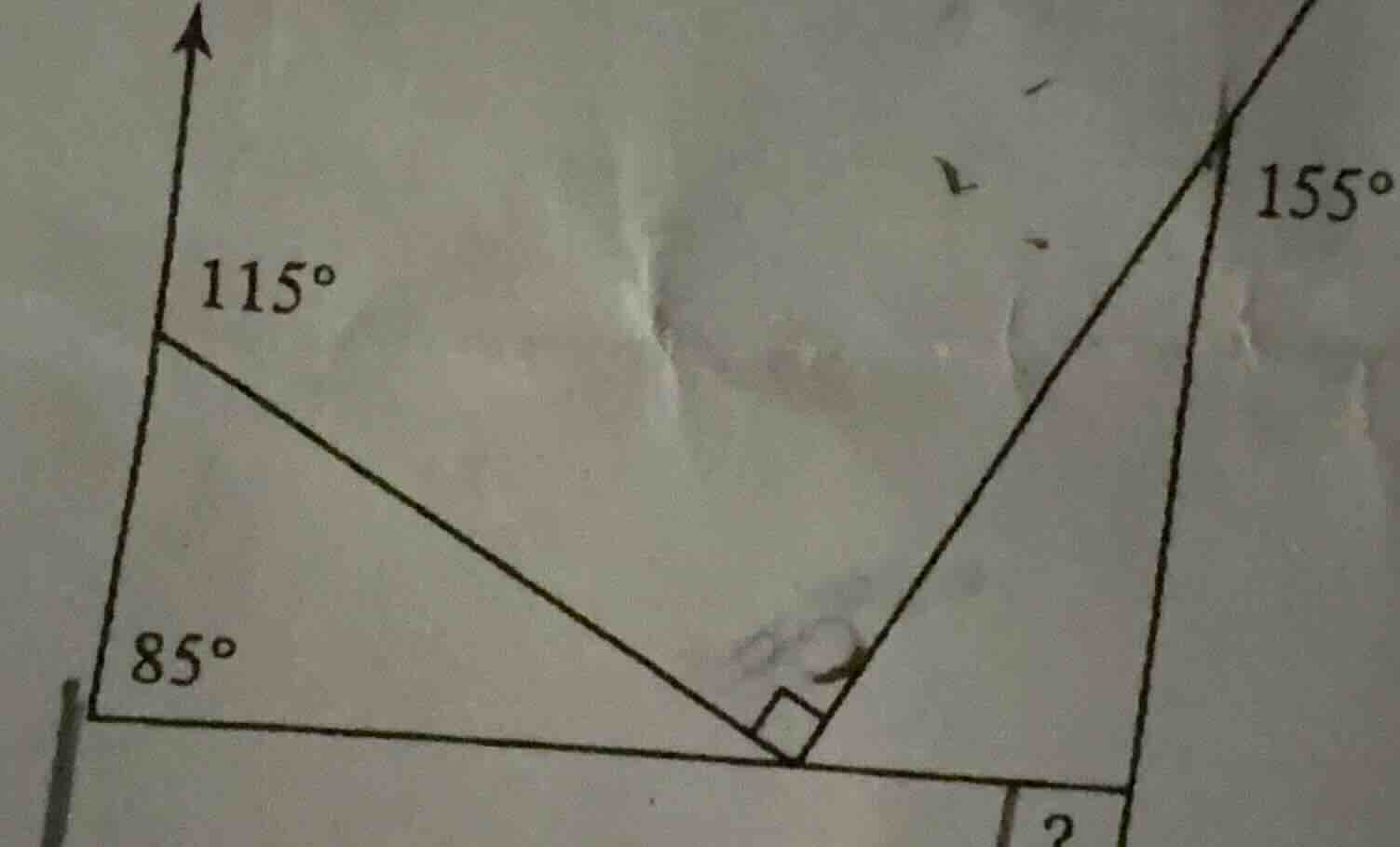
there is a geometric figure with angles 115°, 85°, 155° and a right angle, and we need to find the unknown angle (marked as ?).
Step1: Find adjacent supplementary angles
First, find the supplementary angles to \(115^\circ\) and \(155^\circ\). For \(115^\circ\), the supplementary angle is \(180^\circ - 115^\circ = 65^\circ\). For \(155^\circ\), the supplementary angle is \(180^\circ - 155^\circ = 25^\circ\).
Step2: Use angle sum in quadrilateral
A quadrilateral's interior angles sum to \(360^\circ\), and there's a right angle (\(90^\circ\)) and an \(85^\circ\) angle. Let the unknown angle (let's call it \(x\)) be the angle we need to find related to the right angle for the final angle \(?\). Wait, actually, let's re - evaluate. The figure seems to be a combination of angles around a point or in a polygon. Wait, the sum of angles around a point is \(360^\circ\), but there's a right angle (\(90^\circ\)), \(85^\circ\), the supplementary angles \(65^\circ\) and \(25^\circ\), and the angle \(?\). Wait, no, let's do it properly.
Wait, the first triangle - like part: the angle adjacent to \(115^\circ\) is \(180 - 115=65^\circ\). The angle adjacent to \(155^\circ\) is \(180 - 155 = 25^\circ\). Now, in the quadrilateral (or the angle sum around the right - angled vertex), we know that the sum of angles in a quadrilateral is \(360^\circ\), but there's a right angle (\(90^\circ\)), an \(85^\circ\) angle, the \(65^\circ\) angle, the \(25^\circ\) angle, and the angle \(?\) and the right angle? Wait, no, let's look at the right angle. Let's assume that we have a set of angles where we can use the fact that the sum of angles in a polygon or around a point. Wait, maybe a better approach: the sum of all angles around the point (or in the figure) should account for the right angle, \(85^\circ\), the two supplementary angles, and the angle \(?\).
Wait, let's start over. The angle next to \(115^\circ\) (linear pair) is \(180 - 115 = 65^\circ\). The angle next to \(155^\circ\) (linear pair) is \(180 - 155=25^\circ\). Now, we have a right angle (\(90^\circ\)), an \(85^\circ\) angle, the \(65^\circ\) angle, the \(25^\circ\) angle, and the angle \(?\), and we know that the sum of angles in a quadrilateral (if it's a quadrilateral with a right angle) or the sum of angles around a point? Wait, no, the sum of interior angles of a quadrilateral is \(360^\circ\). Let's consider the quadrilateral with angles \(85^\circ\), \(90^\circ\), the angle adjacent to \(115^\circ\) (\(65^\circ\)), the angle adjacent to \(155^\circ\) (\(25^\circ\)), and the angle \(?\)? No, that can't be. Wait, maybe the figure is such that we have a right angle, \(85^\circ\), \(65^\circ\), \(25^\circ\), and we need to find the remaining angle (which is \(?\)) such that when we consider the sum of angles in a polygon or the linear pairs.
Wait, another approach: The sum of angles in a triangle is \(180^\circ\), but here we have a right angle. Wait, let's use the fact that the sum of all angles involved should be such that:
We know that \(85^\circ+65^\circ + 90^\circ+25^\circ+?= 360^\circ\)? No, \(85 + 65=150\), \(150+90 = 240\), \(240 + 25=265\), \(360 - 265 = 95\)? No, that's not right. Wait, maybe the angle \(?\) is related to the right angle. Wait, no, let's look at the linear pair with the right angle. Wait, the correct way:
The angle adjacent to \(115^\circ\) is \(180 - 115=65^\circ\)
The angle adjacent to \(155^\circ\) is \(180 - 155 = 25^\circ\)
Now, in the figure, we have a right angle (\(90^\circ\)), an \(85^\circ\) angle, the \(65^\circ\) angle, the \(25^\circ\) angle, and the angle \(?\). Since the sum of angles in a quadrilateral is \(360^\circ\), but we also have to consider that the right ang…

Snap & solve any problem in the app
Get step-by-step solutions on Sovi AI
Photo-based solutions with guided steps
Explore more problems and detailed explanations
\(35^\circ\)