QUESTION IMAGE
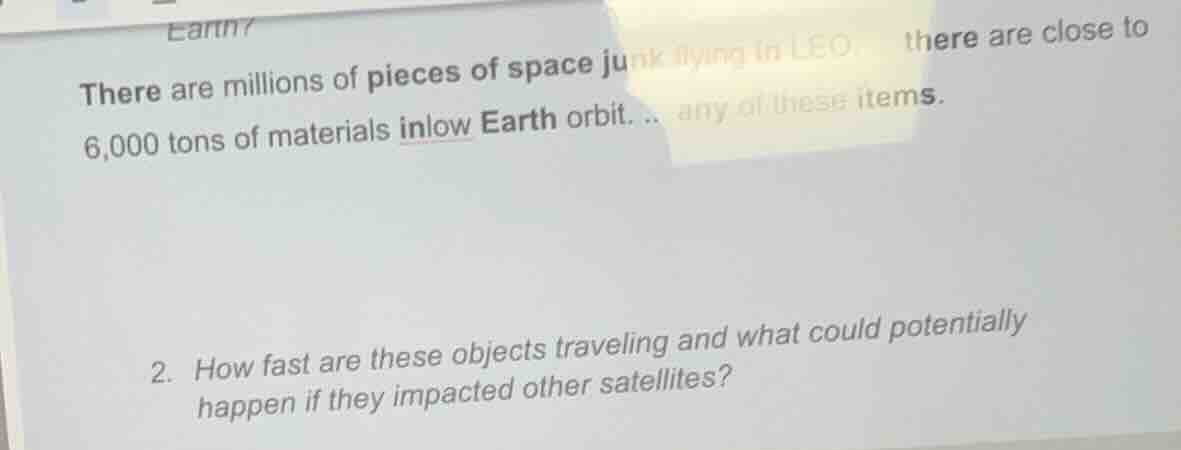
Question
there are millions of pieces of space junk flying in leo there are close to 6,000 tons of materials inlow earth orbit... any of these items. 2. how fast are these objects traveling and what could potentially happen if they impacted other satellites?
Brief Explanations
- Speed of space junk in LEO: Objects in Low Earth Orbit (LEO) typically travel at speeds of about 7 - 8 kilometers per second (or approximately 15,000 - 18,000 miles per hour). This high speed is due to the orbital mechanics required to maintain a stable orbit around the Earth at that altitude (usually between 160 - 2,000 kilometers above the Earth's surface). The orbital velocity \( v \) of an object in a circular orbit around a central body (like Earth) can be calculated using the formula \( v=\sqrt{\frac{GM}{r}} \), where \( G \) is the gravitational constant (\( 6.674\times 10^{-11}\space m^3 kg^{-1} s^{-2} \)), \( M \) is the mass of the Earth (\( 5.972\times 10^{24}\space kg \)), and \( r \) is the distance from the center of the Earth to the object (which is the sum of the Earth's radius and the orbital altitude). For LEO, \( r \) is relatively small compared to higher orbits, leading to high orbital speeds.
- Impact on other satellites: If space junk collides with a satellite, the consequences can be severe. Due to the high relative speed (even a small piece of debris, say a few centimeters in size, traveling at orbital speeds) the kinetic energy involved in the collision is extremely high. The kinetic energy \( KE \) of an object is given by \( KE = \frac{1}{2}mv^2 \), where \( m \) is the mass of the debris and \( v \) is its velocity. Even a small mass at high velocity can have a large amount of kinetic energy. This collision can cause physical damage to the satellite, such as puncturing its hull, damaging its solar panels, or disrupting its delicate electronic components. In extreme cases, a collision can completely destroy the satellite, creating even more space junk in the process (a phenomenon known as the Kessler Syndrome, where a single collision triggers a chain reaction of further collisions, leading to a significant increase in the amount of debris in orbit and making certain orbital regions unusable for spacecraft).

Snap & solve any problem in the app
Get step-by-step solutions on Sovi AI
Photo-based solutions with guided steps
Explore more problems and detailed explanations
- Speed of space junk in LEO: Space junk in Low Earth Orbit (LEO) typically travels at speeds of about 7 - 8 kilometers per second (or approximately 15,000 - 18,000 miles per hour).
- Impact on other satellites: A collision between space junk and a satellite can cause severe physical damage (e.g., puncturing the hull, damaging solar panels, disrupting electronics) or even completely destroy the satellite. Collisions can also trigger the Kessler Syndrome, where one collision leads to a chain reaction of further collisions, increasing debris and making orbital regions unusable.