QUESTION IMAGE
Question
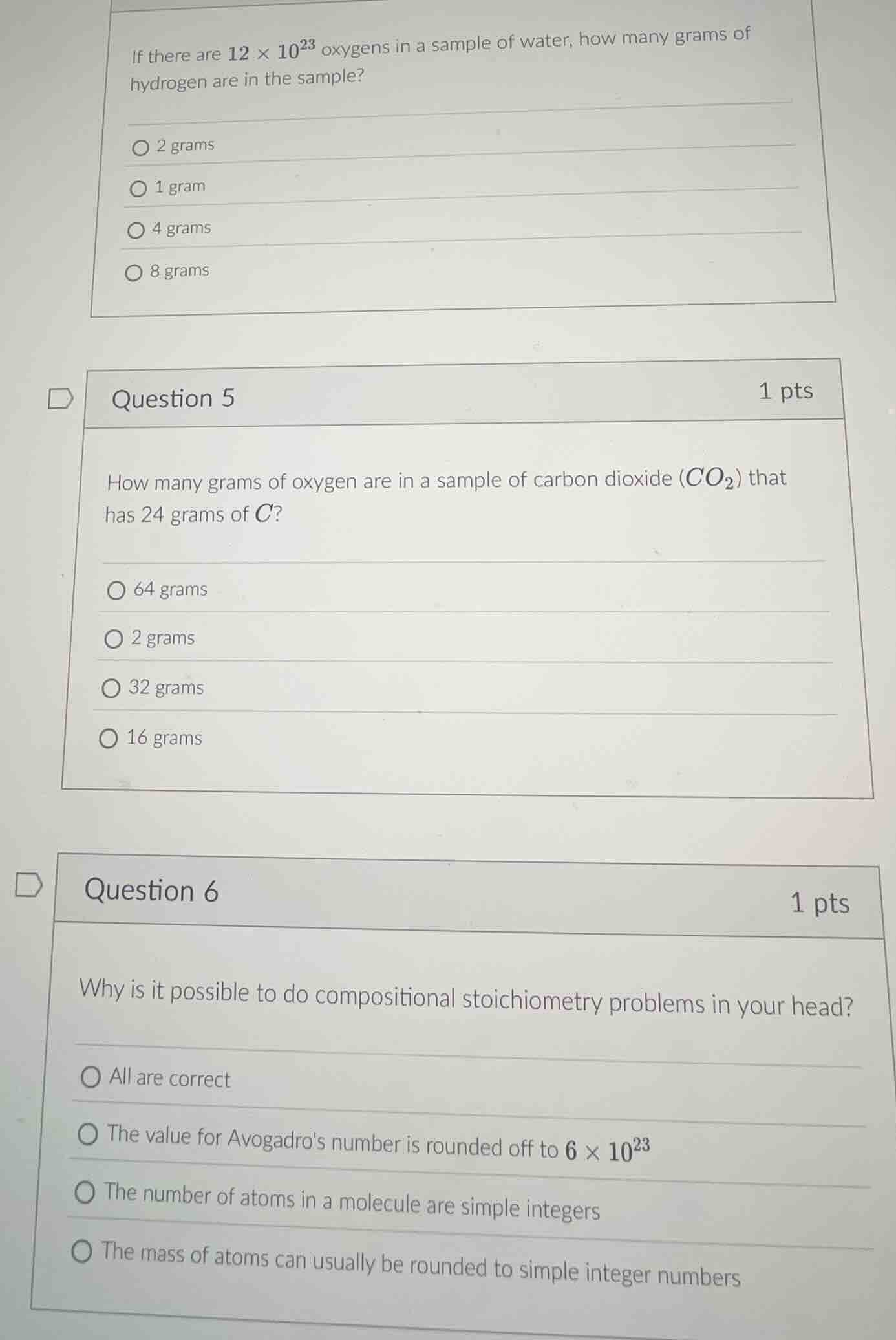
if there are $12 \times 10^{23}$ oxygens in a sample of water, how many grams of hydrogen are in the sample?
2 grams
1 gram
4 grams
8 grams
question 5
1 pts
how many grams of oxygen are in a sample of carbon dioxide ($co_2$) that has 24 grams of $c$?
64 grams
2 grams
32 grams
16 grams
question 6
1 pts
why is it possible to do compositional stoichiometry problems in your head?
all are correct
the value for avogadros number is rounded off to $6 \times 10^{23}$
the number of atoms in a molecule are simple integers
the mass of atoms can usually be rounded to simple integer numbers
First Question (Oxygen in water sample, find hydrogen mass)
Step1: Determine moles of O
Avogadro's number is $6\times10^{23}$ atoms/mol. Moles of O = $\frac{12\times10^{23}}{6\times10^{23}}$ = 2 mol.
Step2: Mole ratio of H to O in $H_2O$
In $H_2O$, mole ratio H:O = 2:1. So moles of H = 2 × 2 = 4 mol? Wait, no—wait, $H_2O$ has 2 H per 1 O. Wait, moles of O is 2 mol (from step1). So moles of H = 2 × 2 mol = 4 mol? Wait, no, molar mass of H is 1 g/mol. Wait, no—wait, moles of O: $\frac{12\times10^{23}}{6\times10^{23}}$ = 2 mol. In $H_2O$, 2 H per O, so moles of H = 2 × 2 mol = 4 mol? No, wait, 1 O in $H_2O$ has 2 H. So if O is 2 mol, H is 4 mol? But molar mass of H is 1 g/mol, so mass of H would be 4 mol × 1 g/mol = 4 g? Wait, no, the options have 2 grams. Wait, maybe I messed up. Wait, $H_2O$: 1 mole of O (16 g) has 2 moles of H (2 g). Wait, no—wait, moles of O: $\frac{12\times10^{23}}{6\times10^{23}}$ = 2 mol. So moles of H: 2 × 2 = 4 mol? But 4 mol H is 4 g. But the options have 2 grams. Wait, maybe I made a mistake. Wait, no—wait, $H_2O$: each O atom is in one $H_2O$ molecule, so moles of $H_2O$ = moles of O = 2 mol. Then moles of H = 2 × 2 mol = 4 mol? Mass of H: 4 mol × 1 g/mol = 4 g. But the options include 4 grams. Wait, maybe the first question's answer is 4 grams? Wait, no, let's recheck. Wait, Avogadro's number is $6.022\times10^{23}$, but rounded to $6\times10^{23}$. So moles of O: $\frac{12\times10^{23}}{6\times10^{23}}$ = 2 mol. $H_2O$: 2 H per O, so moles of H = 2 × 2 = 4 mol. Mass of H: 4 mol × 1 g/mol = 4 g. So answer is 4 grams.
Question 5 (Oxygen in $CO_2$ with 24 g C)
Step1: Moles of C
Molar mass of C is 12 g/mol. Moles of C = $\frac{24\ g}{12\ g/mol}$ = 2 mol.
Step2: Mole ratio of O to C in $CO_2$
In $CO_2$, 2 O per 1 C. So moles of O = 2 × 2 mol = 4 mol.
Step3: Mass of O
Molar mass of O is 16 g/mol. Mass of O = 4 mol × 16 g/mol = 64 g? Wait, no—wait, $CO_2$: 1 C (12 g) has 2 O (32 g). So 24 g C is 2 moles (24/12=2). Then O is 4 moles (2×2), mass is 4×16=64 g? But the options have 64 grams. Wait, but let's check again. Wait, molar mass of $CO_2$: 12 + 32 = 44 g/mol. But for 24 g C (2 moles), moles of $CO_2$ is 2 moles. So moles of O is 2×2=4 moles. Mass of O: 4×16=64 g. So answer is 64 grams.
Question 6 (Why compositional stoichiometry can be done in head)
- Avogadro's number is rounded to $6\times10^{23}$, making mole calculations simpler.
- Atom counts in molecules are simple integers (e.g., $H_2O$ has 2 H, 1 O; $CO_2$ has 1 C, 2 O).
- Atomic masses are often rounded to simple integers (e.g., C=12, O=16, H=1).
- All these factors make the calculations straightforward, so "All are correct" is the answer.

Snap & solve any problem in the app
Get step-by-step solutions on Sovi AI
Photo-based solutions with guided steps
Explore more problems and detailed explanations
s:
First Question (Hydrogen in water):