QUESTION IMAGE
Question
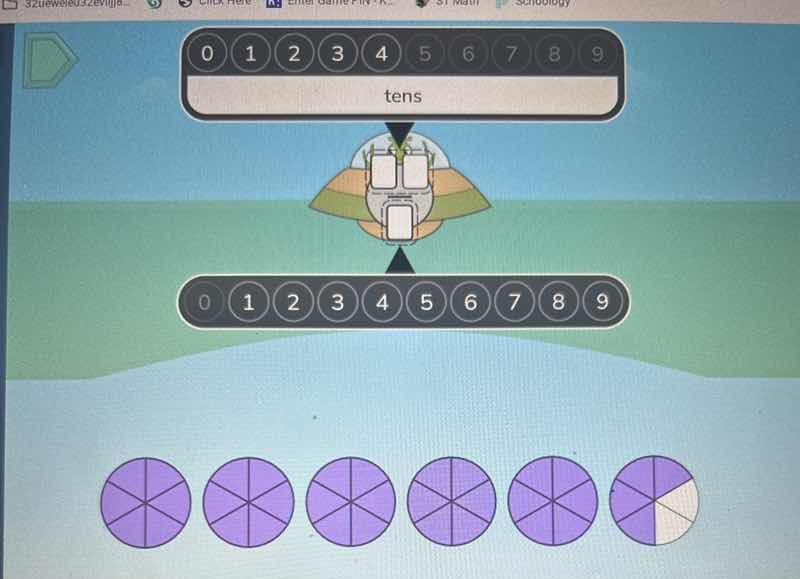
there are two rows of number buttons (0 - 9) labeled tens and another row below. at the bottom, there are six circles divided into sixths, five fully purple and one with two white sixths.
To solve this, we analyze the fraction circles:
Step 1: Count full circles
There are 5 full circles, each representing 1 (or \(\frac{6}{6}\)). So \(5\times1 = 5\).
Step 2: Analyze the partial circle
The 6th circle is divided into 6 parts, with 4 purple parts. So it represents \(\frac{4}{6}=\frac{2}{3}\), but wait, maybe we are dealing with tenths? Wait, no, the circles are sixths. Wait, maybe the problem is about counting the total number of sixths? Wait, no, looking at the tens and the other digit. Wait, maybe the circles are representing a number with tenths? Wait, no, let's re - evaluate.
Wait, each full circle has 6 purple parts. The first 5 circles are fully purple (6 parts each), so \(5\times6 = 30\) purple parts. The 6th circle has 4 purple parts. So total purple parts: \(30 + 4=34\)? Wait, no, maybe the problem is about a decimal or a two - digit number. Wait, the top is "tens" and the bottom is the other digit.
Wait, maybe the circles are representing a number where each full circle is 1 (in tens or units? No, the tens place is at the top. Wait, maybe we count the number of full circles as tens? No, 5 full circles and a partial. Wait, no, let's look at the number of purple - shaded sixths.
Wait, 5 full circles (each with 6 sixths) and 4 sixths in the last circle. So total sixths: \(5\times6+4 = 34\). But if we consider this as a decimal in tenths? No, maybe the problem is that the first 5 circles are 5 (in the units place? No, the top is tens). Wait, maybe the tens digit is 3 and the other digit is 4? Wait, no, let's count the total number of purple regions.
Wait, each circle has 6 regions. 5 circles have \(5\times6 = 30\) regions, and the 6th has 4. So total is 34. So the tens digit is 3 and the units digit is 4? Wait, but the top is "tens" with numbers 0 - 9 and the bottom is the other digit (units or tenths? But the bottom has 0 - 9 too). Wait, maybe the answer is 5 (tens) and 4? No, that doesn't make sense. Wait, maybe I made a mistake.
Wait, looking at the circles: 5 full circles (each is 1) and a circle with 4 out of 6. But maybe the problem is about counting the number of purple - colored parts as a two - digit number where the tens digit is 5 and the units digit is 4? No, 5 full circles and 4 parts in the sixth. Wait, maybe the answer is 5 (tens) and 4 (the other digit), so the number is 54? Wait, no, 5 full circles (5) and 4/6 of a circle. But if we consider the number of purple - shaded parts as a two - digit number (tens and units), where each full circle contributes 1 to the tens? No, 5 full circles would be 5 in tens? No, 5 in units. Wait, I think I messed up.
Wait, let's start over. The figure has 5 fully shaded circles and 1 circle with 4 out of 6 shaded. If we are to represent this as a number with tens and a digit (maybe the number of full circles is the tens digit and the number of shaded parts in the last circle is the units digit? No, 5 full circles and 4 shaded parts. So the tens digit is 5 and the units digit is 4? So the number is 54? Wait, but the tens place at the top has numbers 0 - 9 and the bottom too. So the tens digit is 5 and the other digit is 4? So we put 5 in the tens place and 4 in the bottom (units) place.
So the tens digit is 5 and the units digit is 4. So the number is 54.

Snap & solve any problem in the app
Get step-by-step solutions on Sovi AI
Photo-based solutions with guided steps
Explore more problems and detailed explanations
The tens digit is 5 and the units digit is 4, so the number is 54 (put 5 in the "tens" box and 4 in the lower box).