QUESTION IMAGE
Question
thermodynamics of ammonia
formation of ammonia
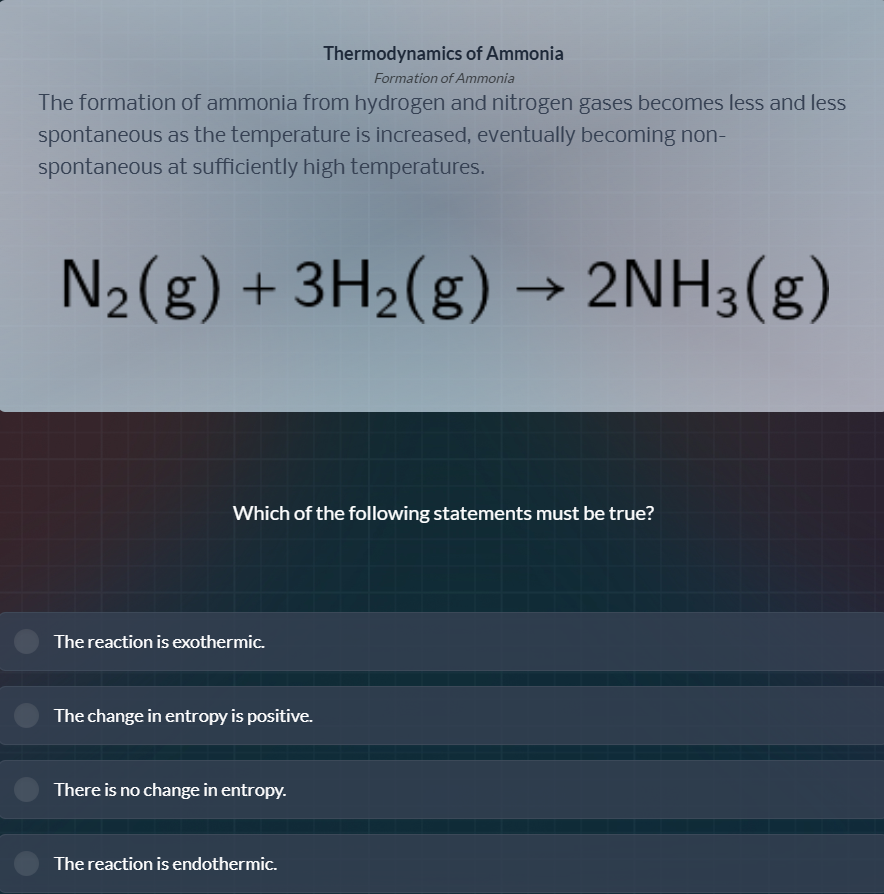
the formation of ammonia from hydrogen and nitrogen gases becomes less and less spontaneous as the temperature is increased, eventually becoming non - spontaneous at sufficiently high temperatures.
\ce{n_{2}(g) + 3h_{2}(g) -> 2nh_{3}(g)}
which of the following statements must be true?
- the reaction is exothermic.
- the change in entropy is positive.
- there is no change in entropy.
- the reaction is endothermic.
To determine the correct statement, we use the Gibbs free energy equation for spontaneity: $\Delta G = \Delta H - T\Delta S$. A reaction is spontaneous when $\Delta G < 0$. The problem states the reaction becomes less spontaneous (approaches $\Delta G = 0$ or positive) as temperature ($T$) increases.
- Analyze entropy change ($\Delta S$):
For the reaction $\ce{N2(g) + 3H2(g) -> 2NH3(g)}$, the number of moles of gas decreases (4 moles reactants → 2 moles products). Since entropy is related to disorder, a decrease in moles of gas means $\Delta S < 0$ (negative entropy change). Thus, options about positive or no entropy change are false.
- Analyze enthalpy change ($\Delta H$):
The spontaneity decreases with increasing $T$. From $\Delta G = \Delta H - T\Delta S$, if $\Delta S < 0$ (as established), the term $-T\Delta S$ becomes positive (because $\Delta S$ is negative, $-T\Delta S = -T(-|\Delta S|) = +T|\Delta S|$). For $\Delta G$ to become less negative (or non - spontaneous) as $T$ increases, the $\Delta H$ term must be negative (exothermic). If $\Delta H$ were positive (endothermic), increasing $T$ would make $\Delta G$ more negative (more spontaneous), which contradicts the problem statement. Thus, the reaction must be exothermic ($\Delta H < 0$).

Snap & solve any problem in the app
Get step-by-step solutions on Sovi AI
Photo-based solutions with guided steps
Explore more problems and detailed explanations
The reaction is exothermic.