QUESTION IMAGE
Question
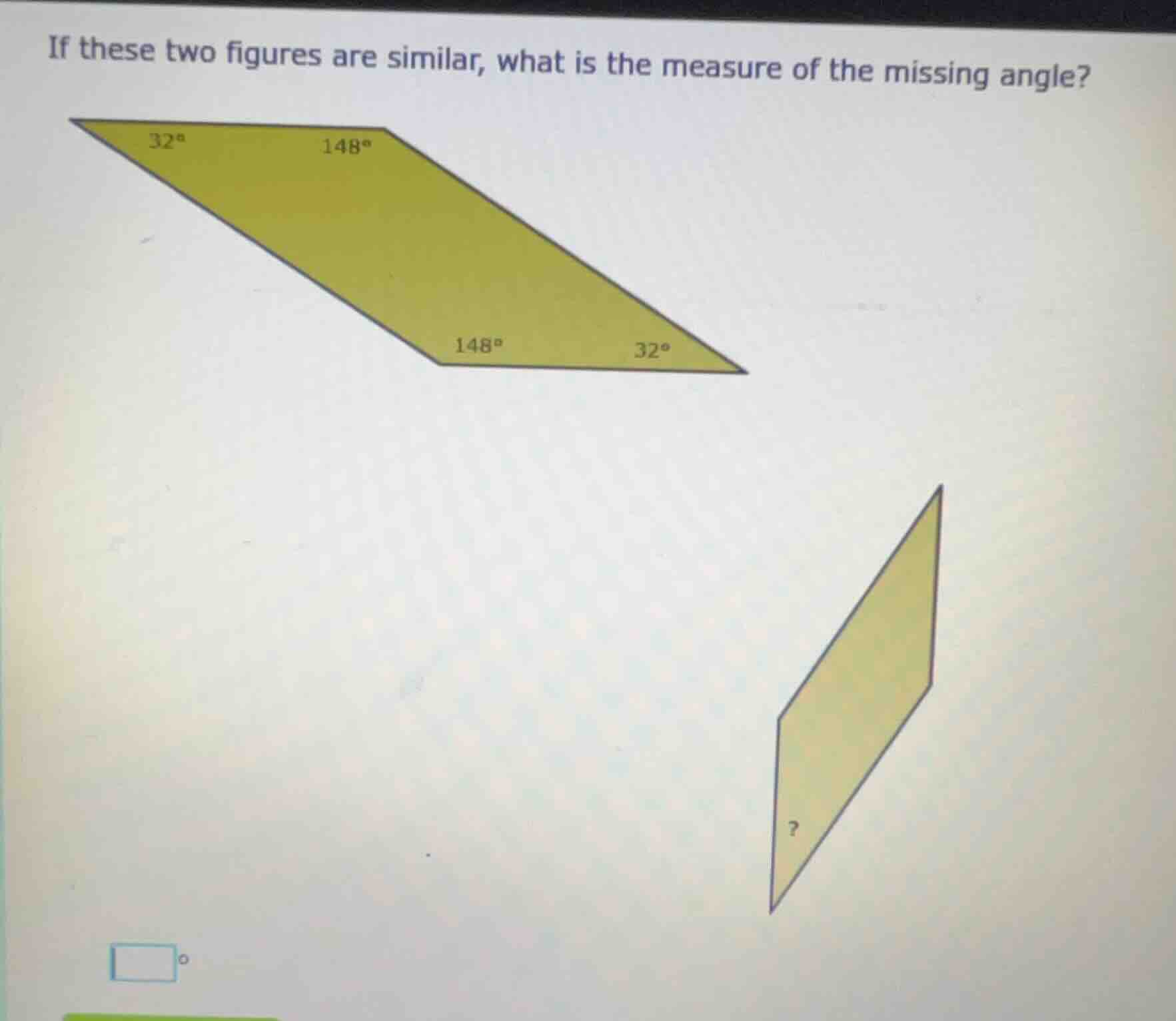
if these two figures are similar, what is the measure of the missing angle?
Step1: Recall properties of similar figures
Similar figures have corresponding angles equal. The first figure is a parallelogram (since opposite angles are equal: \(32^\circ\) and \(32^\circ\), \(148^\circ\) and \(148^\circ\)) and the second figure is also a parallelogram (as it's similar to the first). In a parallelogram, opposite angles are equal, and consecutive angles are supplementary. But for similar figures, corresponding angles are congruent.
Step2: Identify corresponding angles
Looking at the first parallelogram, the angles are \(32^\circ\), \(148^\circ\), \(32^\circ\), \(148^\circ\). The second parallelogram, being similar, will have the same set of angles. The missing angle should correspond to one of the angles in the first parallelogram. Since in a parallelogram, opposite angles are equal, and the first parallelogram has angles \(32^\circ\) and \(148^\circ\) (consecutive angles are supplementary: \(32 + 148 = 180\), which holds). The second figure, being a parallelogram, will have angles equal to the first. So the missing angle, depending on its position, should be either \(32^\circ\) or \(148^\circ\). Wait, but let's check the structure. The first figure has two \(32^\circ\) and two \(148^\circ\) angles. The second figure, when similar, will have the same angle measures. Let's confirm the sum of angles in a quadrilateral: sum is \(360^\circ\). For the first figure: \(32 + 148 + 32 + 148 = 360\), which works. For the second figure, let's assume the missing angle is \(32^\circ\) or \(148^\circ\). Wait, looking at the shape, the second figure's angle that's missing: in a parallelogram, opposite angles are equal. If we look at the first figure, the angles at the "pointed" ends are \(32^\circ\), and the "blunt" ends are \(148^\circ\). The second figure's angle that's missing: if we compare the orientation, the corresponding angle should be \(32^\circ\)? Wait no, wait. Wait the first figure: let's label the angles. Top left: \(32^\circ\), top right: \(148^\circ\), bottom right: \(32^\circ\), bottom left: \(148^\circ\). The second figure: let's see, it's a parallelogram, so opposite angles equal. So if we match the angles, the missing angle should correspond to one of the \(32^\circ\) or \(148^\circ\) angles. Wait, maybe I made a mistake. Wait, in a parallelogram, consecutive angles are supplementary. So if one angle is \(32^\circ\), the next is \(148^\circ\), then \(32^\circ\), then \(148^\circ\). So the second figure, being a parallelogram, will have the same angles. So the missing angle: let's see the second figure's shape. It looks like the angle opposite to the side that's similar to the first figure's \(32^\circ\) angle. Wait, maybe the missing angle is \(32^\circ\)? No, wait, no. Wait the first figure has two \(32^\circ\) and two \(148^\circ\). The second figure, when similar, must have the same angles. So the missing angle is either \(32^\circ\) or \(148^\circ\). Wait, but let's check the sum. Suppose the second figure has angles: let's say two angles are \(x\) and two are \(y\), with \(x + y = 180\) (consecutive angles in parallelogram). Since it's similar to the first, \(x = 32\) and \(y = 148\) (or vice versa). So the missing angle is \(32^\circ\) or \(148^\circ\). Wait, but looking at the first figure, the angles at the "sharp" vertices are \(32^\circ\), and the "blunt" are \(148^\circ\). The second figure's sharp vertex angle should be \(32^\circ\), and blunt \(148^\circ\). Wait, but maybe I messed up. Wait, let's re-express: in similar figures, corresponding angles are equal. So the first figure's angles ar…

Snap & solve any problem in the app
Get step-by-step solutions on Sovi AI
Photo-based solutions with guided steps
Explore more problems and detailed explanations
\(32^\circ\) (or \(148^\circ\) depending on position, but likely \(32^\circ\) as per the diagram's sharp angle)