QUESTION IMAGE
Question
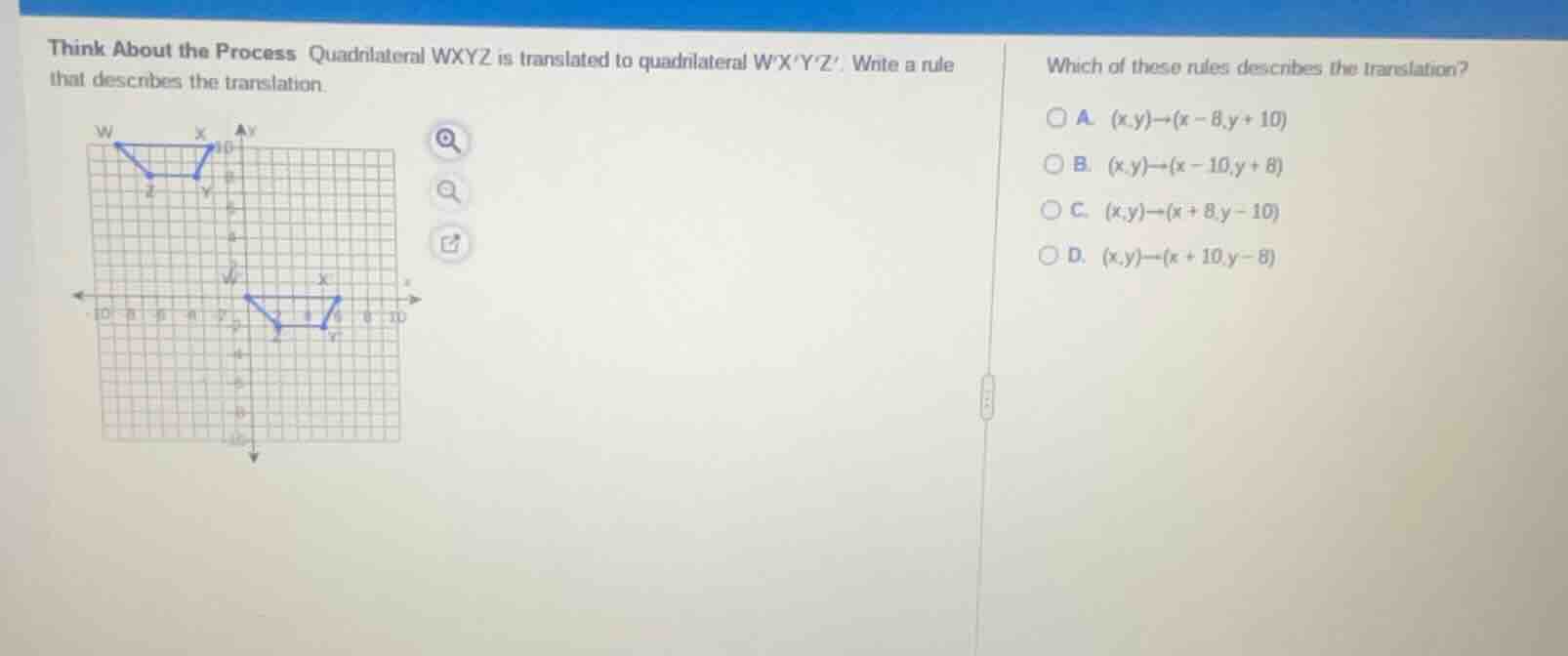
think about the process quadrilateral wxyz is translated to quadrilateral wxyz. write a rule that describes the translation.
which of these rules describes the translation?
a. ((x,y)\to(x - 8,y + 10))
b. ((x,y)\to(x - 10,y + 8))
c. ((x,y)\to(x + 8,y - 10))
d. ((x,y)\to(x + 10,y - 8))
Step 1: Identify a point on original and translated figure
Let's take point \( Y \) from quadrilateral \( WXYZ \) (original) and its image \( Y' \) on \( W'X'Y'Z' \) (translated). From the grid, original \( Y \) has coordinates \( (-4, 8) \), and translated \( Y' \) has coordinates \( (4, -2) \).
Step 2: Calculate horizontal (x) change
The change in \( x \)-coordinate: \( 4 - (-4) = 4 + 4 = 8 \)? Wait, no, wait. Wait, original \( Y \) is at \( (-4, 8) \), translated \( Y' \) is at \( (4, -2) \). Wait, maybe I picked the wrong point. Let's check another point. Let's take point \( Z \) on original: \( (-6, 8) \), translated \( Z' \): \( (2, -2) \). Wait, no, maybe the original quadrilateral is the upper one, and translated is the lower right. Wait, original \( WXYZ \): let's find coordinates. Let's say original \( X \) is at \( (-2, 10) \)? No, maybe better to take a vertex. Let's take original \( Y \): let's see the grid. Original quadrilateral: let's say a vertex at \( (-6, 8) \) (original \( Z \)), and translated \( Z' \) at \( (2, -2) \). Wait, no, maybe the original is on the left, translated to the right and down. Let's calculate the horizontal shift: from \( x = -6 \) to \( x = 2 \), the change is \( 2 - (-6) = 8 \)? Wait, no, 2 - (-6) is 8? Wait, 2 + 6 = 8. Vertical shift: from \( y = 8 \) to \( y = -2 \), change is \( -2 - 8 = -10 \). So the rule is \( (x, y)
ightarrow (x + 8, y - 10) \)? Wait, but let's check the options. Option C is \( (x,y)
ightarrow(x + 8,y - 10) \). Wait, but let's verify with another point. Original \( X \): let's say \( (-2, 10) \), translated \( X' \): \( (6, 0) \). Then \( x \)-change: \( 6 - (-2) = 8 \), \( y \)-change: \( 0 - 10 = -10 \). Yes, that matches \( (x + 8, y - 10) \). So the correct rule is \( (x,y)
ightarrow(x + 8,y - 10) \), which is option C.

Snap & solve any problem in the app
Get step-by-step solutions on Sovi AI
Photo-based solutions with guided steps
Explore more problems and detailed explanations
C. \((x,y)
ightarrow(x + 8,y - 10)\)