QUESTION IMAGE
Question
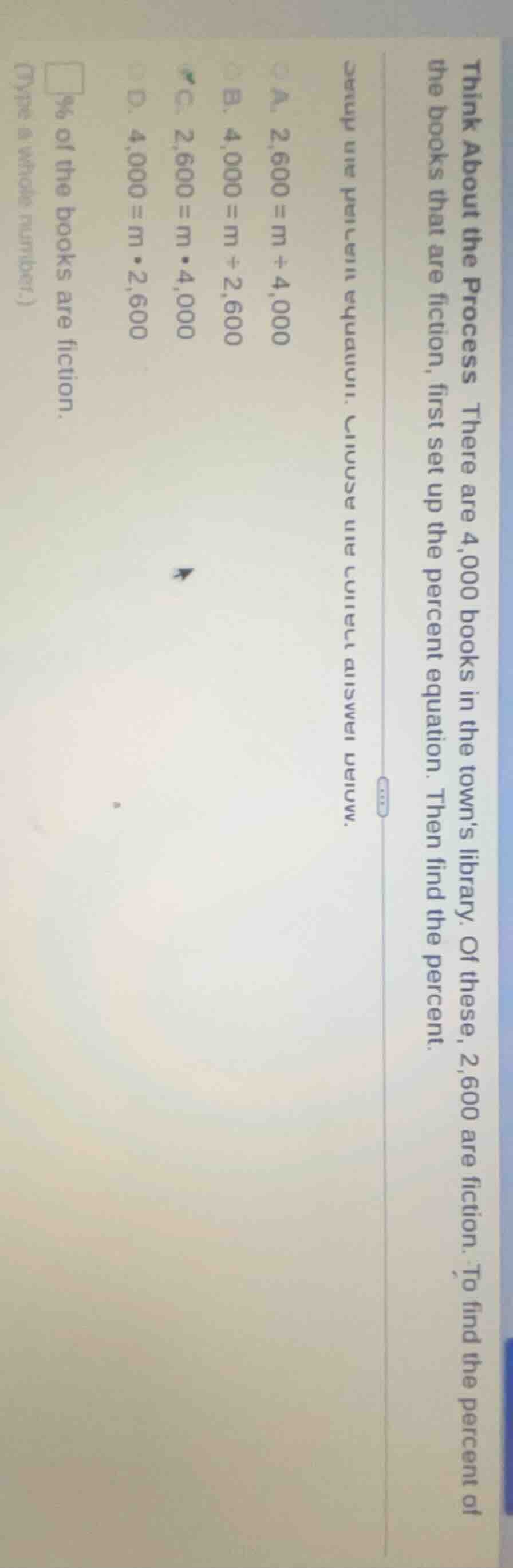
think about the process there are 4,000 books in the town’s library. of these, 2,600 are fiction. to find the percent of the books that are fiction, first set up the percent equation. then find the percent. setup the percent equation. choose the correct answer below. a. 2,600 = m ÷ 4,000 b. 4,000 = m ÷ 2,600 c. 2,600 = m • 4,000 d. 4,000 = m • 2,600 (type a whole number.) % of the books are fiction.
Part 1: Choosing the correct equation
To find the percentage \( m\% \) of books that are fiction, we use the formula: \( \text{Part} = \text{Whole} \times \text{Percent (in decimal)} \). Here, the whole number of books is \( 4000 \), the part (fiction books) is \( 2600 \), and the percent (in decimal) is \( \frac{m}{100} \). But in terms of the equation with \( m \) as the percent (not decimal), the relationship is \( 2600 = 4000\times\frac{m}{100} \), which can be rewritten as \( 2600 = m\times\frac{4000}{100} \)? Wait, no, let's think again. The basic percent equation is \( \text{Part} = \text{Whole} \times \text{Percent (decimal)} \). If \( m \) is the percent, then the decimal is \( \frac{m}{100} \), so \( 2600 = 4000\times\frac{m}{100} \), which simplifies to \( 2600=\frac{m\times4000}{100} \), or multiplying both sides by 100: \( 260000 = m\times4000 \), then dividing both sides by 4000: \( m=\frac{260000}{4000} \), but looking at the options, the options are in terms of \( 2600 = m\times\frac{4000}{100} \)? Wait, no, the options are:
A. \( 2600 = m \div 4000 \)
B. \( 4000 = m \div 2600 \)
C. \( 2600 = m \times 4000 \) (Wait, no, the option C is \( 2600 = m \cdot 4000 \)? Wait, no, the user's options:
Wait the options are:
A. \( 2600 = m \div 4000 \)
B. \( 4000 = m \div 2600 \)
C. \( 2600 = m \cdot 4000 \) (Wait, no, the original options:
Looking at the image, the options are:
A. \( 2600 = m \div 4000 \)
B. \( 4000 = m \div 2600 \)
C. \( 2600 = m \cdot 4000 \) (Wait, no, the user wrote:
A. \( 2,600 = m \div 4,000 \)
B. \( 4,000 = m \div 2,600 \)
C. \( 2,600 = m \cdot 4,000 \)
D. \( 4,000 = m \cdot 2,600 \)
Wait, no, the correct percent equation is \( \text{Part} = \text{Whole} \times \text{Percent (decimal)} \). If \( m \) is the percent, then the decimal is \( \frac{m}{100} \), so \( 2600 = 4000 \times \frac{m}{100} \), which can be rearranged as \( 2600 = \frac{m \times 4000}{100} \), or \( 2600 = m \times 40 \) (since \( 4000/100=40 \)), but the options don't have that. Wait, maybe the question is considering \( m \) as the decimal percent? No, the options are in terms of multiplication/division. Wait, maybe the question is using \( m \) as the proportion (decimal) times 100? No, let's re-express the percent formula. The formula for percentage is \( \text{Percentage} = \frac{\text{Part}}{\text{Whole}} \times 100 \). So \( m = \frac{2600}{4000} \times 100 \), which can be written as \( 2600 = \frac{m \times 4000}{100} \), or \( 2600 \times 100 = m \times 4000 \), then \( 260000 = m \times 4000 \), so \( m = \frac{260000}{4000} \). But looking at the options, option C is \( 2600 = m \cdot 4000 \) (if we consider \( m \) as \( \frac{2600}{4000} \), but that's the decimal. Wait, maybe the question has a typo, but among the options, the correct equation to find \( m \) (the percent) is derived from \( \text{Part} = \text{Whole} \times \text{Percent (decimal)} \). If we let \( m \) be the percent (so decimal is \( m/100 \)), then \( 2600 = 4000 \times (m/100) \), which simplifies to \( 2600 = (m \times 4000)/100 \), or \( 2600 = m \times 40 \) (since 4000/100=40). But the options are:
A. 2600 = m ÷ 4000 → 2600 = m/4000 → m=2600×4000, which is too big.
B. 4000 = m ÷ 2600 → m=4000×2600, too big.
C. 2600 = m × 4000 → m=2600/4000=0.65, then 0.65×100=65%, which is the correct percentage. Wait, if m is the decimal (0.65), then 2600=0.65×4000. But the question says "set up the percent equation". Maybe the question is using m as the decimal? No, the second part asks for the percent (type a whole number), so m is the percent. Wait, maybe the options have a m…
Step 1: Use the correct equation
From option C: \( 2600 = m \times 4000 \) (assuming m is the decimal percent, i.e., m = 0.65, but we need to find the percent as a whole number, so we convert the decimal to percent by multiplying by 100).
Step 2: Solve for m (decimal)
\( m = \frac{2600}{4000} = 0.65 \)
Step 3: Convert decimal to percent
Multiply by 100: \( 0.65 \times 100 = 65 \)

Snap & solve any problem in the app
Get step-by-step solutions on Sovi AI
Photo-based solutions with guided steps
Explore more problems and detailed explanations
(for the percent):
65
But first, the correct equation is option C. So:
For the equation part, the answer is C. 2,600 = m • 4,000
For the percent part, the answer is 65.