QUESTION IMAGE
Question
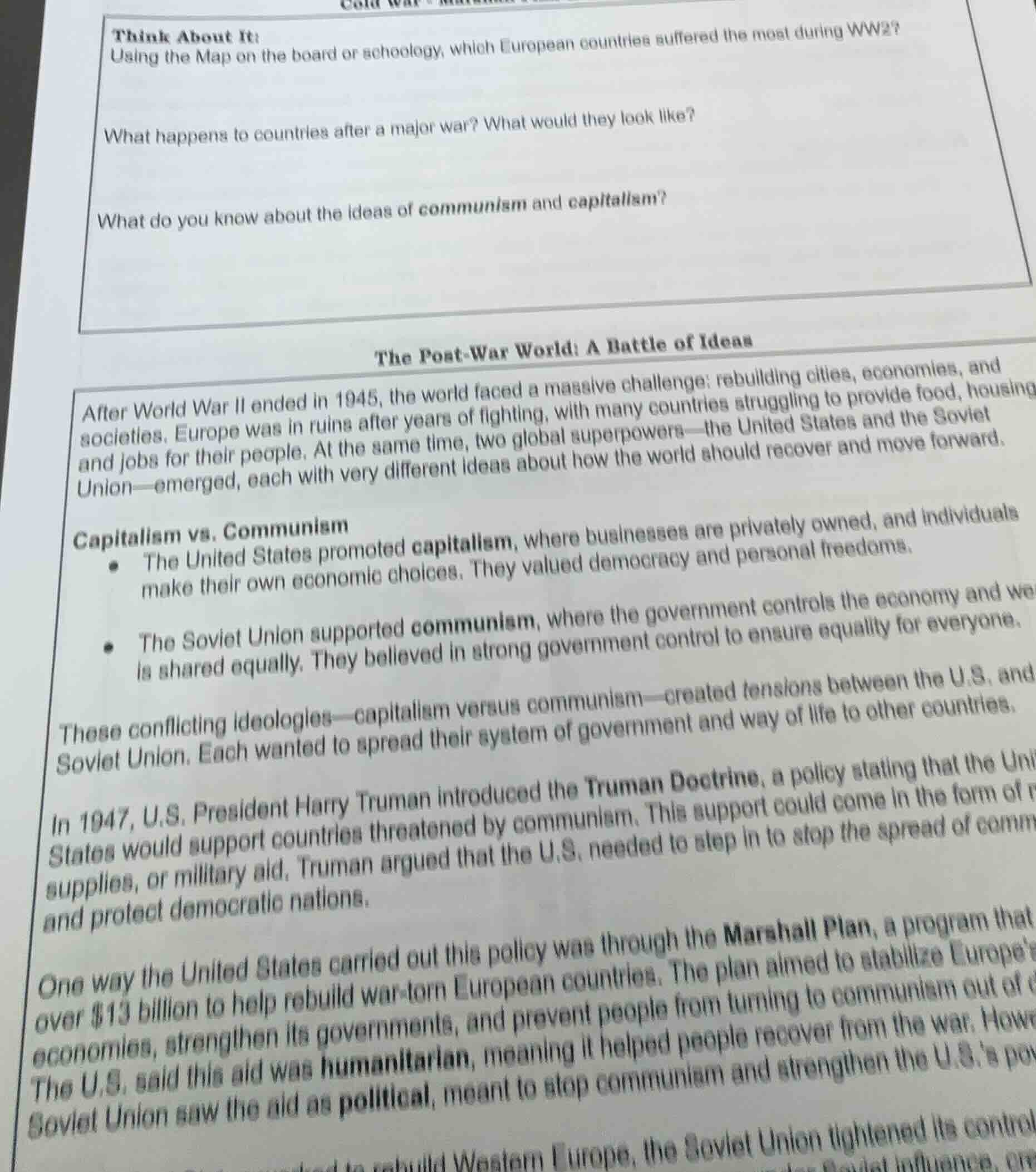
think about it:
using the map on the board or schoology, which european countries suffered the most during ww2?
what happens to countries after a major war? what would they look like?
what do you know about the ideas of communism and capitalism?
the post - war world: a battle of ideas
after world war ii ended in 1945, the world faced a massive challenge: rebuilding cities, economies, and societies. europe was in ruins after years of fighting, with many countries struggling to provide food, housing and jobs for their people. at the same time, two global superpowers—the united states and the soviet union—emerged, each with very different ideas about how the world should recover and move forward.
capitalism vs. communism
- the united states promoted capitalism, where businesses are privately owned, and individuals make their own economic choices. they valued democracy and personal freedoms.
- the soviet union supported communism, where the government controls the economy and we is shared equally. they believed in strong government control to ensure equality for everyone.
these conflicting ideologies—capitalism versus communism—created tensions between the u.s. and soviet union. each wanted to spread their system of government and way of life to other countries.
in 1947, u.s. president harry truman introduced the truman doctrine, a policy stating that the uni states would support countries threatened by communism. this support could come in the form of supplies, or military aid. truman argued that the u.s. needed to step in to stop the spread of comm and protect democratic nations.
one way the united states carried out this policy was through the marshall plan, a program that over $13 billion to help rebuild war - torn european countries. the plan aimed to stabilize europes economies, strengthen its governments, and prevent people from turning to communism out of the u.s. said this aid was humanitarian, meaning it helped people recover from the war. how soviet union saw the aid as political, meant to stop communism and strengthen the u.s.s po rebuild western europe, the soviet union tightened its control
Since the problem here is about analyzing post - WWII world politics, economic systems (capitalism and communism), and historical events like the Truman Doctrine and Marshall Plan, we'll use the Answer - Explanation Format.
The content is about the post - World War II world, focusing on the ideological conflict between capitalism (US - led) and communism (Soviet - led), along with political policies (Truman Doctrine, Marshall Plan) and post - war recovery. This falls under the Social Science discipline, specifically the subfield of History (as it deals with post - WWII historical events and developments) and also touches on Politics (due to the ideological and policy - related aspects).
For the first "Think About It" question "Using the Map on the board or schoology, which European countries suffered the most during WW2?":
- Key points: During World War II, countries that were major battlefronts or occupied suffered heavily. For example, Poland was invaded at the start, endured occupation and atrocities. The Soviet Union (though a trans - continental country with a large European part) had massive casualties and destruction, especially in cities like Stalingrad and Leningrad. Germany, as the aggressor but also a battlefront, had its cities bombed and faced occupation. France was occupied, and countries like Yugoslavia had partisan wars and heavy losses.
For the second "Think About It" question "What happens to countries after a major war? What would they look like?":
- Key points: Post - war countries often face physical reconstruction (cities, infrastructure), economic recovery (rebuilding industries, agriculture), political changes (new governments, ideological shifts like the spread of communism or capitalism in post - WWII Europe), social changes (displaced populations, changes in gender roles due to war - time labor, trauma and social reconstruction), and may be influenced by external powers (like the US and Soviet Union in post - WWII Europe).
For the third "Think About It" question "What do you know about the ideas of communism and capitalism?":
- Key points: Capitalism (as promoted by the US) is an economic system with private ownership of businesses, individuals making economic choices, and a focus on democracy and personal freedoms. Communism (as supported by the Soviet Union) has government control of the economy, with the goal of equal distribution of wealth and strong government control for equality. These are ideological systems that also influence political and social structures.

Snap & solve any problem in the app
Get step-by-step solutions on Sovi AI
Photo-based solutions with guided steps
Explore more problems and detailed explanations
- For "Which European countries suffered the most during WW2?": Countries like Poland, the Soviet Union (European part), Germany, France (occupied), Yugoslavia, and others that were major battlefronts or occupied suffered heavily.
- For "What happens to countries after a major war? What would they look like?": Countries face physical reconstruction, economic recovery, political and social changes, and external influence (e.g., post - WWII Europe's division into capitalist and communist blocs).
- For "What do you know about the ideas of communism and capitalism?": Capitalism: Private business ownership, individual economic choice, democratic and personal freedom - focused. Communism: Government - controlled economy, equal wealth distribution, strong government control for equality.