QUESTION IMAGE
Question
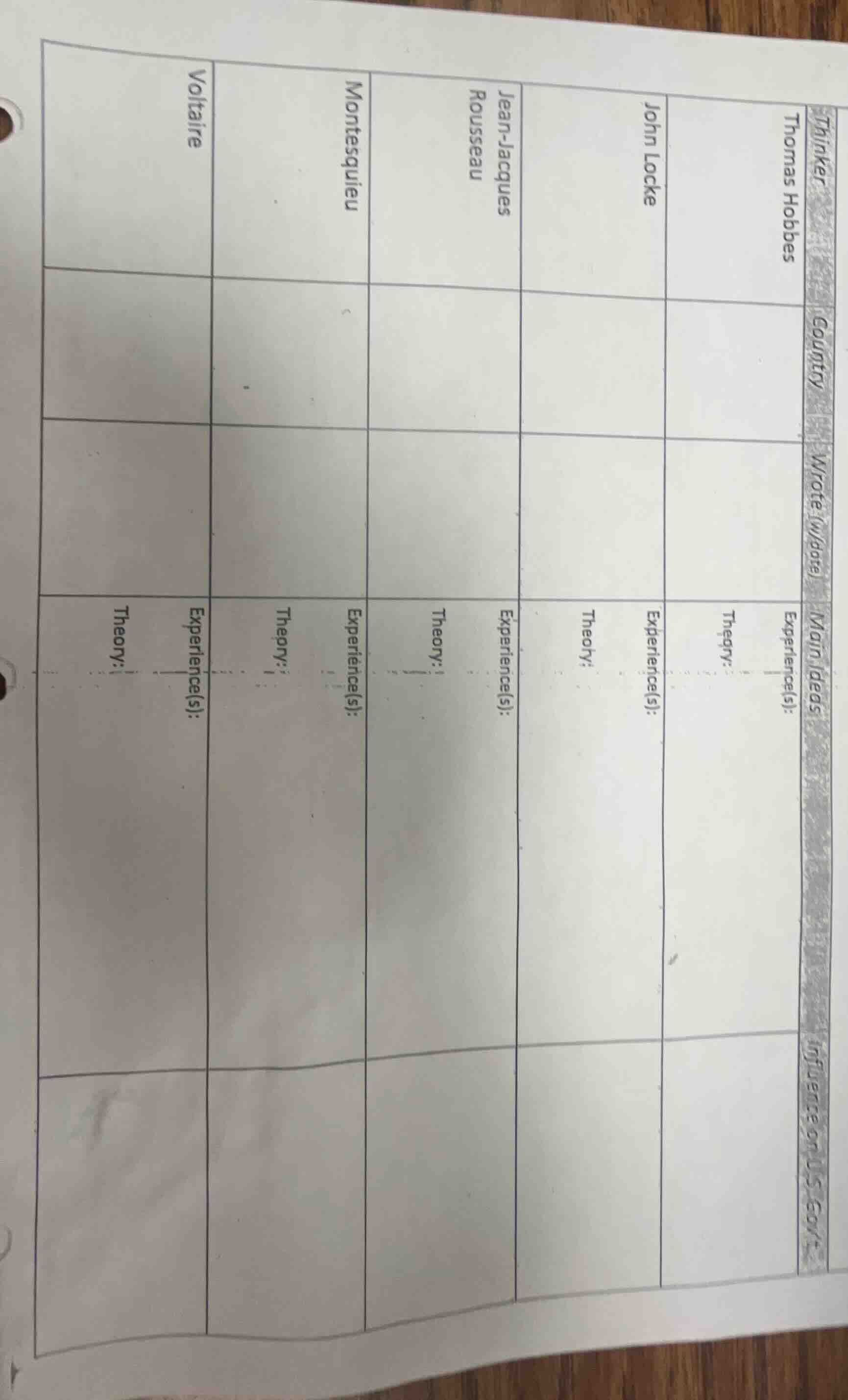
thinker
thomas hobbes
john locke
jean-jacques rousseau
montesquieu
voltaire
country
wrote (w/date)
main ideas
experience(s):
theory:
experience(s):
theory:
experience(s):
theory:
experience(s):
theory:
experience(s):
theory:
influence on u.s. govt
Brief Explanations
This table requires filling in key details about Enlightenment thinkers, including their country of origin, major works, core experiences and theories, and their influence on the U.S. government. Each entry is based on standard historical academic records of these philosophers.

Snap & solve any problem in the app
Get step-by-step solutions on Sovi AI
Photo-based solutions with guided steps
Explore more problems and detailed explanations
| Thinker | Country | Wrote (w/date) | Main Ideas | Influence on U.S Gov't |
|---|---|---|---|---|
| John Locke | England | Two Treatises of Government (1689) | Experience(s): Witnessed Glorious Revolution<br>Theory: Natural rights (life, liberty, property); social contract; right to revolt against unjust rulers | Influenced Declaration of Independence (natural rights, right to revolution) and property protections in the U.S. Constitution |
| Jean-Jacques Rousseau | France | The Social Contract (1762) | Experience(s): Marginalized, lived in poverty across Europe<br>Theory: "General will" of the people; direct democracy; social contract where people give up individual will for collective good | Influenced ideals of popular sovereignty in the U.S. system, especially in democratic participation |
| Montesquieu | France | The Spirit of the Laws (1748) | Experience(s): Studied European governments<br>Theory: Separation of powers (executive, legislative, judicial); checks and balances to prevent tyranny | Directly shaped the U.S. Constitution's separation of powers and checks and balances system |
| Voltaire | France | Candide (1759), Letters on England (1733) | Experience(s): Imprisoned and exiled for criticizing the French crown and church<br>Theory: Religious tolerance; freedom of speech and press; opposition to absolutism and religious persecution | Influenced the First Amendment (freedom of speech, press, and religious freedom) |