QUESTION IMAGE
Question
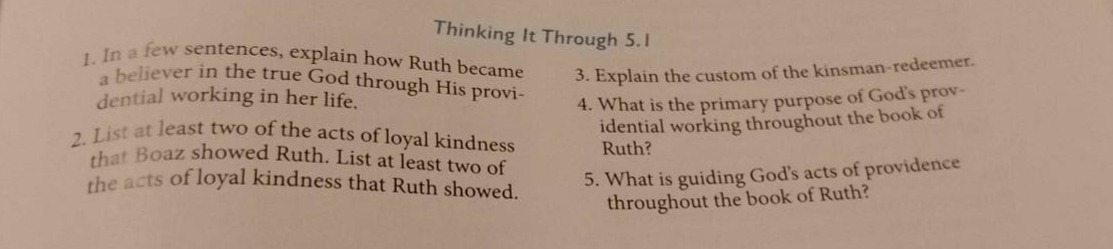
thinking it through 5.1
- in a few sentences, explain how ruth became a believer in the true god through his providential working in her life.
- list at least two of the acts of loyal kindness that boaz showed ruth. list at least two of the acts of loyal kindness that ruth showed.
- explain the custom of the kinsman - redeemer.
- what is the primary purpose of gods providential working throughout the book of ruth?
- what is guiding gods acts of providence throughout the book of ruth?
Each answer is grounded in the narrative and cultural context of the Book of Ruth, focusing on the core themes of divine providence, loyal kindness (Hebrew chesed), Israelite social customs, and the redemptive mission of God. For question 1, the explanation traces Ruth's journey from Moab to faith through God's orchestrated events. Question 2 draws direct examples from the text of mutual loyal kindness between Boaz and Ruth. Question 3 defines the kinsman-redeemer based on ancient Israelite legal and social norms as depicted in the book. Question 4 centers on God's overarching redemptive plan and inclusive love shown in the narrative. Question 5 identifies God's covenant faithfulness and redemptive intent as the guiding force behind His providential acts.

Snap & solve any problem in the app
Get step-by-step solutions on Sovi AI
Photo-based solutions with guided steps
Explore more problems and detailed explanations
- Ruth left her pagan homeland, clung to Naomi and the God of Israel, and through a series of divinely orchestrated events (including meeting Boaz, a kinsman-redeemer) she entered the Israelite community, married Boaz, and became part of the lineage of Jesus Christ—all demonstrating God's providence drawing her to faith in the true God.
- Boaz's acts of loyal kindness: 1) He instructed his workers to leave extra grain for Ruth to glean. 2) He invited her to eat with his workers and gave her food generously. Ruth's acts of loyal kindness: 1) She refused to leave Naomi after Naomi's husband and sons died, choosing to care for her. 2) She worked tirelessly gleaning grain to provide food for herself and Naomi.
- The kinsman-redeemer was a custom in ancient Israel where a close male relative had the obligation to redeem a family member's lost property, marry a widow to preserve the family line and inheritance, and rescue family members from hardship or slavery, ensuring the family's survival and honor within the community.
- The primary purpose of God's providential working in Ruth is to demonstrate that God's covenant love and care extend beyond the Israelite nation, to fulfill His promise of a coming Messiah (as Ruth is part of Jesus' ancestral line), and to reveal His faithfulness in sustaining and restoring His people even in difficult circumstances.
- God's acts of providence in Ruth are guided by His holy, redemptive purpose to bring about the fulfillment of His covenant promises, His loving care for the vulnerable, and His desire to build up His people and advance the line of the coming Savior.