QUESTION IMAGE
Question
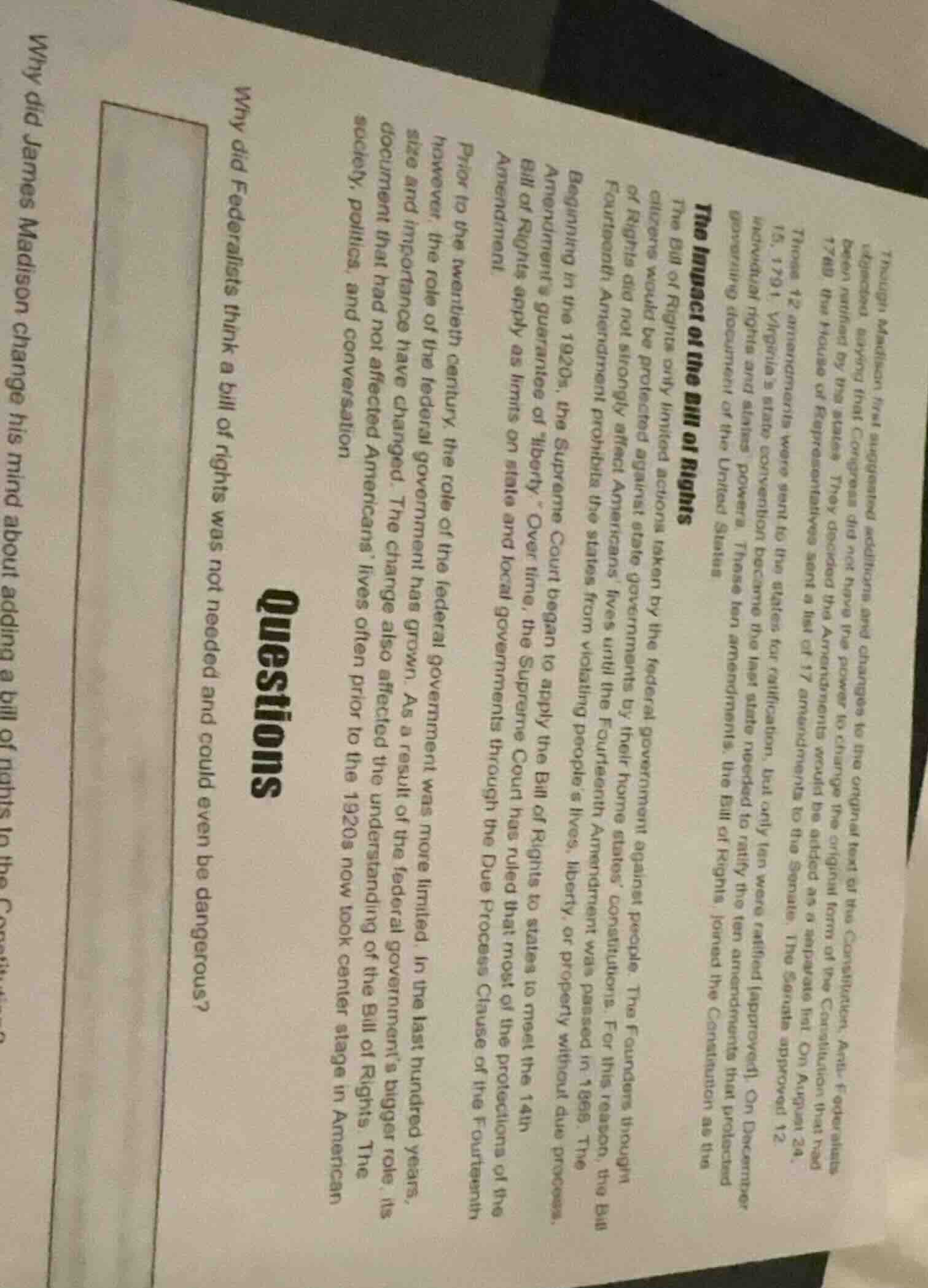
though madison first suggested additions and changes to the original text of the constitution, anti - federalists objected, saying that congress did not have the power to change the original form of the constitution that had been ratified by the states. they decided the amendments would be added as a separate list. on august 24, 1789, the house of representatives sent a list of 17 amendments to the senate. the senate approved 12 amendments. those 12 amendments were sent to the states for ratification. on december 15, 1791, virginia’s state convention became the last state needed to ratify the ten amendments that protected individual rights and states’ powers. these ten amendments, the bill of rights, joined the constitution as the governing document of the united states. the impact of the bill of rights the bill of rights only limited actions taken by the federal government against people. the founders thought citizens would be protected against state governments by their home states’ constitutions. for this reason, the bill of rights did not strongly affect americans’ lives until the fourteenth amendment was passed in 1868. the fourteenth amendment prohibits the states from violating people’s lives, liberty, or property without due process. the amendment’s guarantee of “liberty” over time, the supreme court has ruled that most of the protections of the bill of rights apply as limits on state and local governments through the due process clause of the fourteenth amendment. prior to the twentieth century, the role of the federal government was more limited. in the last hundred years, however, the role of the federal government has grown. as a result of the federal government’s bigger role, its document that had not affected americans’ lives often prior to the 1920s now took center stage in american society, politics, and conversation. questions why did federalists think a bill of rights was not needed and could even be dangerous? why did james madison change his mind about adding a bill of rights to the constitution?
- For the Federalists' view: They argued the Constitution already limited federal government power via separation of powers and checks and balances. They feared a bill of rights would be incomplete, and unlisted rights might be seen as unprotected, plus it could unnecessarily restrict the federal government's ability to act.
- For James Madison's change of heart: He initially opposed a bill of rights for similar Federalist reasons, but he shifted to secure ratification of the Constitution. Key states like Virginia and New York were hesitant to ratify without explicit protections for individual rights, so Madison supported adding the Bill of Rights to build trust and ensure the Constitution was adopted.

Snap & solve any problem in the app
Get step-by-step solutions on Sovi AI
Photo-based solutions with guided steps
Explore more problems and detailed explanations
- Federalists thought a bill of rights was unnecessary because the Constitution already limited federal government power through structural safeguards (separation of powers, checks and balances). They believed it could be dangerous because unlisted rights might be interpreted as not protected, and it could improperly restrict federal authority.
- James Madison changed his mind to help secure ratification of the U.S. Constitution. He recognized that key states would not ratify the document without explicit protections for individual rights, so he backed the addition of the Bill of Rights to gain their support and finalize the Constitution's adoption.