QUESTION IMAGE
Question
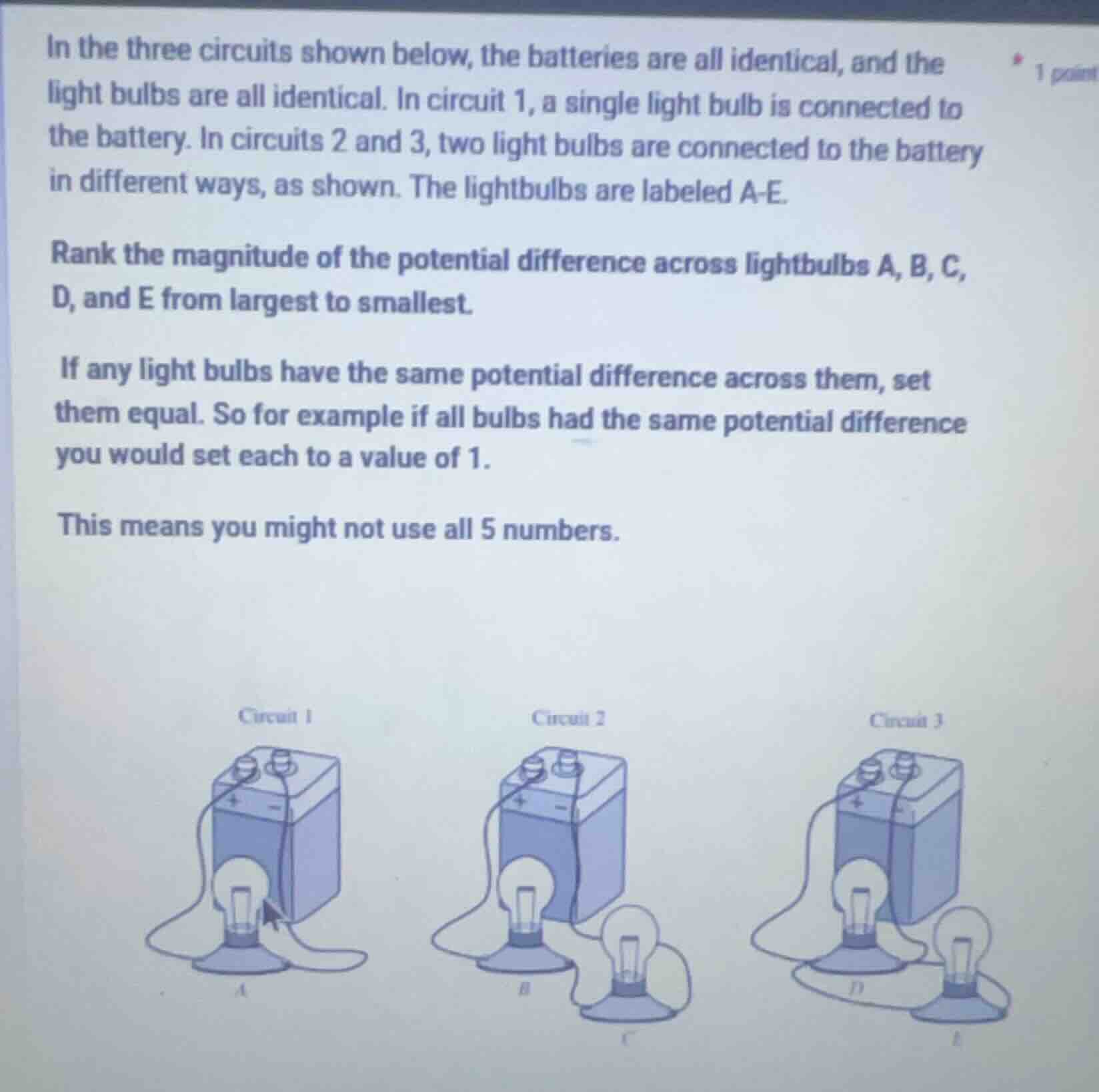
in the three circuits shown below, the batteries are all identical, and the light bulbs are all identical. in circuit 1, a single light bulb is connected to the battery. in circuits 2 and 3, two light bulbs are connected to the battery in different ways, as shown. the lightbulbs are labeled a - e. rank the magnitude of the potential difference across lightbulbs a, b, c, d, and e from largest to smallest. if any light bulbs have the same potential difference across them, set them equal. so for example if all bulbs had the same potential difference you would set each to a value of 1. this means you might not use all 5 numbers.
Step1: Define battery voltage
Let the battery voltage be $V$.
Step2: Find V across Bulb A
Bulb A is directly connected to the battery, so its potential difference equals the battery voltage: $\Delta V_A = V$
Step3: Analyze Circuit 2 (series)
Bulbs B and C are identical in series. Series components split the total voltage equally:
$\Delta V_B = \Delta V_C = \frac{V}{2}$
Step4: Analyze Circuit 3 (parallel)
Bulbs D and E are in parallel with the battery. Parallel components have the same voltage as the source:
$\Delta V_D = \Delta V_E = V$
Step5: Rank all potential differences
Compare the values: $V = V > \frac{V}{2} = \frac{V}{2}$

Snap & solve any problem in the app
Get step-by-step solutions on Sovi AI
Photo-based solutions with guided steps
Explore more problems and detailed explanations
$\Delta V_A = \Delta V_D = \Delta V_E > \Delta V_B = \Delta V_C$
(Or ranked numerically: 1 for A, D, E; 2 for B, C)