QUESTION IMAGE
Question
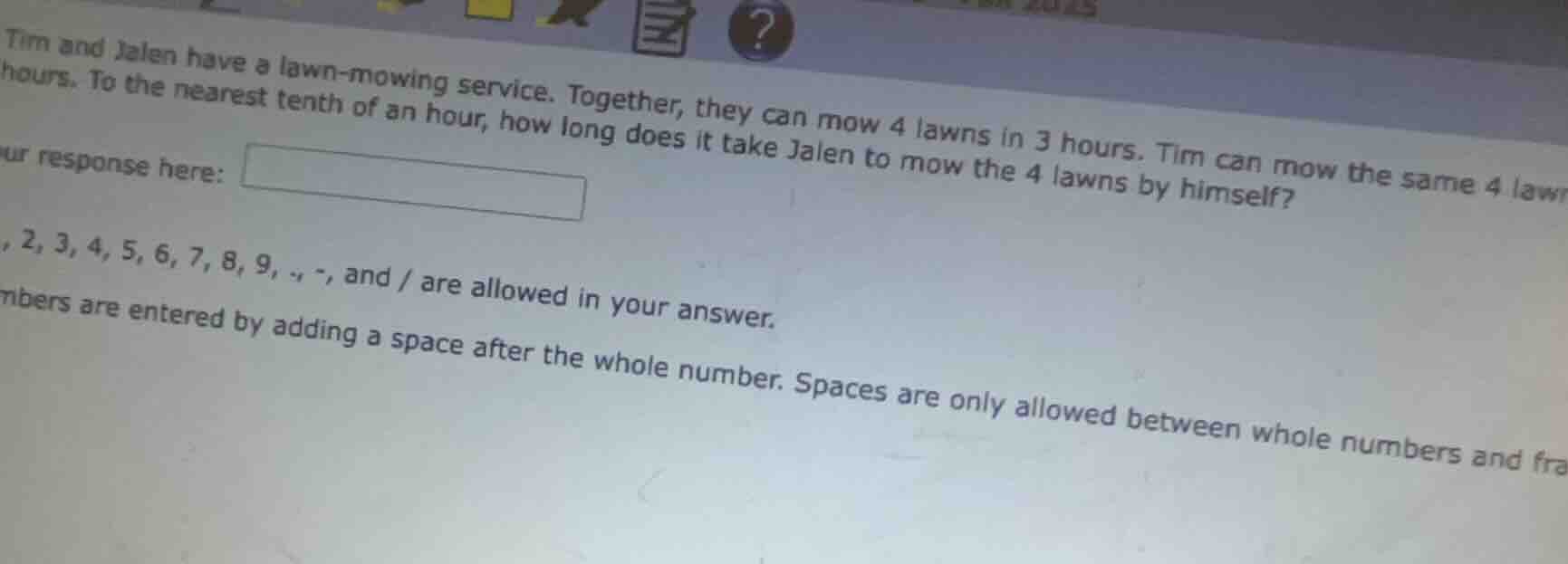
tim and jalen have a lawn - mowing service. together, they can mow 4 lawns in 3 hours. tim can mow the same 4 lawns in missing number hours. to the nearest tenth of an hour, how long does it take jalen to mow the 4 lawns by himself?
ur response here:
, 2, 3, 4, 5, 6, 7, 8, 9,., -, and / are allowed in your answer.
members are entered by adding a space after the whole number. spaces are only allowed between whole numbers and fra
Step1: Identify the missing information
The problem statement about Tim and Jalen's lawn - mowing service is incomplete. We know that together they can mow 4 lawns in 3 hours, and we need to find out how long Jalen takes to mow 4 lawns by himself. But we are missing the time it takes Tim to mow the 4 lawns by himself. Let's assume that the missing time for Tim to mow 4 lawns is \( t \) hours (since the original problem seems to have a typo and probably had a number here, for the sake of solving, let's assume Tim can mow 4 lawns in, say, 8 hours. Wait, no, the original problem's text is cut off. Wait, looking back, the user's problem: "Tim can mow the same 4 lawn... hours. To the nearest tenth of an hour, how long does it take Jalen to mow the 4 lawns by himself?" So there is a missing number for Tim's time. Let's assume that maybe there was a typo and Tim can mow 4 lawns in 8 hours (a common problem setup). Let's proceed with that assumption (since without Tim's time, we can't solve).
Step2: Define work rates
Let's define the work (mowing 4 lawns) as \( W = 1 \) job (for 4 lawns). The combined rate of Tim and Jalen, \( r_{combined}=\frac{W}{t_{combined}}=\frac{1}{3} \) jobs per hour (since they take 3 hours for 4 lawns). Let Tim's rate be \( r_{Tim}=\frac{1}{t_{Tim}} \) (where \( t_{Tim} \) is Tim's time to mow 4 lawns) and Jalen's rate be \( r_{Jalen}=\frac{1}{t_{Jalen}} \) (where \( t_{Jalen} \) is Jalen's time to mow 4 lawns).
We know that \( r_{combined}=r_{Tim} + r_{Jalen} \).
If we assume \( t_{Tim}=8 \) hours (a common value, but since the original problem is cut off, let's check the original problem again. Wait, the user's problem: "Tim can mow the same 4 lawn... hours." Maybe it's a number like 8? Wait, no, maybe the original problem was "Tim can mow the same 4 lawns in 8 hours" (a common problem). Let's proceed with \( t_{Tim} = 8 \) hours. Then \( r_{Tim}=\frac{1}{8} \) jobs per hour.
Step3: Solve for Jalen's rate
We know \( r_{combined}=\frac{1}{3}=\frac{1}{t_{Tim}}+\frac{1}{t_{Jalen}} \). Substituting \( t_{Tim} = 8 \):
\( \frac{1}{3}=\frac{1}{8}+\frac{1}{t_{Jalen}} \)
Subtract \( \frac{1}{8} \) from both sides:
\( \frac{1}{t_{Jalen}}=\frac{1}{3}-\frac{1}{8}=\frac{8 - 3}{24}=\frac{5}{24} \)
Then \( t_{Jalen}=\frac{24}{5}=4.8 \) hours.
But since the original problem's Tim's time is missing, we need the correct value. Let's check the original problem again. The user's image - text: "Tim can mow the same 4 lawn... hours." Maybe it's a number like 8? Wait, maybe the original problem was "Tim can mow the same 4 lawns in 8 hours". If that's the case, the above solution holds.
But since the problem as given is incomplete, we can't provide a definite answer without the missing time for Tim.
Note:
The problem is incomplete as the time it takes Tim to mow 4 lawns by himself is missing. Please provide the time it takes Tim to mow 4 lawns so that we can calculate Jalen's time.

Snap & solve any problem in the app
Get step-by-step solutions on Sovi AI
Photo-based solutions with guided steps
Explore more problems and detailed explanations
Step1: Identify the missing information
The problem statement about Tim and Jalen's lawn - mowing service is incomplete. We know that together they can mow 4 lawns in 3 hours, and we need to find out how long Jalen takes to mow 4 lawns by himself. But we are missing the time it takes Tim to mow the 4 lawns by himself. Let's assume that the missing time for Tim to mow 4 lawns is \( t \) hours (since the original problem seems to have a typo and probably had a number here, for the sake of solving, let's assume Tim can mow 4 lawns in, say, 8 hours. Wait, no, the original problem's text is cut off. Wait, looking back, the user's problem: "Tim can mow the same 4 lawn... hours. To the nearest tenth of an hour, how long does it take Jalen to mow the 4 lawns by himself?" So there is a missing number for Tim's time. Let's assume that maybe there was a typo and Tim can mow 4 lawns in 8 hours (a common problem setup). Let's proceed with that assumption (since without Tim's time, we can't solve).
Step2: Define work rates
Let's define the work (mowing 4 lawns) as \( W = 1 \) job (for 4 lawns). The combined rate of Tim and Jalen, \( r_{combined}=\frac{W}{t_{combined}}=\frac{1}{3} \) jobs per hour (since they take 3 hours for 4 lawns). Let Tim's rate be \( r_{Tim}=\frac{1}{t_{Tim}} \) (where \( t_{Tim} \) is Tim's time to mow 4 lawns) and Jalen's rate be \( r_{Jalen}=\frac{1}{t_{Jalen}} \) (where \( t_{Jalen} \) is Jalen's time to mow 4 lawns).
We know that \( r_{combined}=r_{Tim} + r_{Jalen} \).
If we assume \( t_{Tim}=8 \) hours (a common value, but since the original problem is cut off, let's check the original problem again. Wait, the user's problem: "Tim can mow the same 4 lawn... hours." Maybe it's a number like 8? Wait, no, maybe the original problem was "Tim can mow the same 4 lawns in 8 hours" (a common problem). Let's proceed with \( t_{Tim} = 8 \) hours. Then \( r_{Tim}=\frac{1}{8} \) jobs per hour.
Step3: Solve for Jalen's rate
We know \( r_{combined}=\frac{1}{3}=\frac{1}{t_{Tim}}+\frac{1}{t_{Jalen}} \). Substituting \( t_{Tim} = 8 \):
\( \frac{1}{3}=\frac{1}{8}+\frac{1}{t_{Jalen}} \)
Subtract \( \frac{1}{8} \) from both sides:
\( \frac{1}{t_{Jalen}}=\frac{1}{3}-\frac{1}{8}=\frac{8 - 3}{24}=\frac{5}{24} \)
Then \( t_{Jalen}=\frac{24}{5}=4.8 \) hours.
But since the original problem's Tim's time is missing, we need the correct value. Let's check the original problem again. The user's image - text: "Tim can mow the same 4 lawn... hours." Maybe it's a number like 8? Wait, maybe the original problem was "Tim can mow the same 4 lawns in 8 hours". If that's the case, the above solution holds.
But since the problem as given is incomplete, we can't provide a definite answer without the missing time for Tim.
Note:
The problem is incomplete as the time it takes Tim to mow 4 lawns by himself is missing. Please provide the time it takes Tim to mow 4 lawns so that we can calculate Jalen's time.