QUESTION IMAGE
Question
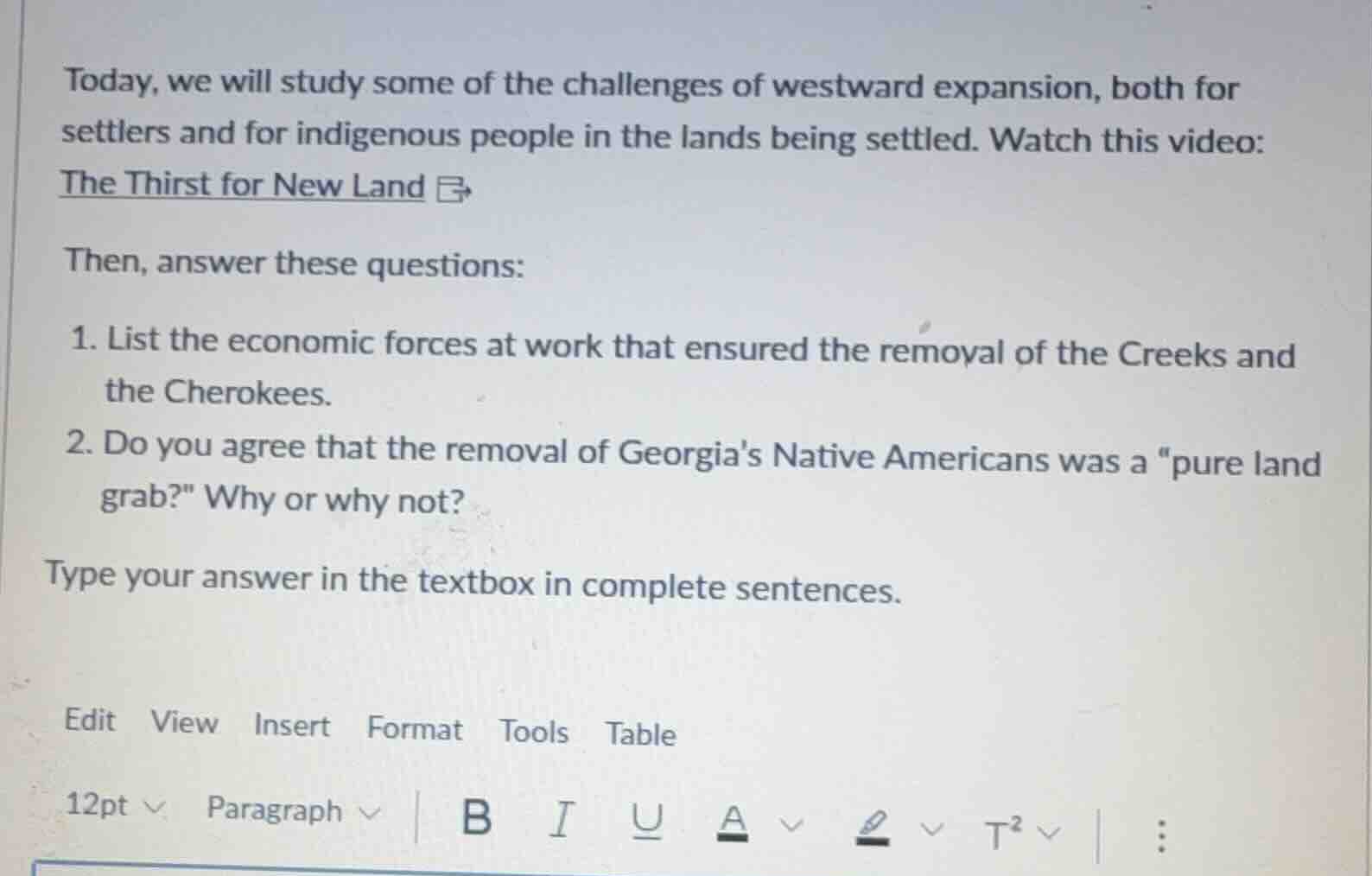
today, we will study some of the challenges of westward expansion, both for settlers and for indigenous people in the lands being settled. watch this video: the thirst for new land then, answer these questions: 1. list the economic forces at work that ensured the removal of the creeks and the cherokees. 2. do you agree that the removal of georgias native americans was a \pure land grab?\ why or why not? type your answer in the textbox in complete sentences.
To answer these questions, we first need to analyze the context of westward expansion and Native American removal, especially related to economic forces and land acquisition.
Question 1: Economic Forces for Creek and Cherokee Removal
Step 1: Identify Key Economic Drivers
- Cotton Boom and Plantation Agriculture: The demand for fertile land for cotton cultivation (driven by the cotton gin's invention and growing textile industries in the North and Europe) made Native American lands in the Southeast (like Georgia) highly desirable. Planters and speculators sought this land to expand their cotton plantations, which were extremely profitable.
- Land Speculation: Investors and land companies anticipated huge profits from buying Native American lands (either through government treaties or forced removal) and reselling them to white settlers at inflated prices.
- Government Policies (Economic Incentives): The U.S. government, influenced by economic interests, enacted policies like the Indian Removal Act (1830). This allowed the government to negotiate treaties (often coercive) to acquire Native lands, with the promise of "Indian Territory" (present - day Oklahoma) in exchange. The government also benefited from opening up these lands to white settlement, which increased tax revenues and boosted the national economy through agricultural production.
- Rise of a Market Economy and White Settler Demand: The growing population of white settlers (many seeking economic opportunities like farming, mining, or trade) created a high demand for land. Native American lands were seen as under - utilized (from a white settler perspective) and ripe for development to support the expanding market economy.
Step 2: Summarize the Forces
The economic forces included the profitability of cotton plantation agriculture driving demand for fertile Native - held lands, land speculation by investors looking to profit from land sales, government policies that facilitated land acquisition for economic gain (both for the government and private interests), and the demand from white settlers for land to participate in the growing market economy.
Question 2: Was Georgia's Native American Removal a "Pure Land Grab"?
Step 1: Define "Pure Land Grab"
A "pure land grab" implies that the primary (or only) motivation was to acquire land, with little or no legitimate reason beyond territorial expansion and economic gain for white settlers and speculators.
Step 2: Analyze the Evidence
- Support for "Pure Land Grab":
- Lack of Justification Beyond Land: There was no significant threat (military or otherwise) from the Creeks and Cherokees at the time of removal. The Cherokees, in particular, had adopted many aspects of white culture (like a written constitution, private property, and slave - holding in some cases) and were not a "hostile" force. The main motivation was the desire for their land, driven by the economic forces mentioned above (cotton, speculation, settler demand).
- Coercive Treaties: Treaties like the Treaty of New Echota (1835) with the Cherokees were signed by a minority of Cherokee leaders and not the majority of the tribe. The U.S. government used these treaties as a legal pretext to remove the Cherokees, even though the majority opposed it. This shows that the government was more interested in acquiring the land than in respecting Native sovereignty or rights.
- Counter - Arguments (if any): Some might argue that there were "civilizing" or "assimilation" goals, but these were often secondary o…

Snap & solve any problem in the app
Get step-by-step solutions on Sovi AI
Photo-based solutions with guided steps
Explore more problems and detailed explanations
To answer these questions, we first need to analyze the context of westward expansion and Native American removal, especially related to economic forces and land acquisition.
Question 1: Economic Forces for Creek and Cherokee Removal
Step 1: Identify Key Economic Drivers
- Cotton Boom and Plantation Agriculture: The demand for fertile land for cotton cultivation (driven by the cotton gin's invention and growing textile industries in the North and Europe) made Native American lands in the Southeast (like Georgia) highly desirable. Planters and speculators sought this land to expand their cotton plantations, which were extremely profitable.
- Land Speculation: Investors and land companies anticipated huge profits from buying Native American lands (either through government treaties or forced removal) and reselling them to white settlers at inflated prices.
- Government Policies (Economic Incentives): The U.S. government, influenced by economic interests, enacted policies like the Indian Removal Act (1830). This allowed the government to negotiate treaties (often coercive) to acquire Native lands, with the promise of "Indian Territory" (present - day Oklahoma) in exchange. The government also benefited from opening up these lands to white settlement, which increased tax revenues and boosted the national economy through agricultural production.
- Rise of a Market Economy and White Settler Demand: The growing population of white settlers (many seeking economic opportunities like farming, mining, or trade) created a high demand for land. Native American lands were seen as under - utilized (from a white settler perspective) and ripe for development to support the expanding market economy.
Step 2: Summarize the Forces
The economic forces included the profitability of cotton plantation agriculture driving demand for fertile Native - held lands, land speculation by investors looking to profit from land sales, government policies that facilitated land acquisition for economic gain (both for the government and private interests), and the demand from white settlers for land to participate in the growing market economy.
Question 2: Was Georgia's Native American Removal a "Pure Land Grab"?
Step 1: Define "Pure Land Grab"
A "pure land grab" implies that the primary (or only) motivation was to acquire land, with little or no legitimate reason beyond territorial expansion and economic gain for white settlers and speculators.
Step 2: Analyze the Evidence
- Support for "Pure Land Grab":
- Lack of Justification Beyond Land: There was no significant threat (military or otherwise) from the Creeks and Cherokees at the time of removal. The Cherokees, in particular, had adopted many aspects of white culture (like a written constitution, private property, and slave - holding in some cases) and were not a "hostile" force. The main motivation was the desire for their land, driven by the economic forces mentioned above (cotton, speculation, settler demand).
- Coercive Treaties: Treaties like the Treaty of New Echota (1835) with the Cherokees were signed by a minority of Cherokee leaders and not the majority of the tribe. The U.S. government used these treaties as a legal pretext to remove the Cherokees, even though the majority opposed it. This shows that the government was more interested in acquiring the land than in respecting Native sovereignty or rights.
- Counter - Arguments (if any): Some might argue that there were "civilizing" or "assimilation" goals, but these were often secondary or used as a pretext. The economic benefits of land acquisition far outweighed any genuine concern for Native American welfare or assimilation. The government's actions were overwhelmingly focused on transferring land from Native Americans to white settlers for economic gain.
Step 3: Formulate the Answer
Yes, the removal of Georgia's Native Americans was largely a pure land grab. The primary motivations were economic gain from land speculation, cotton agriculture, and meeting the land demands of white settlers. There was little legitimate reason (such as self - defense or a need to "civilize" in a non - exploitative way) beyond acquiring the valuable Native - held lands. The coercive treaties and lack of a real threat from the Native Americans further support the idea that the main goal was land acquisition.
Final Answers
Question 1 Answer:
The economic forces ensuring the removal of the Creeks and Cherokees included the high profitability of cotton plantation agriculture (driving demand for their fertile lands), land speculation by investors seeking to profit from land sales, U.S. government policies (like the Indian Removal Act) that facilitated land acquisition for economic gain, and the demand from white settlers for land to participate in the growing market economy.
Question 2 Answer:
I agree that the removal of Georgia's Native Americans was a "pure land grab." The primary motivation was to acquire their valuable lands for white settlers, planters, and speculators to profit from cotton agriculture, land sales, and economic expansion. There was no significant threat from the Creeks and Cherokees (especially the Cherokees, who had assimilated in many ways), and treaties were often coercive. The actions were overwhelmingly focused on land acquisition rather than any legitimate non - land - related goals.