QUESTION IMAGE
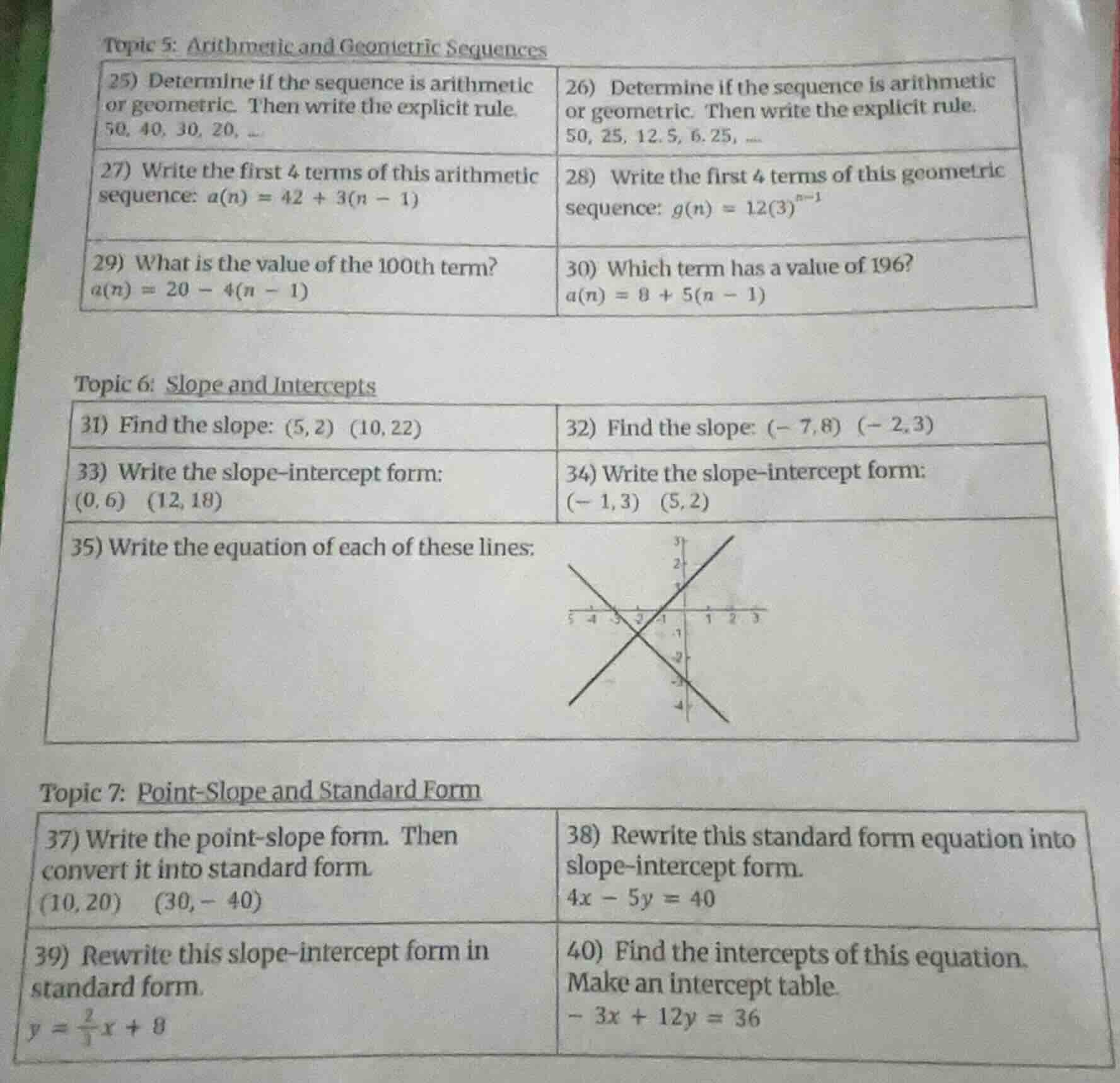
Question
topic 5: arithmetic and geometric sequences
- determine if the sequence is arithmetic or geometric. then write the explicit rule.
50, 40, 30, 20, ...
- determine if the sequence is arithmetic or geometric. then write the explicit rule.
50, 25, 12.5, 6.25, ...
- write the first 4 terms of this arithmetic sequence: ( a(n) = 42 + 3(n - 1) )
- write the first 4 terms of this geometric sequence: ( g(n) = 12(3)^{n - 1} )
- what is the value of the 100th term?( a(n) = 20 - 4(n - 1) )
- which term has a value of 196?( a(n) = 8 + 5(n - 1) )
topic 6: slope and intercepts
- find the slope: ( (5, 2) ) ( (10, 22) )
- find the slope: ( (-7, 8) ) ( (-2, 3) )
- write the slope - intercept form:( (0, 6) ) ( (12, 18) )
- write the slope - intercept form:( (-1, 3) ) ( (5, 2) )
- write the equation of each of these lines:
(image of two intersecting lines on a coordinate plane)
topic 7: point - slope and standard form
- write the point - slope form. then convert it into standard form.( (10, 20) ) ( (30, -40) )
- rewrite this standard form equation into slope - intercept form.( 4x - 5y = 40 )
- rewrite this slope - intercept form in standard form.( y=\frac{2}{3}x + 8 )
- find the intercepts of this equation. make an intercept table.( -3x + 12y = 36 )
---
Question 25
Step1: Identify sequence type
Check differences: $40-50=-10$, $30-40=-10$, $20-30=-10$ (constant difference, arithmetic)
Step2: Find explicit rule
Arithmetic rule: $a(n)=a_1+(n-1)d$, $a_1=50$, $d=-10$
$a(n)=50+(n-1)(-10)=60-10n$
Question 26
Step1: Identify sequence type
Check ratios: $\frac{25}{50}=0.5$, $\frac{12.5}{25}=0.5$, $\frac{6.25}{12.5}=0.5$ (constant ratio, geometric)
Step2: Find explicit rule
Geometric rule: $g(n)=g_1r^{n-1}$, $g_1=50$, $r=0.5$
$g(n)=50(0.5)^{n-1}$
Question 27
Step1: Calculate term 1
Substitute $n=1$: $a(1)=42+3(1-1)=42$
Step2: Calculate term 2
Substitute $n=2$: $a(2)=42+3(2-1)=45$
Step3: Calculate term 3
Substitute $n=3$: $a(3)=42+3(3-1)=48$
Step4: Calculate term 4
Substitute $n=4$: $a(4)=42+3(4-1)=51$
Question 28
Step1: Calculate term 1
Substitute $n=1$: $g(1)=12(3)^{1-1}=12$
Step2: Calculate term 2
Substitute $n=2$: $g(2)=12(3)^{2-1}=36$
Step3: Calculate term 3
Substitute $n=3$: $g(3)=12(3)^{3-1}=108$
Step4: Calculate term 4
Substitute $n=4$: $g(4)=12(3)^{4-1}=324$
Question 29
Step1: Substitute $n=100$
$a(100)=20-4(100-1)$
Step2: Simplify expression
$a(100)=20-4(99)=20-396=-376$
Question 30
Step1: Set $a(n)=196$, solve for $n$
$196=8+5(n-1)$
Step2: Isolate the variable term
$196-8=5(n-1) \implies 188=5(n-1)$
Step3: Solve for $n$
$n-1=\frac{188}{5}=37.6 \implies n=38.6$ (correction: $196-8=188$ → $188\div5=37.6$, but since $n$ must be integer, recheck: $8+5(n-1)=196$ → $5(n-1)=188$ → no integer solution? Wait, $8+5(38-1)=8+185=193$, $8+5(39-1)=8+190=198$. Note: If we assume no typo, $n=38.6$, but standard sequences use integer $n$.
Question 31
Step1: Use slope formula $m=\frac{y_2-y_1}{x_2-x_1}$
$(x_1,y_1)=(5,2)$, $(x_2,y_2)=(10,22)$
Step2: Calculate slope
$m=\frac{22-2}{10-5}=\frac{20}{5}=4$
Question 32
Step1: Use slope formula
$(x_1,y_1)=(-7,8)$, $(x_2,y_2)=(-2,3)$
Step2: Calculate slope
$m=\frac{3-8}{-2-(-7)}=\frac{-5}{5}=-1$
Question 33
Step1: Calculate slope
$(x_1,y_1)=(0,6)$, $(x_2,y_2)=(12,18)$
$m=\frac{18-6}{12-0}=\frac{12}{12}=1$
Step2: Write slope-intercept form ($y=mx+b$)
$b=6$ (y-intercept, from $(0,6)$), so $y=x+6$
Question 34
Step1: Calculate slope
$(x_1,y_1)=(-1,3)$, $(x_2,y_2)=(5,2)$
$m=\frac{2-3}{5-(-1)}=\frac{-1}{6}=-\frac{1}{6}$
Step2: Find $b$ using $y=mx+b$
Substitute $(-1,3)$: $3=-\frac{1}{6}(-1)+b \implies 3=\frac{1}{6}+b \implies b=\frac{17}{6}$
Step3: Write final equation
$y=-\frac{1}{6}x+\frac{17}{6}$
Question 35
Line 1 (positive slope):
Step1: Identify intercepts
Y-intercept $b=1$, x-intercept $(-1,0)$
Step2: Calculate slope
$m=\frac{1-0}{0-(-1)}=1$
Step3: Write equation
$y=x+1$
Line 2 (negative slope):
Step1: Identify intercepts
Y-intercept $b=-3$, x-intercept $(-3,0)$
Step2: Calculate slope
$m=\frac{-3-0}{0-(-3)}=-1$
Step3: Write equation
$y=-x-3$
Question 37
Step1: Calculate slope
$(x_1,y_1)=(10,20)$, $(x_2,y_2)=(30,-40)$
$m=\frac{-40-20}{30-10}=\frac{-60}{20}=-3$
Step2: Write point-slope form
Use $(10,20)$: $y-20=-3(x-10)$
Step3: Convert to standard form ($Ax+By=C$)
$y-20=-3x+30 \implies 3x+y=50$
Question 38
Step1: Isolate $y$ to solve
$4x-5y=40$
Step2: Rearrange into slope-intercept form
$-5y=-4x+40 \implies y=\frac{4}{5}x-8$
Question 39
Step1: Eliminate fraction, rearrange
$y=\frac{2}{3}x+8$ → multiply by 3: $3y=2x+24$
Step2: Write standard form
$-2x+3y=24$ or $2x-3y=-24$
Question 40
Step1: Find x-intercept (set $y=0$)
$-3x+12(0)=36 \implies -3x=36 \impl…

Snap & solve any problem in the app
Get step-by-step solutions on Sovi AI
Photo-based solutions with guided steps
Explore more problems and detailed explanations
- Arithmetic sequence; $a(n)=60-10n$
- Geometric sequence; $g(n)=50(0.5)^{n-1}$
- 42, 45, 48, 51
- 12, 36, 108, 324
- $-376$
- No integer term equals 196; $n=38.6$
- $4$
- $-1$
- $y=x+6$
- $y=-\frac{1}{6}x+\frac{17}{6}$
- Positive slope line: $y=x+1$; Negative slope line: $y=-x-3$
- Point-slope: $y-20=-3(x-10)$; Standard: $3x+y=50$
- $y=\frac{4}{5}x-8$
- $2x-3y=-24$
40)
| Intercept Type | Value | Coordinate |
|---|---|---|
| Y-intercept | $3$ | $(0, 3)$ |