QUESTION IMAGE
Question
topic: experimental chemistry (experimental design, methods of purification and analysis) time required: 45 min
section a: multiple choice questions 8
1 which piece of apparatus should be used for the accurate measurement of 26.0cm³ of a liquid?
a beaker
b burette
c measuring cylinder
d pipette
( )
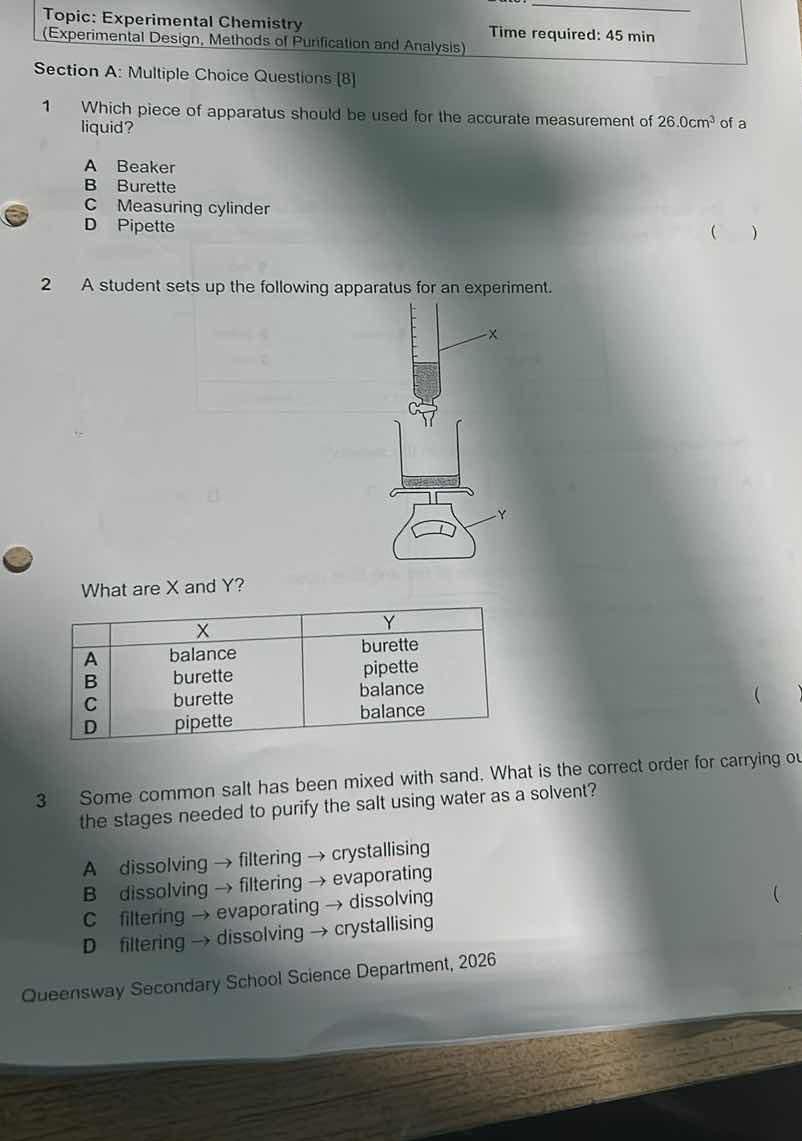
2 a student sets up the following apparatus for an experiment.
image of apparatus with x and y labels
what are x and y?
| x | y | |
| a | balance | burette |
| b | burette | pipette |
| c | burette | balance |
| d | pipette | balance |
( )
3 some common salt has been mixed with sand. what is the correct order for carrying out the stages needed to purify the salt using water as a solvent?
a dissolving → filtering → crystallising
b dissolving → filtering → evaporating
c filtering → evaporating → dissolving
d filtering → dissolving → crystallising
( )
queensway secondary school science department, 2026
Question 1
To measure 26.0 cm³ of liquid accurately: A beaker is for holding, not accurate measurement. A burette measures variable volumes (e.g., for titrations) with precision, can measure 26.0 cm³. A measuring cylinder has lower precision. A pipette is for fixed volumes (e.g., 25 cm³, 50 cm³), not 26.0. So burette (B) is correct.
X is a burette (used for liquid volume, has a tap), Y is a balance (used to weigh, the apparatus below the beaker looks like a balance). So X = burette, Y = balance, which matches option C.
To purify salt from sand: First, dissolve the mixture (salt dissolves, sand doesn't). Then filter (to remove sand). Then crystallise (to get pure salt crystals, or evaporate to get solid salt; but crystallising is more specific for salt). So order is dissolving → filtering → crystallising (option A) or evaporating, but crystallising is better for salt. So A is correct.

Snap & solve any problem in the app
Get step-by-step solutions on Sovi AI
Photo-based solutions with guided steps
Explore more problems and detailed explanations
B. Burette