QUESTION IMAGE
Question
topic 3 rational functions skills practice continued
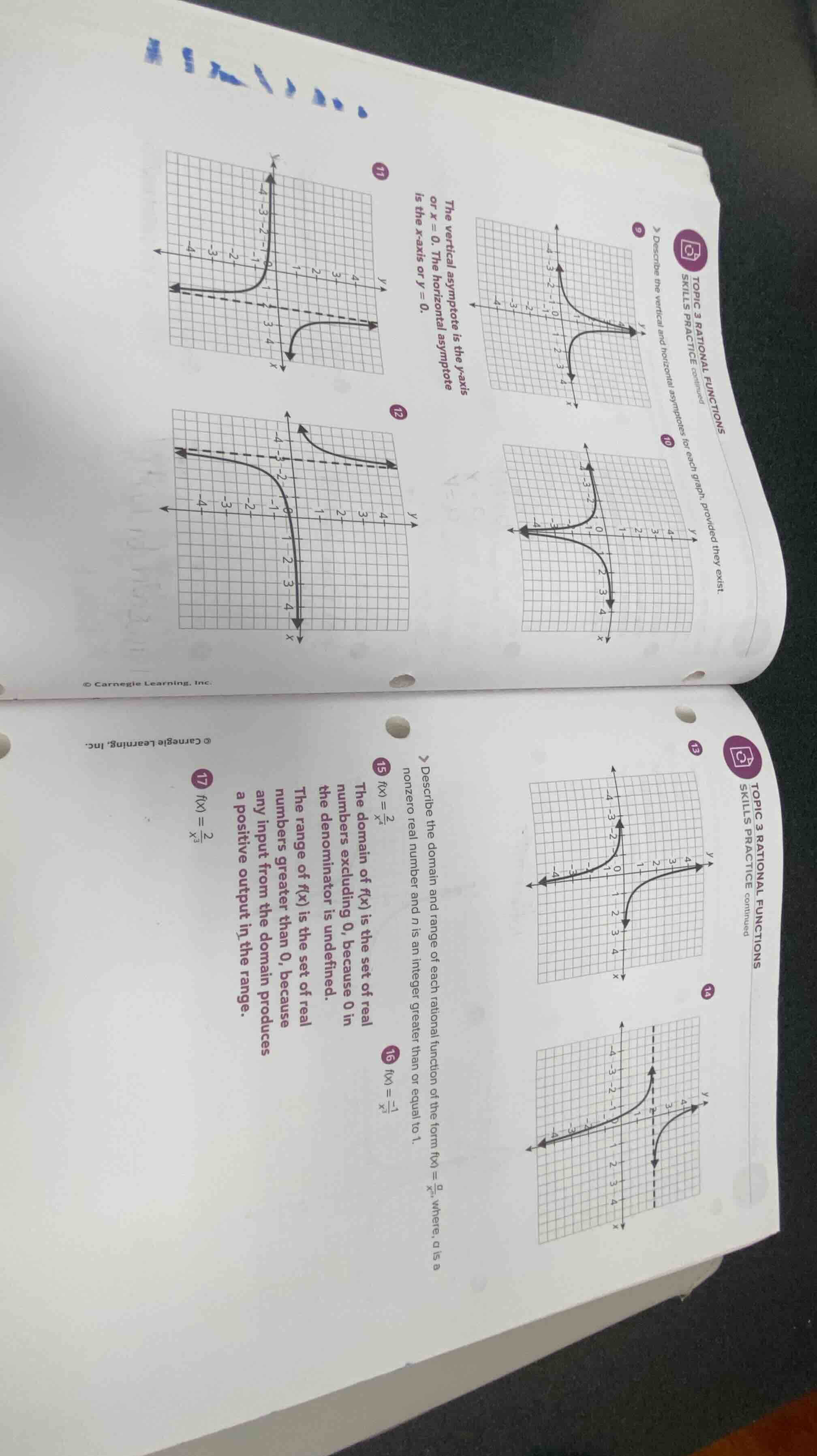
describe the vertical and horizontal asymptotes for each graph, provided they exist.
the vertical asymptote is the y - axis or ( x = 0 ). the horizontal asymptote is the x - axis or ( y = 0 ).
topic 3 rational functions skills practice continued
describe the domain and range of each rational function of the form ( f(x)=\frac{a}{x^{n}} ), where, ( a ) is a nonzero real number, and ( n ) is an integer greater than or equal to 1.
15 ( f(x)=\frac{2}{x^{2}} )
the domain of ( f(x) ) is the set of real numbers excluding 0, because 0 in the denominator is undefined.
the range of ( f(x) ) is the set of real numbers greater than 0, because any input from the domain produces a positive output in the range.
16 ( f(x)=\frac{-1}{x^{3}} )
17 ( f(x)=\frac{2}{x^{3}} )
To solve problems related to rational functions (like finding asymptotes, domain, range), we use concepts from Algebra (specifically, the subfield of Algebra dealing with functions, rational functions, and their graphs). Let's take an example from the given problems (e.g., describing asymptotes for a rational function graph):
Step 1: Identify Vertical Asymptote
A vertical asymptote occurs where the function is undefined (denominator = 0) and the graph approaches infinity/negative infinity. For a rational function graph, check where the graph has a vertical break (e.g., for \( y = \frac{k}{x} \), vertical asymptote is \( x = 0 \) (y-axis)).
Step 2: Identify Horizontal Asymptote
A horizontal asymptote is a horizontal line the graph approaches as \( x \to \pm\infty \). For \( y = \frac{k}{x} \), the horizontal asymptote is \( y = 0 \) (x-axis) because as \( |x| \) becomes very large, \( \frac{k}{x} \to 0 \).
For example, in the graph labeled "9" (top right), the vertical asymptote is \( x = 0 \) (y-axis, since the graph splits at \( x = 0 \)) and the horizontal asymptote is \( y = 0 \) (x-axis, since the graph approaches \( y = 0 \) as \( x \to \pm\infty \)).

Snap & solve any problem in the app
Get step-by-step solutions on Sovi AI
Photo-based solutions with guided steps
Explore more problems and detailed explanations
(for a typical graph like "9"):
Vertical asymptote: \( x = 0 \) (y - axis); Horizontal asymptote: \( y = 0 \) (x - axis)