QUESTION IMAGE
Question
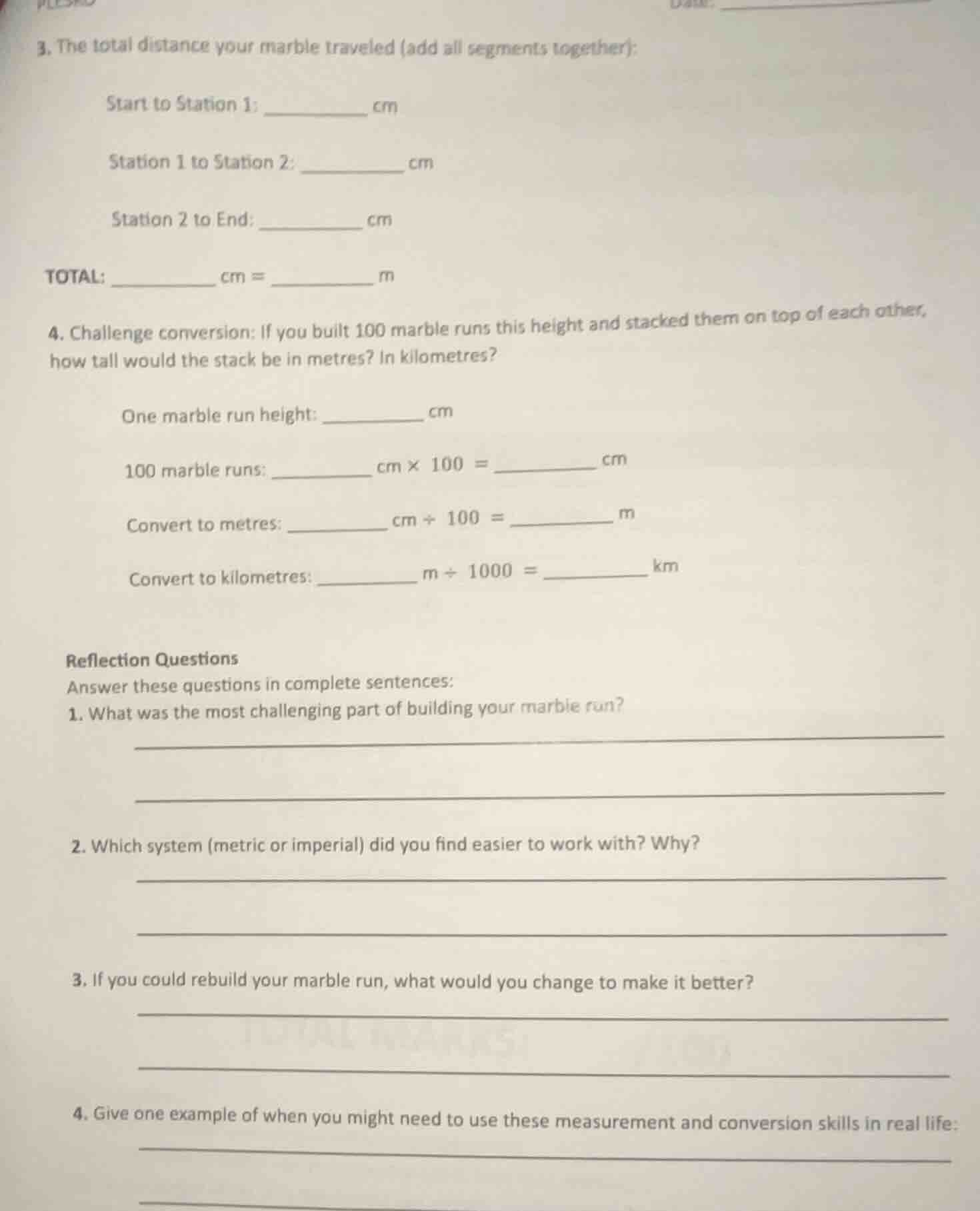
- the total distance your marble traveled (add all segments together):
start to station 1: ________ cm
station 1 to station 2: ________ cm
station 2 to end: ________ cm
total: ______ cm = ______ m
- challenge conversion: if you built 100 marble runs this height and stacked them on top of each other, how tall would the stack be in metres? in kilometres?
one marble run height: ________ cm
100 marble runs: ______ cm × 100 = ______ cm
convert to metres: ______ cm ÷ 100 = ______ m
convert to kilometres: ______ m ÷ 1000 = ______ km
reflection questions
answer these questions in complete sentences:
- what was the most challenging part of building your marble run?
_____________________________________________________
_____________________________________________________
- which system (metric or imperial) did you find easier to work with? why?
_____________________________________________________
_____________________________________________________
- if you could rebuild your marble run, what would you change to make it better?
_____________________________________________________
_____________________________________________________
- give one example of when you might need to use these measurement and conversion skills in real life:
_____________________________________________________
_____________________________________________________
To solve these problems, we'll assume some sample values for the distances (since the original problem has blanks, we'll use example numbers to demonstrate the process). Let's assume:
Problem 3: Total Distance of Marble Travel
Let's say:
- Start to Station 1: \( 50 \) cm
- Station 1 to Station 2: \( 40 \) cm
- Station 2 to End: \( 30 \) cm
Step 1: Calculate Total in Centimeters
To find the total distance in centimeters, we add the three segments together.
\[
50 + 40 + 30 = 120 \text{ cm}
\]
Step 2: Convert Centimeters to Meters
We know that \( 1 \text{ m} = 100 \text{ cm} \), so to convert centimeters to meters, we divide by 100.
\[
120 \div 100 = 1.2 \text{ m}
\]
Problem 4: Challenge Conversion (Using Sample Height)
Let's assume one marble run height is \( 100 \) cm (this is just a sample; the actual height would be from the marble run built).
Step 1: Calculate Total Height for 100 Runs in Centimeters
Multiply the height of one run by 100.
\[
100 \times 100 = 10000 \text{ cm}
\]
Step 2: Convert Total Height to Meters
Divide the total height in centimeters by 100 (since \( 1 \text{ m} = 100 \text{ cm} \)).
\[
10000 \div 100 = 100 \text{ m}
\]
Step 3: Convert Meters to Kilometers
We know that \( 1 \text{ km} = 1000 \text{ m} \), so divide the total height in meters by 1000.
\[
100 \div 1000 = 0.1 \text{ km}
\]
Reflection Questions (Sample Answers)
- What was the most challenging part...?
The most challenging part was ensuring the marble traveled smoothly between stations without getting stuck, as aligning the tracks perfectly required careful adjustment.
- Which system (metric/imperial) was easier?
The metric system was easier because conversions (like cm to m, m to km) are based on powers of 10, making calculations straightforward (e.g., dividing by 100 or 1000) compared to the imperial system’s more complex conversion factors (like inches to feet to yards).
- If you could rebuild...?
I would make the track steeper in some sections to ensure the marble moves faster and adjust the curves to be more gradual, reducing the chance of the marble derailing.
- Real-life example of measurement skills?
When baking, you might need to convert a recipe’s measurements (e.g., from milliliters to liters for a large batch) or when measuring fabric for sewing (converting centimeters to meters to determine how much material to buy).
Final Answers (Using Sample Values)
Problem 3:
- Total: \( \boldsymbol{120} \) cm \( = \boldsymbol{1.2} \) m (using sample values; replace with actual measurements).
Problem 4:
- One marble run height: \( \boldsymbol{100} \) cm (sample)
- 100 marble runs: \( \boldsymbol{100} \) cm \( \times 100 = \boldsymbol{10000} \) cm
- Convert to meters: \( \boldsymbol{10000} \) cm \( \div 100 = \boldsymbol{100} \) m
- Convert to kilometers: \( \boldsymbol{100} \) m \( \div 1000 = \boldsymbol{0.1} \) km
(Note: Replace the sample values with the actual measurements from your marble run to get accurate results.)

Snap & solve any problem in the app
Get step-by-step solutions on Sovi AI
Photo-based solutions with guided steps
Explore more problems and detailed explanations
To solve these problems, we'll assume some sample values for the distances (since the original problem has blanks, we'll use example numbers to demonstrate the process). Let's assume:
Problem 3: Total Distance of Marble Travel
Let's say:
- Start to Station 1: \( 50 \) cm
- Station 1 to Station 2: \( 40 \) cm
- Station 2 to End: \( 30 \) cm
Step 1: Calculate Total in Centimeters
To find the total distance in centimeters, we add the three segments together.
\[
50 + 40 + 30 = 120 \text{ cm}
\]
Step 2: Convert Centimeters to Meters
We know that \( 1 \text{ m} = 100 \text{ cm} \), so to convert centimeters to meters, we divide by 100.
\[
120 \div 100 = 1.2 \text{ m}
\]
Problem 4: Challenge Conversion (Using Sample Height)
Let's assume one marble run height is \( 100 \) cm (this is just a sample; the actual height would be from the marble run built).
Step 1: Calculate Total Height for 100 Runs in Centimeters
Multiply the height of one run by 100.
\[
100 \times 100 = 10000 \text{ cm}
\]
Step 2: Convert Total Height to Meters
Divide the total height in centimeters by 100 (since \( 1 \text{ m} = 100 \text{ cm} \)).
\[
10000 \div 100 = 100 \text{ m}
\]
Step 3: Convert Meters to Kilometers
We know that \( 1 \text{ km} = 1000 \text{ m} \), so divide the total height in meters by 1000.
\[
100 \div 1000 = 0.1 \text{ km}
\]
Reflection Questions (Sample Answers)
- What was the most challenging part...?
The most challenging part was ensuring the marble traveled smoothly between stations without getting stuck, as aligning the tracks perfectly required careful adjustment.
- Which system (metric/imperial) was easier?
The metric system was easier because conversions (like cm to m, m to km) are based on powers of 10, making calculations straightforward (e.g., dividing by 100 or 1000) compared to the imperial system’s more complex conversion factors (like inches to feet to yards).
- If you could rebuild...?
I would make the track steeper in some sections to ensure the marble moves faster and adjust the curves to be more gradual, reducing the chance of the marble derailing.
- Real-life example of measurement skills?
When baking, you might need to convert a recipe’s measurements (e.g., from milliliters to liters for a large batch) or when measuring fabric for sewing (converting centimeters to meters to determine how much material to buy).
Final Answers (Using Sample Values)
Problem 3:
- Total: \( \boldsymbol{120} \) cm \( = \boldsymbol{1.2} \) m (using sample values; replace with actual measurements).
Problem 4:
- One marble run height: \( \boldsymbol{100} \) cm (sample)
- 100 marble runs: \( \boldsymbol{100} \) cm \( \times 100 = \boldsymbol{10000} \) cm
- Convert to meters: \( \boldsymbol{10000} \) cm \( \div 100 = \boldsymbol{100} \) m
- Convert to kilometers: \( \boldsymbol{100} \) m \( \div 1000 = \boldsymbol{0.1} \) km
(Note: Replace the sample values with the actual measurements from your marble run to get accurate results.)