QUESTION IMAGE
Question
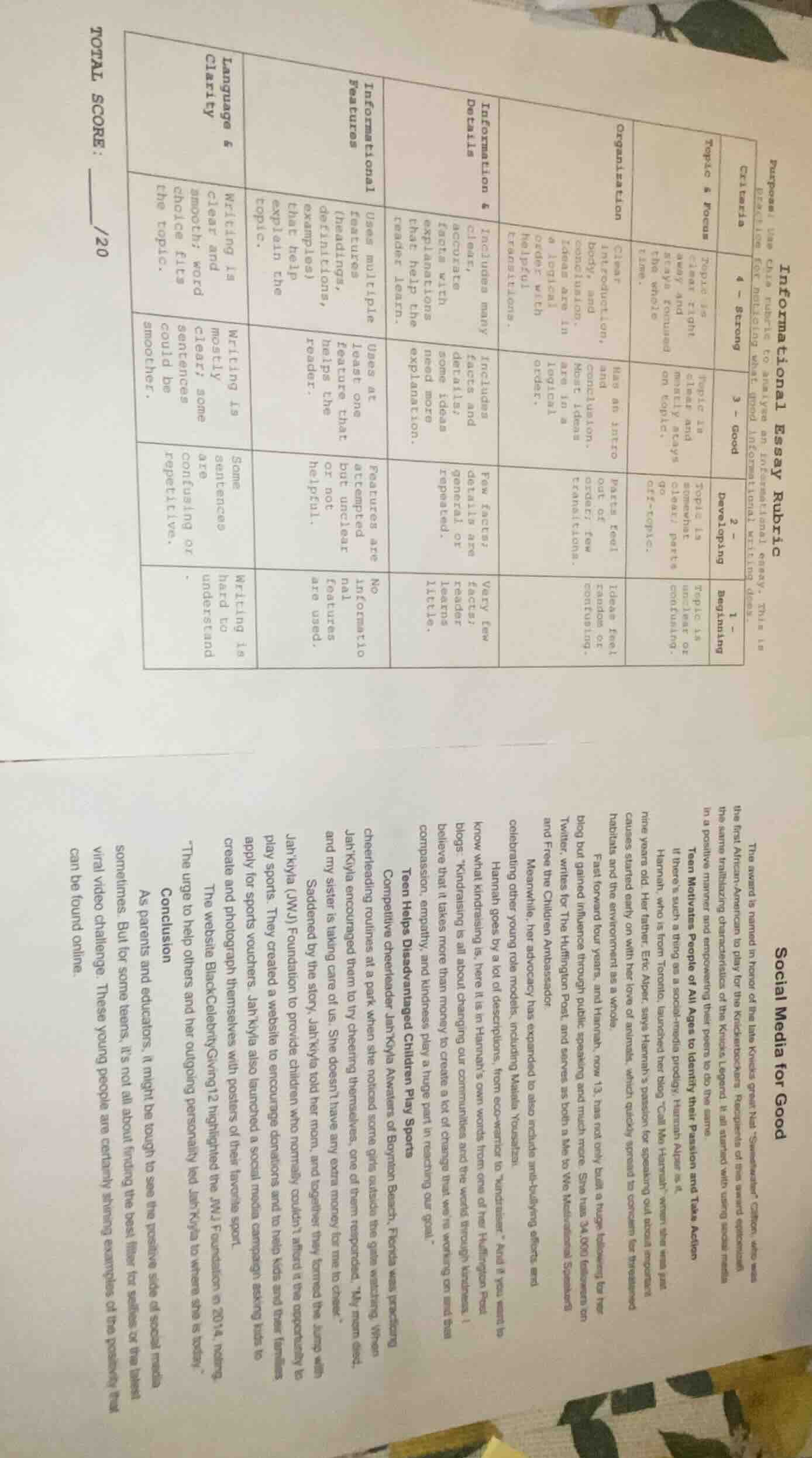
total score: ______/20
informational essay rubric
purpose: use this rubric to evaluate one public to analyze an informational writing essay. this is a tool for noticing what good informational writing does.
criteria
4 - strong
3 - good
2 - developing
1 - beginning
topic & focus
topic is clear, right away and focused the whole time.
topic is clear and mostly stays on topic.
topic is somewhat clear? parts go off - topic.
topic is unclear or confusing.
organization
clear introduction, body, and conclusion. ideas are in a logical order with helpful transitions.
has an intro and conclusion. most ideas are in a logical order.
parts feel out of order? few transitions.
ideas feel random or confusing.
information & details
includes many clear, accurate facts with explanations that help the reader learn.
includes facts and some ideas need more explanation.
few facts? details are general or repeated.
very few facts? reader learns little.
informational features
uses multiple features (headings, definitions, examples) that help explain the topic.
uses at least one feature that helps the reader.
features are attempted but unclear or not helpful.
no informational features are used.
language & clarity
writing is clear and smooth; word choice fits the topic.
writing is mostly clear; some sentences could be smoother.
some sentences are confusing or repetitive.
writing is hard to understand
social media for good
the award is named in honor of the late kwame owusu - bempah’s “somewhere only we know” children, who was the first african american to play for the knicks. legend has it all started with using social media the same trailblazing characteristics of the knicks’ greats. it all started with using social media in a positive manner and empowering their peers to do the same.
teen motivates people of all ages to identify their passion and take action
if there’s such a thing as a social - media prodigy, hannah alper is it. hannah, who is from toronto, launched her blog “call me hannah” when she was just nine years old. her father, eric alper, says hannah’s passion for speaking out about important causes started early on with her love of animals, which quickly spread to concern for threatened habitats and the environment as a whole.
fast forward four years, and hannah, now 13, has not only built a huge following on her blog but gained influence through public speaking and much more. she has 34,000 followers on twitter, writes for the huffington post, and serves as both a me to we media ambassador and free the children ambassador.
meanwhile, her advocacy has expanded to also include anti - bullying efforts and celebrating other young role models, including malala yousafzai.
hannah goes by a lot of descriptions, from eco - warrior to “kindness ambassador.” and it goes to show she knows what kind of kindness is, here it is in hannah’s own words from one of her huffington post blogs: “kindness is all about changing our communities and the world through kindness! i believe that it takes more than money to create a lot of change that we’re working on and compassion, empathy, and kindness play a huge part in reaching our goal.”
teen helps disadvantaged children play sports
competitive cheerleader jah’kyla alwaters of boynton beach, florida was practicing cheerleading routines at a park when she noticed some girls outside the gate watching. when jah’kyla encouraged them to try cheering themselves, one of them responded, “my mom died, and my sister is taking care of us. she doesn’t have any extra money for me to cheer.”
saddened by the story, jah’kyla told her mom, and together they formed the jump with jah’kyla (jwj) foundation to provide children who normally couldn’t afford it the opportunity to play sports. they created a website to encourage donations and to help kids and their families apply for sports vouchers. jah’kyla also launched a social media campaign asking kids to create and photograph themselves with posters of their favorite sport.
the website blackcelebritygiving12 highlighted the jwj foundation in 2014, noting “the urge to help others and her outgoing personality led jah’kyla to where she is today.”
conclusion
as parents and educators, it might be tough to see the positive side of social media sometimes. but for some teens, it’s not all about finding the best filter or the latest viral video challenge. these young people are certainly showing examples of the positive that can be found online.
To score the essay using the rubric, we analyze each category:
1. Criteria (4 - strong, 3 - good, 2 - developing, 1 - beginning)
- Topic & Focus: The topic (“Social Media for Good”) is clear, with a consistent focus on how teens use social media positively. This aligns with “3 - good” (clear and mostly stays on topic) or “4 - strong” (clear, right away, and focused). The essay introduces the topic, shares examples, and concludes on theme.
- Organization: It has an introduction (introduces the topic and examples), body (details about Hannah, Jah’Kyla, etc.), and conclusion (summarizes the positive impact). Ideas are in logical order with helpful transitions (e.g., “Fast forward four years...”, “As parents and educators...”). This fits “3 - good” (has intro, body, conclusion; ideas in logical order) or “4 - strong” (clear introduction, body, conclusion; ideas in order with helpful transitions).
- Information & Details: Includes many clear facts (e.g., Hannah’s origin, Jah’Kyla’s foundation, statistics like “34,000 followers”) with explanations (e.g., how their actions help others). This aligns with “3 - good” (includes facts and some ideas needing more explanation) or “4 - strong” (includes many clear facts with explanations).
- Informational Features: Uses multiple features (examples: Hannah’s advocacy, Jah’Kyla’s foundation; headings: implicit, like “Teen Motivates People...”, “Competitive cheerleader...”; details to explain the topic). This fits “3 - good” (uses at least one feature to help the reader) or “4 - strong” (uses multiple features).
- Language & Clarity: Writing is clear, with smooth word choice (e.g., “empowering,” “highlighted”) and fits the topic. Some sentences could be smoother, but overall coherent. This aligns with “3 - good” (mostly clear, some sentences could be smoother) or “4 - strong” (clear and smooth, word choice fits).
Scoring (Total /20)
If we rate each category as “3 - good” (3 points per category, 5 categories: \( 3 \times 5 = 15 \)) or “4 - strong” (4 points per category, \( 4 \times 5 = 20 \)). Given the essay’s clarity, organization, and detailed examples, it likely scores 16–18/20 (e.g., 4, 4, 4, 3, 3 = 18; or similar combinations). For a precise score, we’d align each rubric row:
- Topic & Focus: 4 (clear, focused, introduced early).
- Organization: 4 (clear intro, body, conclusion; logical order, transitions).
- Information & Details: 4 (many clear facts with explanations).
- Informational Features: 3 (uses examples, but headings are implicit; could use more explicit features).
- Language & Clarity: 3 (mostly clear, some sentences could flow better).
Total: \( 4 + 4 + 4 + 3 + 3 = 18 \).

Snap & solve any problem in the app
Get step-by-step solutions on Sovi AI
Photo-based solutions with guided steps
Explore more problems and detailed explanations
The essay likely scores \(\boldsymbol{18/20}\) (or a similar range, e.g., 16–19, based on strict rubric alignment).