QUESTION IMAGE
Question
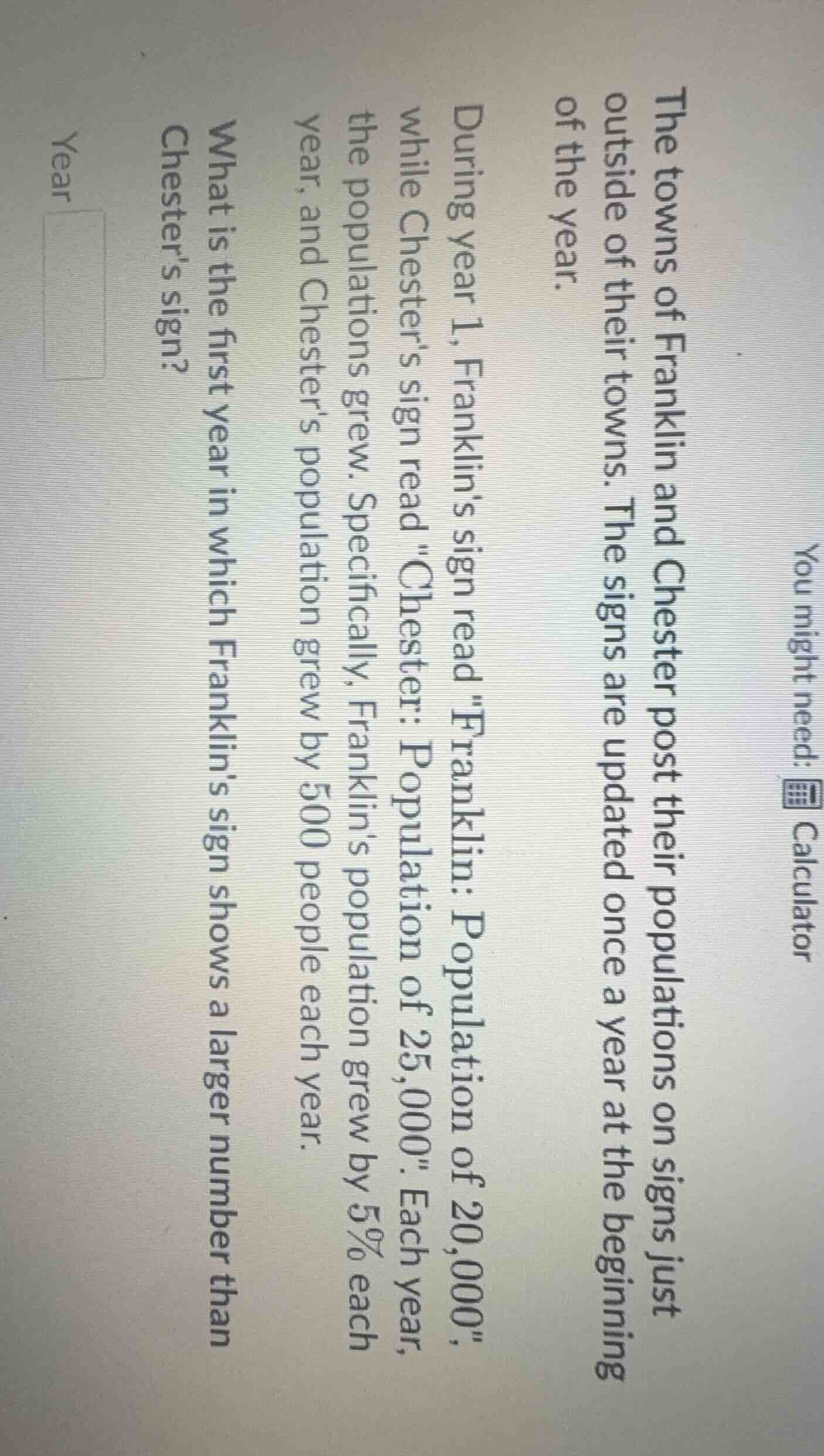
the towns of franklin and chester post their populations on signs just outside of their towns. the signs are updated once a year at the beginning of the year.
during year 1, franklins sign read \franklin: population of 20,000,\ while chesters sign read \chester: population of 25,000.\ each year, the populations grew. specifically, franklins population grew by 5% each year, and chesters population grew by 500 people each year.
what is the first year in which franklins sign shows a larger number than chesters sign?
year
Step 1: Define the population functions
Let \( t \) be the number of years after Year 1.
- Franklin's population: It grows by 500 people each year. Starting from 20,000 in Year 1, so \( F(t)=20000 + 500t \).
- Chester's population: It grows by 5% each year. Starting from 25,000 in Year 1, so \( C(t)=25000(1 + 0.05)^t=25000(1.05)^t \).
We need to find the smallest integer \( t\geq0 \) (where \( t = 0 \) is Year 1) such that \( F(t)>C(t) \).
Step 2: Test \( t = 0 \) (Year 1)
- \( F(0)=20000 + 500(0)=20000 \)
- \( C(0)=25000(1.05)^0 = 25000 \)
\( 20000<25000 \), so not valid.
Step 3: Test \( t = 1 \) (Year 2)
- \( F(1)=20000 + 500(1)=20500 \)
- \( C(1)=25000(1.05)^1=25000\times1.05 = 26250 \)
\( 20500<26250 \), not valid.
Step 4: Test \( t = 2 \) (Year 3)
- \( F(2)=20000 + 500(2)=21000 \)
- \( C(2)=25000(1.05)^2=25000\times1.1025 = 27562.5 \)
\( 21000<27562.5 \), not valid.
Step 5: Test \( t = 3 \) (Year 4)
- \( F(3)=20000 + 500(3)=21500 \)
- \( C(3)=25000(1.05)^3=25000\times1.157625 = 28940.625 \)
\( 21500<28940.625 \), not valid.
Step 6: Test \( t = 4 \) (Year 5)
- \( F(4)=20000 + 500(4)=22000 \)
- \( C(4)=25000(1.05)^4=25000\times1.21550625 = 30387.65625 \)
\( 22000<30387.65625 \), not valid.
Step 7: Test \( t = 5 \) (Year 6)
- \( F(5)=20000 + 500(5)=22500 \)
- \( C(5)=25000(1.05)^5=25000\times1.2762815625 = 31907.0390625 \)
\( 22500<31907.0390625 \), not valid.
Wait, this approach seems wrong. Wait, maybe I mixed up the growth: Franklin's growth is linear (arithmetic sequence), Chester's is exponential (geometric sequence). Wait, actually, Franklin starts at 20,000 and grows by 500, Chester starts at 25,000 and grows by 5% (so exponential decay? No, 5% growth, but starting higher. Wait, maybe I made a mistake in the direction. Wait, the problem says "Franklin's sign shows a larger number than Chester's sign". So we need \( F(t)>C(t) \), but Franklin starts lower. Wait, maybe the initial populations are reversed? Wait, the problem says: "During year 1, Franklin's sign read 'Franklin: Population of 20,000,' while Chester's sign read 'Chester: Population of 25,000.'" So Franklin has 20k, Chester 25k. Franklin grows by 500/year (linear), Chester grows by 5%/year (exponential growth). Wait, but exponential growth with 5% on 25k: \( 25000(1.05)^t \), and linear growth: \( 20000 + 500t \). Wait, but exponential growth will outpace linear growth eventually, but here Franklin starts lower. Wait, no—wait, 5% of 25k is 1250, which is more than 500. So Chester's population is growing faster (1250 in first year, then more) than Franklin's (500/year). So Franklin's population will never exceed Chester's? That can't be. Wait, maybe I misread the growth rates. Wait, the problem says: "Franklin's population grew by 500 people each year, and Chester's population grew by 5% each year." Wait, 5% of 25,000 is 1250, which is more than 500. So Chester's population is increasing by 1250 in the first year, 250001.05=26250 (increase 1250), then 262501.05=27562.5 (increase 1312.5), etc. Franklin's increases by 500 each year. So Chester's growth is faster. So Franklin's population will never be larger than Chester's? But that contradicts the problem's question. Wait, maybe the initial populations are reversed? Maybe Franklin is 25,000 and Chester is 20,000? Let me recheck the problem:
"The towns of Franklin and Chester post their populations on signs just outside of their towns. The signs are updated once a year at the beginning of the year. During year 1, Franklin's sign read 'Franklin: Population of 20,000,' while Chester's si…

Snap & solve any problem in the app
Get step-by-step solutions on Sovi AI
Photo-based solutions with guided steps
Explore more problems and detailed explanations
The first year is \(\boldsymbol{9}\) (Year 9).