QUESTION IMAGE
Question
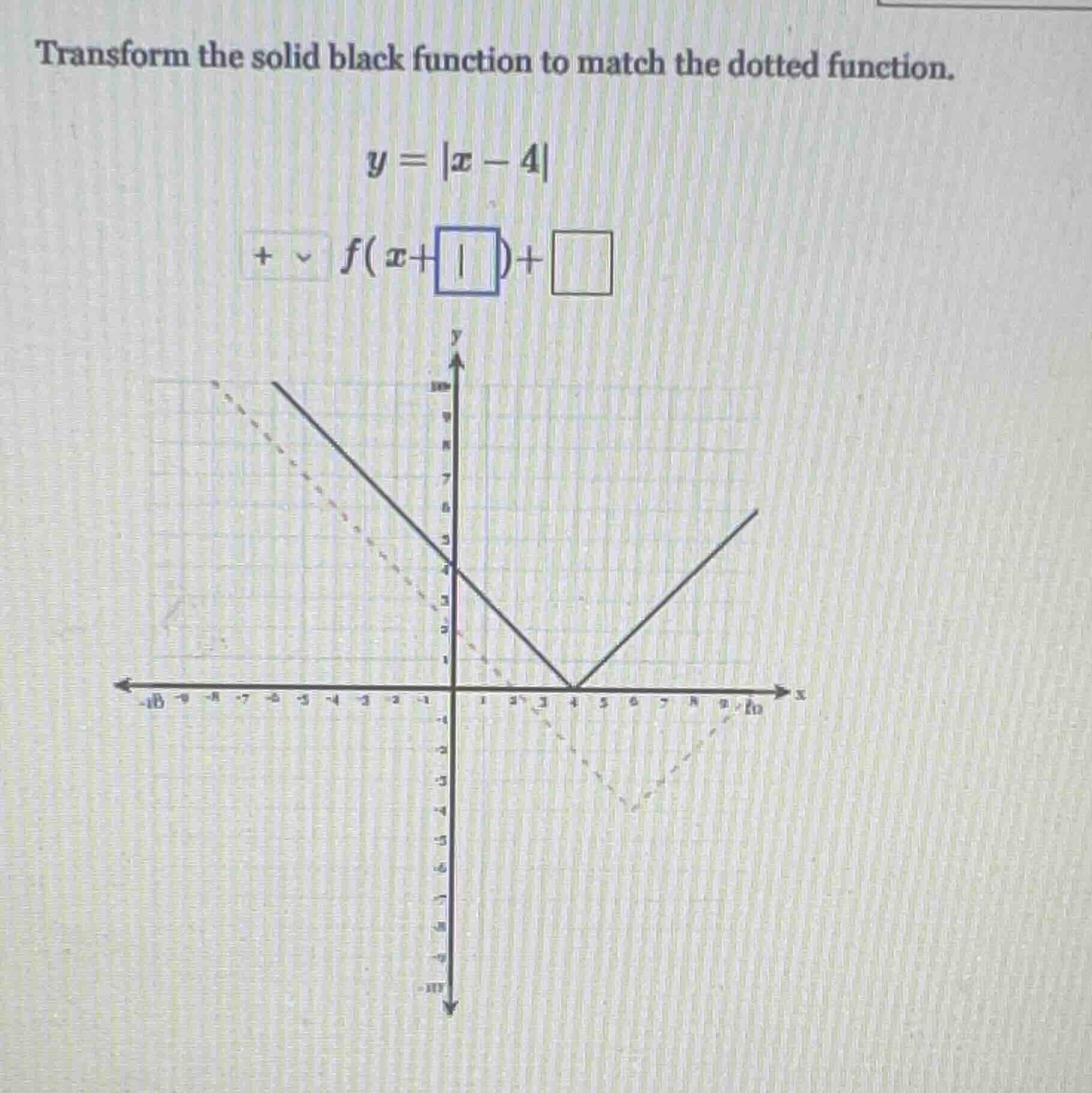
transform the solid black function to match the dotted function.
$y = |x - 4|$
$+ \quad f(x + \boxed{1}) + \square$
Step1: Analyze horizontal shift
The original function is \( f(x)=|x - 4| \), with vertex at \( (4,0) \). The dotted function's vertex seems to shift left. For \( f(x + h) \), a shift left by \( h \) units. Here, to shift from \( x=4 \) to \( x = 4 - 5= - 1? \) Wait, no, looking at the graph, the solid function \( y = |x - 4| \) (black) has vertex at \( (4,0) \). The dotted function (let's check the y - intercept: solid has y - intercept at \( x = 0 \), \( y=|0 - 4| = 4 \); dotted at \( x = 0 \), \( y = 2 \)? Wait, no, maybe better to check the vertex. Wait, the solid function is \( y=|x - 4| \), vertex at \( (4,0) \). The dotted function: let's see the transformation. The form is \( f(x + a)+b \), where \( f(x)=|x - 4| \). So \( f(x + a)=|(x + a)-4|=|x+(a - 4)| \). Now, looking at the vertical shift: the solid function at \( x = 0 \) is \( y = 4 \), the dotted at \( x = 0 \) is \( y = 2 \)? Wait, no, the graph: solid black is \( y=|x - 4| \), dotted is a transformation. Wait, the first box is for the horizontal shift (inside the function) and the second for vertical. Let's recall function transformations: \( f(x + h) \) shifts left by \( h \) units, \( f(x)+k \) shifts up by \( k \) units (down if \( k \) negative).
First, find the vertex of solid: \( (4,0) \). Vertex of dotted: let's see the dotted line. From the graph, the dotted function's vertex seems to be at \( (3, - 2) \)? Wait, no, maybe I misread. Wait, the solid function is \( y = |x - 4| \), so vertex at \( (4,0) \). The dotted function: let's check the transformation. Let's take a point on solid: \( (4,0) \), \( (0,4) \), \( (8,4) \). On dotted: let's see, when \( x = 3 \), what's \( y \)? Wait, maybe the horizontal shift: to get from \( f(x)=|x - 4| \) to \( f(x + a) \), the vertex moves from \( x = 4 \) to \( x = 4 - a \) (since \( f(x + a) \) has vertex at \( x=-a + 4 \)? Wait, no: \( f(x)=|x - h| \) has vertex at \( x = h \). So \( f(x + a)=|(x + a)-4|=|x+(a - 4)| \), vertex at \( x=4 - a \). So if we want to shift left by 5? No, wait the first box is 1? Wait, the user's image has the first box as 1, maybe a typo? Wait, no, let's re - examine. Wait, the problem is to transform \( y = |x - 4| \) (solid) to dotted. Let's look at the vertical shift: the solid at \( x = 0 \) is \( y = 4 \), dotted at \( x = 0 \) is \( y = 2 \)? Wait, no, the graph: solid black crosses y - axis at 4, dotted at 2? Wait, no, the dotted line at \( x = 0 \) is at \( y = 2 \)? Wait, maybe the vertical shift is - 2? Wait, no, let's think again. Wait, the function is \( f(x)=|x - 4| \), and we need to write \( f(x + a)+b \). Let's find \( a \) and \( b \).
Take the vertex of solid: \( (4,0) \). Let's find the vertex of dotted. From the graph, the dotted function's vertex seems to be at \( (3, - 2) \)? Wait, no, maybe the dotted function is \( y=|x - 3|-2 \)? Wait, no, \( f(x)=|x - 4| \), so \( f(x + 1)=|(x + 1)-4|=|x - 3| \), then \( f(x + 1)+b \). If we want to shift down by 2, then \( b=-2 \). Wait, let's check \( x = 0 \): \( f(0 + 1)+b=|0 - 3|+b = 3 + b \). Solid at \( x = 0 \) is 4, dotted at \( x = 0 \) is 2? Wait, 3 + b = 2 ⇒ b=-1? No, maybe I made a mistake. Wait, the solid function is \( y = |x - 4| \), so when \( x = 0 \), \( y = 4 \). The dotted function at \( x = 0 \) is \( y = 2 \), so the vertical shift is \( 2-4=-2 \). The horizontal shift: the vertex of solid is \( (4,0) \), vertex of dotted: let's see, if we shift left by 1 (so \( a = 1 \)), then vertex of \( f(x + 1) \) is \( x=4 - 1 = 3 \), so \( (3,0) \), then shift down by 2, so \( (3,-2) \). Let's check \( x = 3 \): \(…

Snap & solve any problem in the app
Get step-by-step solutions on Sovi AI
Photo-based solutions with guided steps
Explore more problems and detailed explanations
The second box should be filled with \(-2\), so the transformation is \(f(x + 1)-2\) (or \(f(x + 1)+(-2)\)). So the value for the second box is \(\boldsymbol{-2}\).