QUESTION IMAGE
Question
transformations of functions
score 0.5 penalty: 1 off
question
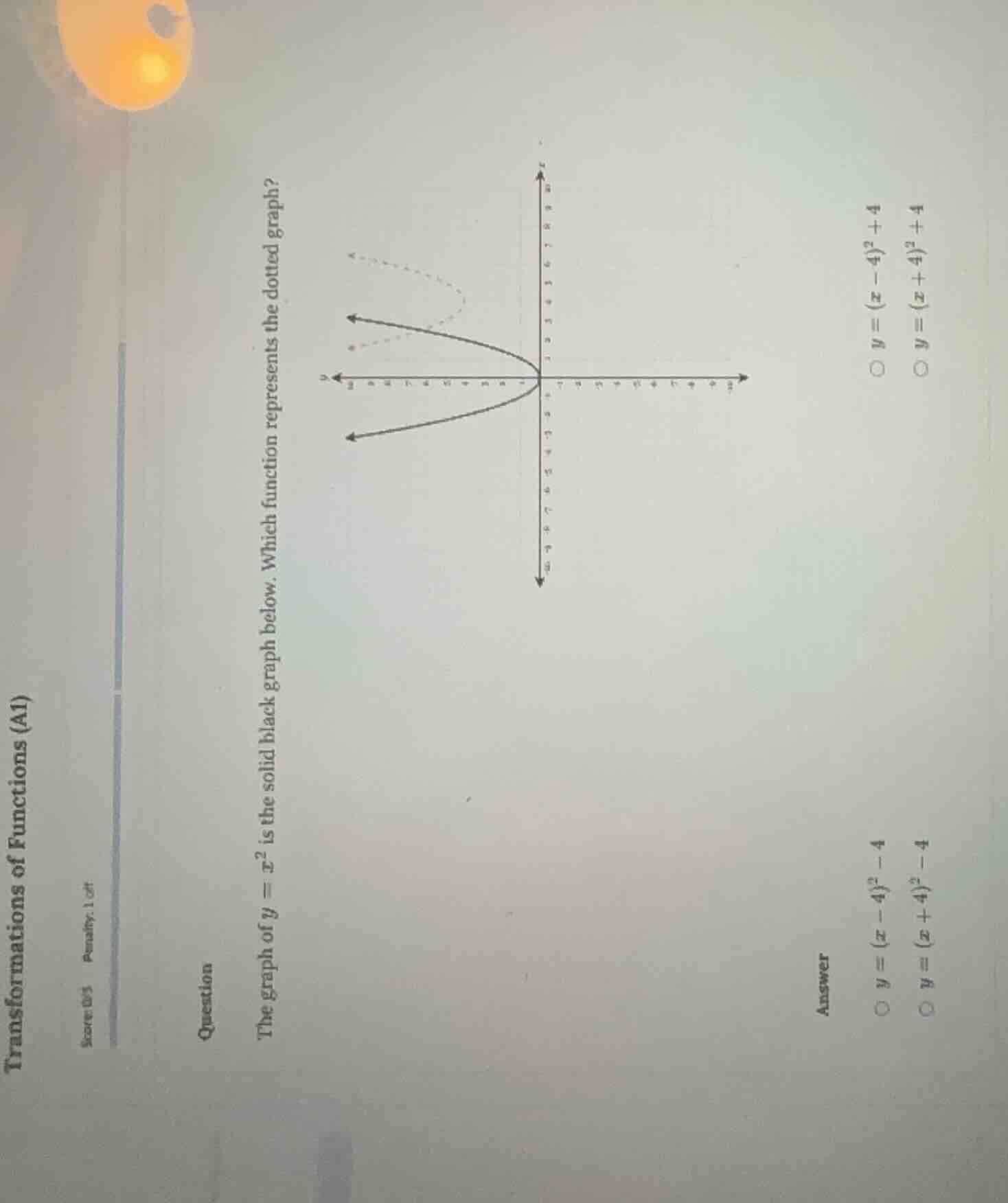
the graph of ( y = x^2 ) is the solid black graph. which function represents the dotted graph?
answer
( circ y = (x - 4)^2 - 4 )
( circ y = (x + 4)^2 - 4 )
( circ y = (x - 4)^2 + 4 )
( circ y = (x + 4)^2 + 4 )
Step1: Analyze the parent function
The parent function is \( y = x^2 \), which has its vertex at the origin \((0,0)\).
Step2: Analyze the transformation
The dotted graph appears to be a horizontal shift of the parent function \( y = x^2 \). For a quadratic function in the form \( y=(x - h)^2 + k \), the vertex is at \((h,k)\). The dotted graph's vertex seems to be at \((4,0)\) (since it's shifted 4 units to the right from the origin). So the function should be \( y=(x - 4)^2 + 4 \)? Wait, no, wait. Wait, looking at the graph, the solid is \( y = x^2 \) (vertex at (0,0)). The dotted graph: let's check the vertex. Wait, maybe I misread. Wait, the options: let's re - evaluate. Wait, the solid is \( y=x^2 \) (vertex (0,0)). The dotted graph: if we look at the options, the function \( y=(x - 4)^2+4 \) would have vertex at (4,4)? No, wait, maybe the dotted graph is a shift. Wait, no, the original solid is \( y = x^2 \) (vertex (0,0)). The dotted graph: let's see the options. Wait, the correct transformation: if the dotted graph is a horizontal shift to the right by 4 units and vertical shift up by 4? No, wait, maybe the vertex of the dotted graph is at (4,4)? Wait, no, looking at the graph, the solid is \( y = x^2 \) (vertex (0,0)). The dotted graph: let's check the options. The function \( y=(x - 4)^2+4 \) has vertex at (4,4). But maybe I made a mistake. Wait, no, the solid is \( y=x^2 \) (vertex (0,0)). The dotted graph: if we shift the graph of \( y = x^2 \) 4 units to the right (so replace x with x - 4) and 4 units up (add 4). So the function is \( y=(x - 4)^2+4 \). Wait, but let's check the options. The options are:
- \( y=(x - 4)^2-4 \)
- \( y=(x + 4)^2-4 \)
- \( y=(x - 4)^2+4 \)
- \( y=(x + 4)^2+4 \)
Wait, maybe I misread the graph. Wait, the solid is \( y = x^2 \) (vertex (0,0)). The dotted graph: if the vertex of the dotted graph is at (4,4), then the function is \( y=(x - 4)^2+4 \), because for \( y=(x - h)^2 + k \), h is the horizontal shift (right if h positive) and k is vertical shift (up if k positive). So if the vertex moves from (0,0) to (4,4), then h = 4 and k = 4, so the function is \( y=(x - 4)^2+4 \).
Step3: Confirm the function
Among the given options, the function \( y=(x - 4)^2+4 \) matches the transformation (shift 4 units right and 4 units up) of the parent function \( y = x^2 \) to get the dotted graph.

Snap & solve any problem in the app
Get step-by-step solutions on Sovi AI
Photo-based solutions with guided steps
Explore more problems and detailed explanations
\( y=(x - 4)^2+4 \) (the option with \( y=(x - 4)^2+4 \))