QUESTION IMAGE
Question
translations- a transformation in which each point of a figure moves the same
____ and in the same ____, the
corresponding angles are ____ and the corresponding sides are ____.
look at the graph below. record the coordinate pairs for the pre - image. when a
point has been transformed it is labeled with a symbol called ______. for
example a ____, b __ c ____ if two transformations have been
performed it is called ______.
pre - image (original
image)
a ( , )
b ( , )
c ( , )
translation rule
(x + 5, y + 2)
a ( , )
b ( , )
c ( , )
in words, describe the translation:
translation rule
(x + 8, y - 8)
a ( , )
b ( , )
c ( , )
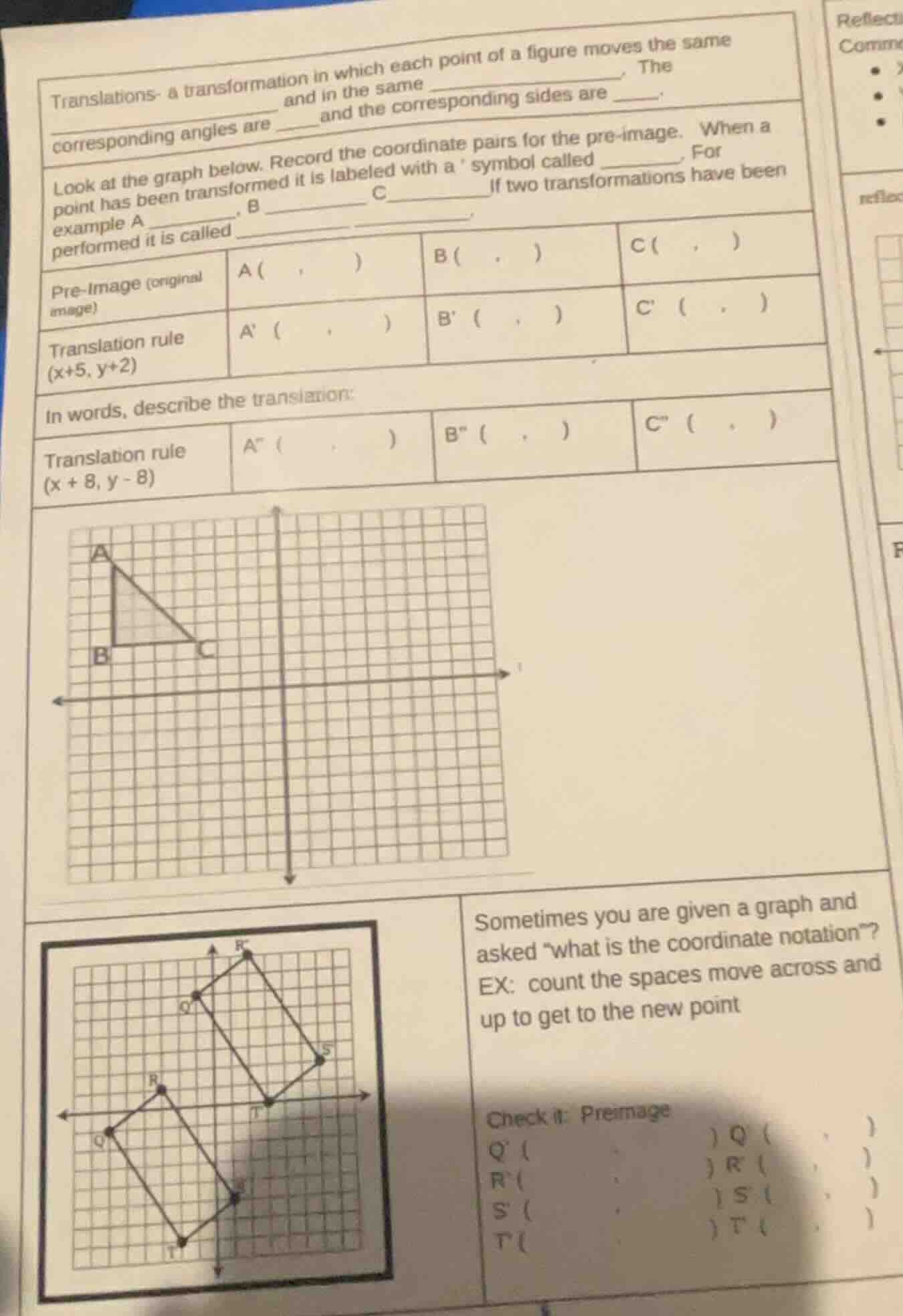
(graph of a triangle with points a, b, c and another graph of a quadrilateral with points q, r, s, t and their transformed versions)
sometimes you are given a graph and
asked “what is the coordinate notation”?
ex: count the spaces move across and
up to get to the new point
check it: preimage
q ( , ) q ( , )
r ( , ) r ( , )
s ( , ) s ( , )
t ( , ) t ( , )
Part 1: Filling in the Blanks about Translations
for Translations Definition:
A translation is a transformation where each point of a figure moves the same distance and in the same direction. In a translation, corresponding angles are congruent (equal in measure) and corresponding sides are congruent (equal in length) because translations preserve the shape and size of the figure.
for Transformed Points:
When a point is transformed, it is labeled with a ' symbol called a prime (e.g., \( A' \) is read as "A prime"). If two transformations are performed, the image is called a double prime (e.g., \( A'' \)).
Part 2: Coordinates for the Pre - Image (Triangle \( ABC \))
To find the coordinates of the pre - image, we look at the graph. Let's assume the grid has the origin \((0,0)\) at the intersection of the x - and y - axes.
- Point \( A \): Looking at the graph, if we count the units from the origin, let's say \( A \) is at \((-9, 5)\) (we move 9 units left on the x - axis (negative x - direction) and 5 units up on the y - axis).
- Point \( B \): \( B \) is directly below \( A \), so it has the same x - coordinate as \( A \) and a lower y - coordinate. So \( B \) is at \((-9, 1)\).
- Point \( C \): \( C \) is to the right of \( B \), so it has the same y - coordinate as \( B \) and a larger x - coordinate. So \( C \) is at \((-5, 1)\).
Part 3: Applying the First Translation Rule \((x + 5, y+2)\)
The translation rule \((x + 5, y + 2)\) means we add 5 to the x - coordinate and 2 to the y - coordinate of each pre - image point.
- For \( A(-9, 5) \):
New x - coordinate: \(-9+5=-4\)
New y - coordinate: \(5 + 2=7\)
So \( A'(-4, 7) \)
- For \( B(-9, 1) \):
New x - coordinate: \(-9+5=-4\)
New y - coordinate: \(1+2 = 3\)
So \( B'(-4, 3) \)
- For \( C(-5, 1) \):
New x - coordinate: \(-5+5 = 0\)
New y - coordinate: \(1+2=3\)
So \( C'(0, 3) \)
Part 4: Describing the Translation \((x + 5, y + 2)\)
In words, the translation \((x + 5, y+2)\) means the figure is moved 5 units to the right (because we add 5 to the x - coordinate) and 2 units up (because we add 2 to the y - coordinate).
Part 5: Applying the Second Translation Rule \((x + 8, y-8)\) to \( A', B', C' \)
We apply the rule \((x + 8, y - 8)\) to the coordinates of \( A', B', C' \).
- For \( A'(-4, 7) \):
New x - coordinate: \(-4+8 = 4\)
New y - coordinate: \(7-8=-1\)
So \( A''(4, -1) \)
- For \( B'(-4, 3) \):
New x - coordinate: \(-4+8 = 4\)
New y - coordinate: \(3-8=-5\)
So \( B''(4, -5) \)
- For \( C'(0, 3) \):
New x - coordinate: \(0+8 = 8\)
New y - coordinate: \(3-8=-5\)
So \( C''(8, -5) \)
Final Answers (Filled Blanks and Coordinates)
Translations Definition Blanks:
- distance, direction, congruent, congruent
Transformed Points Blanks:
- prime, \( A' \), \( B' \), \( C' \), double prime
Pre - Image Coordinates:
- \( A(-9, 5) \), \( B(-9, 1) \), \( C(-5, 1) \)
First Translation (\(x + 5, y + 2\)) Coordinates:
- \( A'(-4, 7) \), \( B'(-4, 3) \), \( C'(0, 3) \)
Translation Description:
- 5 units to the right and 2 units up
Second Translation (\(x + 8, y - 8\)) Coordinates:
- \( A''(4, -1) \), \( B''(4, -5) \), \( C''(8, -5) \)

Snap & solve any problem in the app
Get step-by-step solutions on Sovi AI
Photo-based solutions with guided steps
Explore more problems and detailed explanations
for Transformed Points:
When a point is transformed, it is labeled with a ' symbol called a prime (e.g., \( A' \) is read as "A prime"). If two transformations are performed, the image is called a double prime (e.g., \( A'' \)).
Part 2: Coordinates for the Pre - Image (Triangle \( ABC \))
To find the coordinates of the pre - image, we look at the graph. Let's assume the grid has the origin \((0,0)\) at the intersection of the x - and y - axes.
- Point \( A \): Looking at the graph, if we count the units from the origin, let's say \( A \) is at \((-9, 5)\) (we move 9 units left on the x - axis (negative x - direction) and 5 units up on the y - axis).
- Point \( B \): \( B \) is directly below \( A \), so it has the same x - coordinate as \( A \) and a lower y - coordinate. So \( B \) is at \((-9, 1)\).
- Point \( C \): \( C \) is to the right of \( B \), so it has the same y - coordinate as \( B \) and a larger x - coordinate. So \( C \) is at \((-5, 1)\).
Part 3: Applying the First Translation Rule \((x + 5, y+2)\)
The translation rule \((x + 5, y + 2)\) means we add 5 to the x - coordinate and 2 to the y - coordinate of each pre - image point.
- For \( A(-9, 5) \):
New x - coordinate: \(-9+5=-4\)
New y - coordinate: \(5 + 2=7\)
So \( A'(-4, 7) \)
- For \( B(-9, 1) \):
New x - coordinate: \(-9+5=-4\)
New y - coordinate: \(1+2 = 3\)
So \( B'(-4, 3) \)
- For \( C(-5, 1) \):
New x - coordinate: \(-5+5 = 0\)
New y - coordinate: \(1+2=3\)
So \( C'(0, 3) \)
Part 4: Describing the Translation \((x + 5, y + 2)\)
In words, the translation \((x + 5, y+2)\) means the figure is moved 5 units to the right (because we add 5 to the x - coordinate) and 2 units up (because we add 2 to the y - coordinate).
Part 5: Applying the Second Translation Rule \((x + 8, y-8)\) to \( A', B', C' \)
We apply the rule \((x + 8, y - 8)\) to the coordinates of \( A', B', C' \).
- For \( A'(-4, 7) \):
New x - coordinate: \(-4+8 = 4\)
New y - coordinate: \(7-8=-1\)
So \( A''(4, -1) \)
- For \( B'(-4, 3) \):
New x - coordinate: \(-4+8 = 4\)
New y - coordinate: \(3-8=-5\)
So \( B''(4, -5) \)
- For \( C'(0, 3) \):
New x - coordinate: \(0+8 = 8\)
New y - coordinate: \(3-8=-5\)
So \( C''(8, -5) \)
Final Answers (Filled Blanks and Coordinates)
Translations Definition Blanks:
- distance, direction, congruent, congruent
Transformed Points Blanks:
- prime, \( A' \), \( B' \), \( C' \), double prime
Pre - Image Coordinates:
- \( A(-9, 5) \), \( B(-9, 1) \), \( C(-5, 1) \)
First Translation (\(x + 5, y + 2\)) Coordinates:
- \( A'(-4, 7) \), \( B'(-4, 3) \), \( C'(0, 3) \)
Translation Description:
- 5 units to the right and 2 units up
Second Translation (\(x + 8, y - 8\)) Coordinates:
- \( A''(4, -1) \), \( B''(4, -5) \), \( C''(8, -5) \)