QUESTION IMAGE
Question
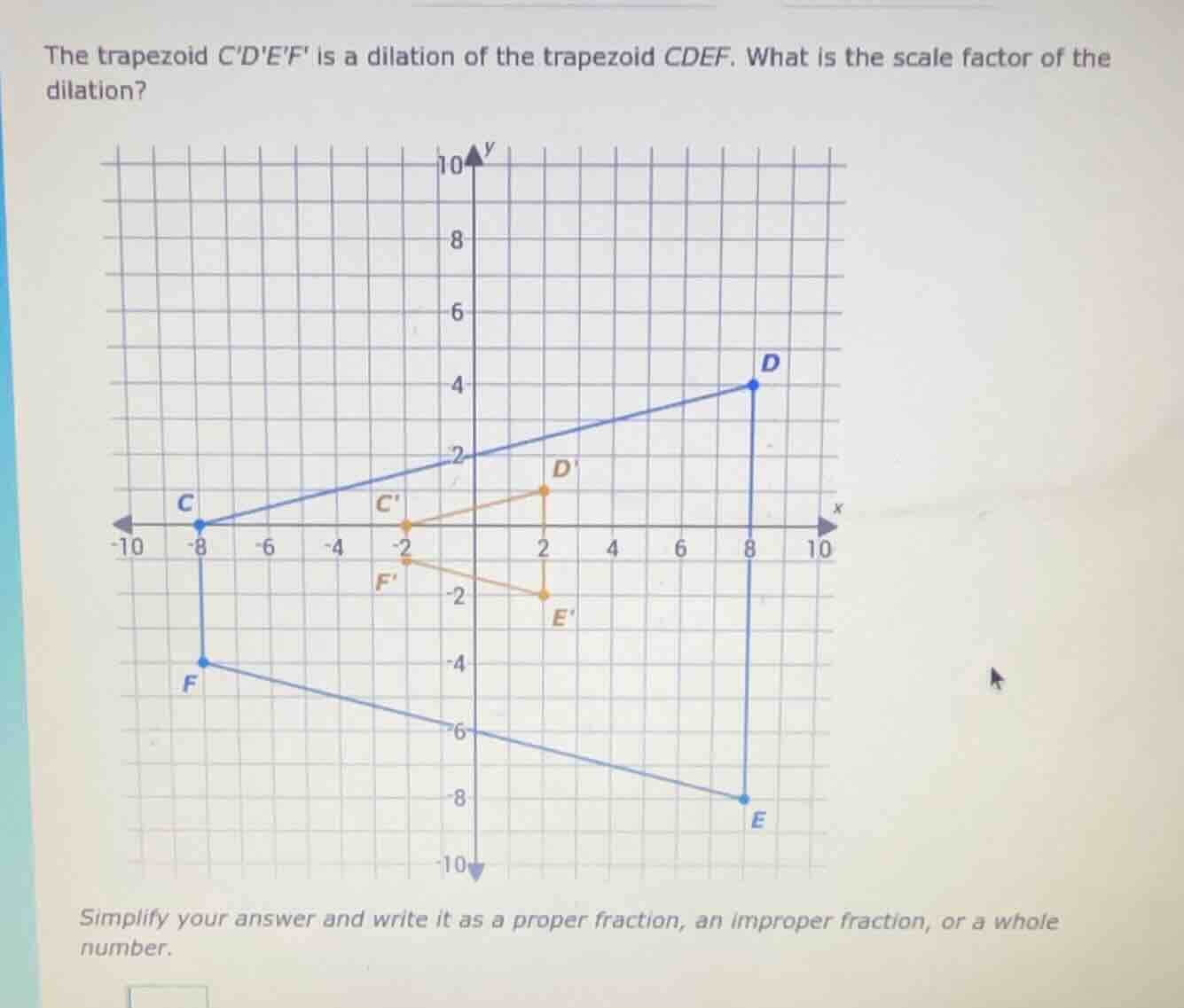
the trapezoid cdef is a dilation of the trapezoid cdef. what is the scale factor of the dilation? simplify your answer and write it as a proper fraction, an improper fraction, or a whole number.
Step1: Find coordinates of corresponding points
First, identify corresponding points of the original trapezoid \( CDEF \) and the dilated trapezoid \( C'D'E'F' \). Let's take point \( D \) and \( D' \).
- Coordinates of \( D \): \( (8, 4) \)
- Coordinates of \( D' \): \( (2, 1) \) (Wait, no, looking at the graph, let's check another pair. Wait, maybe \( C \) and \( C' \).
- Coordinates of \( C \): \( (-8, 0) \)
- Coordinates of \( C' \): \( (-2, 0) \)
Step2: Calculate the scale factor
The scale factor \( k \) of a dilation is given by the ratio of the length of a side (or the distance from the center) of the image to the original. For a dilation, the scale factor can be found by dividing the coordinate of the image point by the coordinate of the original point (assuming the center of dilation is the origin, but let's check the horizontal distance from \( C \) to \( C' \).
The distance from the origin for \( C \) in x - coordinate: \( | - 8|=8 \), for \( C' \): \( | - 2| = 2 \).
Scale factor \( k=\frac{\text{Length of } C'D'}{\text{Length of } CD}=\frac{\text{Coordinate of } C' \text{ (x - axis)}}{\text{Coordinate of } C \text{ (x - axis)}}=\frac{2}{8}=\frac{1}{4} \)? Wait, no, wait. Wait, let's check the vertical side. Let's take \( D \) and \( E \).
- \( D=(8,4) \), \( E=(8, - 8) \). The length of \( DE \) is \( |4-(-8)| = 12 \).
- \( D'=(2,1) \), \( E'=(2, - 2) \). The length of \( D'E' \) is \( |1-(-2)|=3 \).
Now, scale factor \( k=\frac{\text{Length of } D'E'}{\text{Length of } DE}=\frac{3}{12}=\frac{1}{4} \)? Wait, no, wait. Wait, maybe I made a mistake in coordinates. Wait, looking at the graph, \( D \) is at \( (8,4) \), \( D' \) is at \( (2,1) \)? Wait, no, the orange point \( D' \) seems to be at \( (2,1) \)? Wait, no, let's check the x - coordinates. From \( C(-8,0) \) to \( C'(-2,0) \): the change in x - coordinate is from - 8 to - 2. The ratio of the x - coordinates (assuming center of dilation is the origin? Wait, no, maybe the center of dilation is the origin. Let's check the ratio of the coordinates. For point \( C(-8,0) \) and \( C'(-2,0) \), the scale factor \( k=\frac{-2}{-8}=\frac{1}{4} \). For point \( D(8,4) \) and \( D'(2,1) \), \( k = \frac{2}{8}=\frac{1}{4} \) and \( \frac{1}{4} \). Let's confirm with another point. \( E(8,-8) \) and \( E'(2,-2) \): \( \frac{2}{8}=\frac{1}{4} \) and \( \frac{-2}{-8}=\frac{1}{4} \). So the scale factor is \( \frac{1}{4} \)? Wait, no, wait, maybe I got the direction wrong. Wait, the original trapezoid \( CDEF \) is larger, and \( C'D'E'F' \) is smaller. So the scale factor should be the ratio of the image to the original. So if \( C \) is \( (-8,0) \) and \( C' \) is \( (-2,0) \), then \( \frac{-2}{-8}=\frac{1}{4} \). So the scale factor is \( \frac{1}{4} \)? Wait, no, wait, let's check the length of \( CD \). The coordinates of \( C(-8,0) \) and \( D(8,4) \). The vector from \( C \) to \( D \) is \( (8 - (-8),4 - 0)=(16,4) \). The vector from \( C'(-2,0) \) to \( D'(2,1) \) is \( (2-(-2),1 - 0)=(4,1) \). Now, \( \frac{4}{16}=\frac{1}{4} \) and \( \frac{1}{4} \). So the scale factor is \( \frac{1}{4} \)? Wait, no, wait, maybe I messed up. Wait, the original trapezoid: from \( C(-8,0) \) to \( D(8,4) \), and the dilated one from \( C'(-2,0) \) to \( D'(2,1) \). The ratio of the x - distances: from - 8 to 8 is 16 units (horizontal), from - 2 to 2 is 4 units. So \( \frac{4}{16}=\frac{1}{4} \). So the scale factor is \( \frac{1}{4} \). Wait, but let's check the vertical side. From \( D(8,4) \) to \( E(8,-8) \): length is \( 12 \) (vertical distance). From \( D'(2,1) \) to \(…

Snap & solve any problem in the app
Get step-by-step solutions on Sovi AI
Photo-based solutions with guided steps
Explore more problems and detailed explanations
\(\frac{1}{4}\)