QUESTION IMAGE
Question
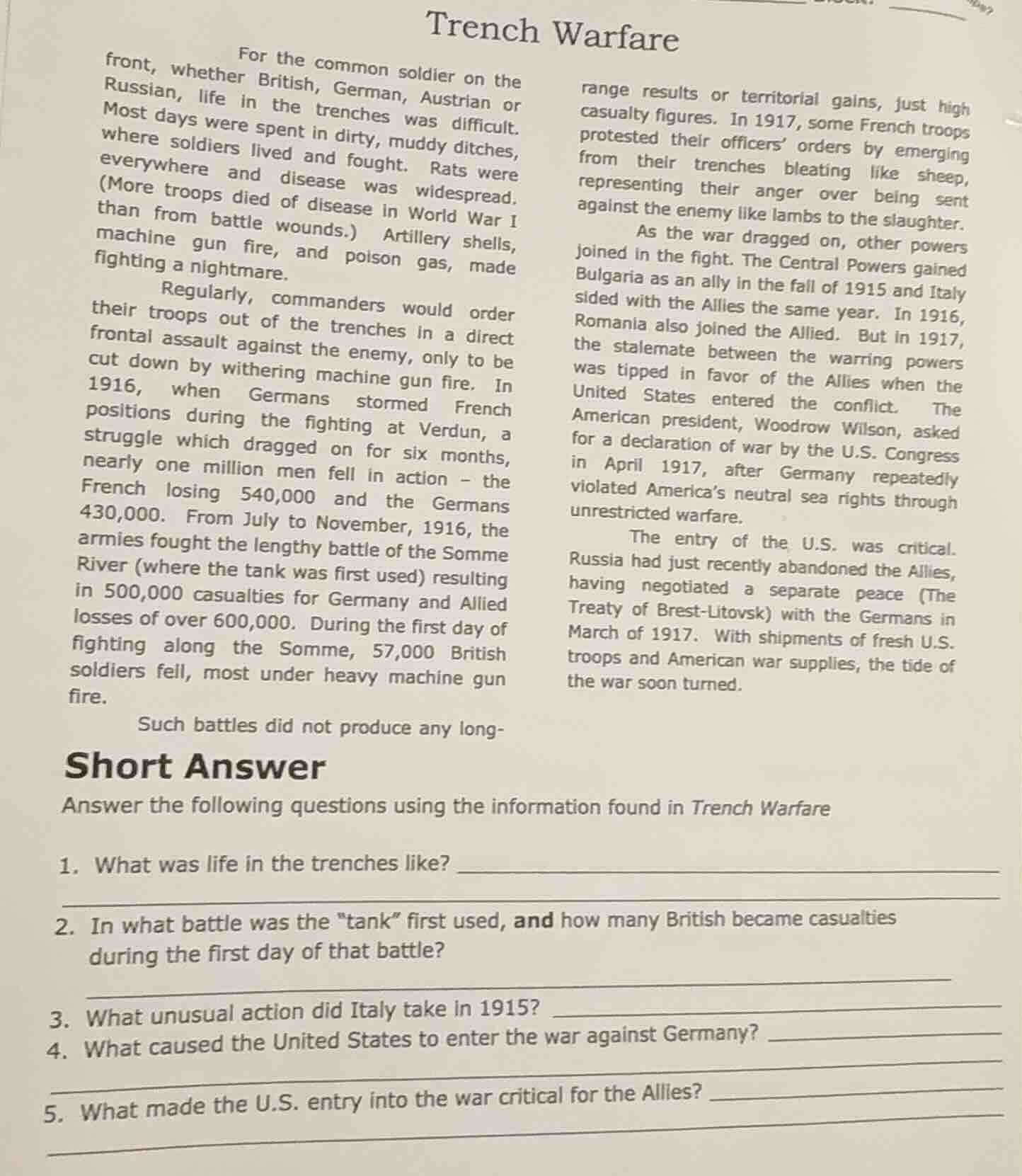
trench warfare
for the common soldier on the
front, whether british, german, austrian or
russian, life in the trenches was difficult.
most days were spent in dirty, muddy ditches,
where soldiers lived and fought. rats were
everywhere and disease was widespread.
(more troops died of disease in world war i
than from battle wounds.) artillery shells,
machine gun fire, and poison gas, made
fighting a nightmare.
regularly, commanders would order
their troops out of the trenches in a direct
frontal assault against the enemy, only to be
cut down by withering machine gun fire. in
1916, when germans stormed french
positions during the fighting at verdun, a
struggle which dragged on for six months,
nearly one million men fell in action - the
french losing 540,000 and the germans
430,000. from july to november, 1916, the
armies fought the lengthy battle of the somme
river (where the tank was first used) resulting
in 500,000 casualties for germany and allied
losses of over 600,000. during the first day of
fighting along the somme, 57,000 british
soldiers fell, most under heavy machine gun
fire.
such battles did not produce any long-
range results or territorial gains, just high
casualty figures. in 1917, some french troops
protested their officers’ orders by emerging
from their trenches bleating like sheep,
representing their anger over being sent
against the enemy like lambs to the slaughter.
as the war dragged on, other powers
joined in the fight. the central powers gained
bulgaria as an ally in the fall of 1915 and italy
sided with the allies the same year. in 1916,
romania also joined the allied. but in 1917,
the stalemate between the warring powers
was tipped in favor of the allies when the
united states entered the conflict. the
american president, woodrow wilson, asked
for a declaration of war by the u.s. congress
in april 1917, after germany repeatedly
violated america’s neutral sea rights through
unrestricted warfare.
the entry of the u.s. was critical.
russia had just recently abandoned the allies,
having negotiated a separate peace (the
treaty of brest - litovsk) with the germans in
march of 1917. with shipments of fresh u.s.
troops and american war supplies, the tide of
the war soon turned.
short answer
answer the following questions using the information found in trench warfare
- what was life in the trenches like?
- in what battle was the \tank\ first used, and how many british became casualties
during the first day of that battle?
- what unusual action did italy take in 1915?
- what caused the united states to enter the war against germany?
- what made the u.s. entry into the war critical for the allies?
Question 1
From the text: "Most days were spent in dirty, muddy ditches, where soldiers lived and fought. Rats were everywhere and disease was widespread."
Find the relevant sentences: "From July to November, 1916, the armies fought the lengthy battle of the Somme River (where the tank was first used) resulting in 500,000 casualties for Germany and Allied losses of over 600,000. During the first day of fighting along the Somme, 57,000 British soldiers fell, most under heavy machine gun fire."
Locate the sentence: "The Central Powers gained Bulgaria as an ally in the fall of 1915 and Italy sided with the Allies the same year." (Unusual as Italy's alignment shifted, originally part of the Triple Alliance with Central Powers but sided with Allies)

Snap & solve any problem in the app
Get step-by-step solutions on Sovi AI
Photo-based solutions with guided steps
Explore more problems and detailed explanations
Life in the trenches was difficult. Most days were spent in dirty, muddy ditches. Rats were everywhere and disease was widespread. Artillery shells, machine gun fire, and poison gas made fighting a nightmare.