QUESTION IMAGE
Question
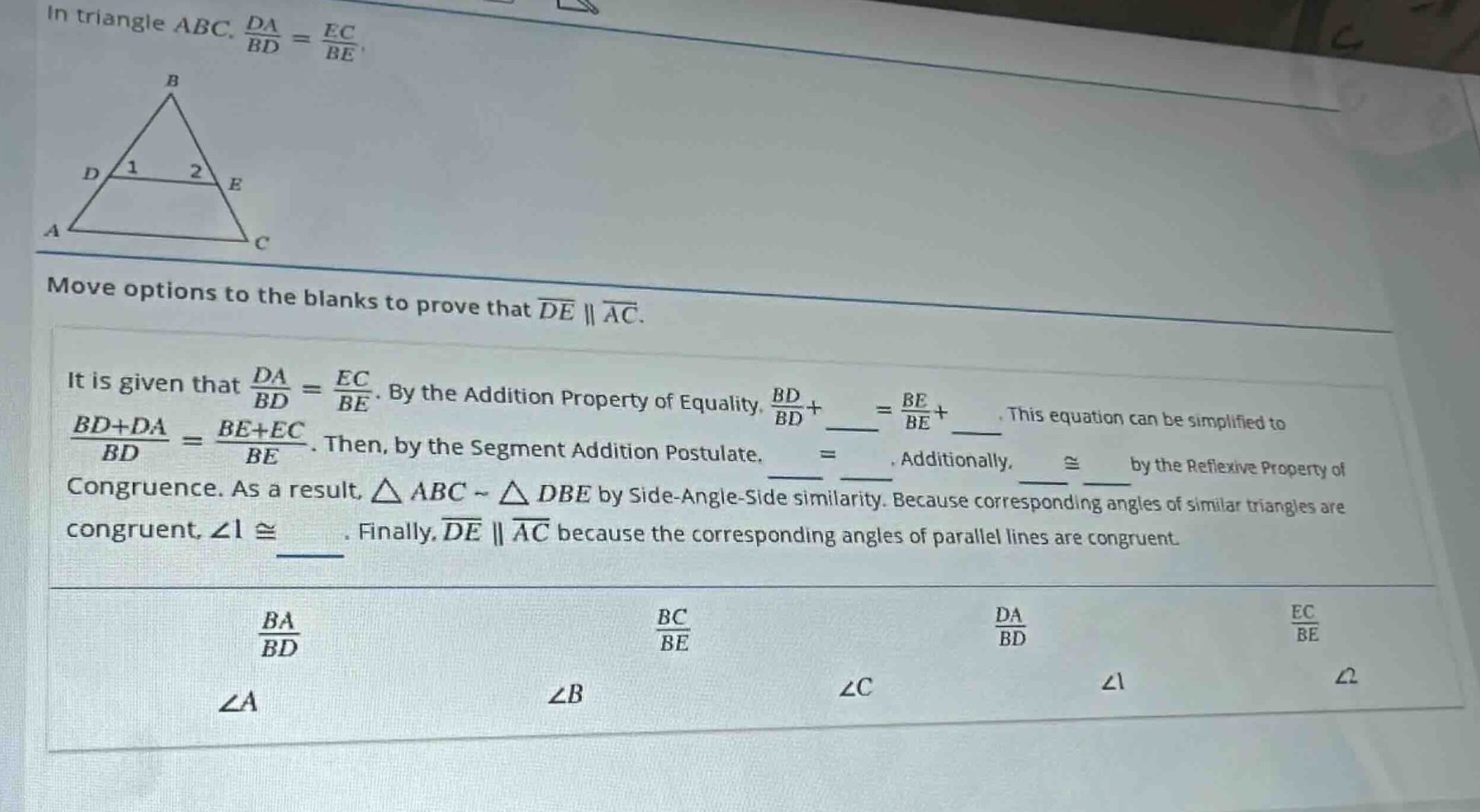
in triangle abc, \\(\frac{da}{bd} = \frac{ec}{be}\\).
move options to the blanks to prove that \\(\overline{de} \parallel \overline{ac}\\).
it is given that \\(\frac{da}{bd} = \frac{ec}{be}\\). by the addition property of equality, \\(\frac{bd}{bd}+\underline{quad} = \frac{be}{be}+\underline{quad}\\). this equation can be simplified to \\(\frac{bd + da}{bd} = \frac{be + ec}{be}\\). then, by the segment addition postulate, \\(\underline{quad} = \underline{quad}\\). additionally, \\(\underline{quad} \cong \underline{quad}\\) by the reflexive property of congruence. as a result, \\(\triangle abc \sim \triangle dbe\\) by side - angle - side similarity. because corresponding angles of similar triangles are congruent, \\(\angle 1 \cong \underline{quad}\\). finally, \\(\overline{de} \parallel \overline{ac}\\) because the corresponding angles of parallel lines are congruent.
options: \\(\frac{ba}{bd}\\), \\(\frac{bc}{be}\\), \\(\frac{da}{bd}\\), \\(\frac{ec}{be}\\), \\(\angle a\\), \\(\angle b\\), \\(\angle c\\), \\(\angle 1\\), \\(\angle 2\\)
- To apply the Addition Property of Equality to the given proportion, we add the original fractions to both sides of the equation.
- Using the Segment Addition Postulate, we recognize that the sum of segments makes up the full sides of the triangle.
- The Reflexive Property of Congruence tells us an angle is congruent to itself, which is the shared angle here.
- Corresponding angles of similar triangles are congruent, so we match the corresponding angle from the larger triangle to $\angle 1$.

Snap & solve any problem in the app
Get step-by-step solutions on Sovi AI
Photo-based solutions with guided steps
Explore more problems and detailed explanations
It is given that $\frac{DA}{BD} = \frac{EC}{BE}$. By the Addition Property of Equality, $\frac{BD}{BD}+\boldsymbol{\frac{DA}{BD}} = \frac{BE}{BE}+\boldsymbol{\frac{EC}{BE}}$. This equation can be simplified to $\frac{BD+DA}{BD} = \frac{BE+EC}{BE}$. Then, by the Segment Addition Postulate, $\boldsymbol{\frac{BA}{BD}} = \boldsymbol{\frac{BC}{BE}}$. Additionally, $\boldsymbol{\angle B} \cong \boldsymbol{\angle B}$ by the Reflexive Property of Congruence. As a result, $\triangle ABC \sim \triangle DBE$ by Side-Angle-Side similarity. Because corresponding angles of similar triangles are congruent, $\angle 1 \cong \boldsymbol{\angle A}$. Finally, $\overline{DE} \parallel \overline{AC}$ because the corresponding angles of parallel lines are congruent.