QUESTION IMAGE
Question
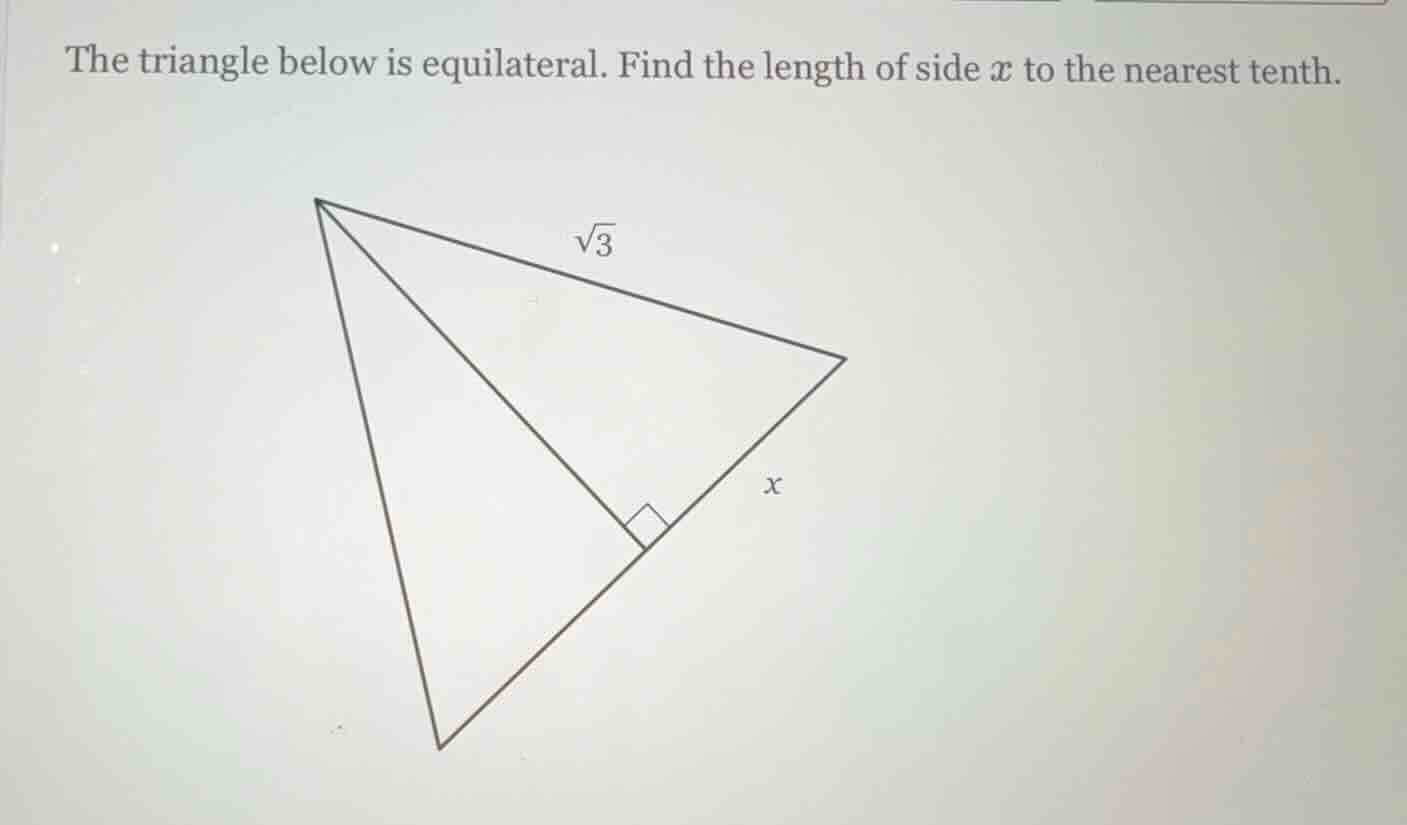
the triangle below is equilateral. find the length of side ( x ) to the nearest tenth.
Step1: Recall properties of equilateral triangle
In an equilateral triangle, the altitude (the perpendicular from a vertex to the opposite side) bisects the side. Also, in a 30 - 60 - 90 triangle (formed by the altitude, half of a side, and a side of the equilateral triangle), the sides are in the ratio \(1:\sqrt{3}:2\), where the side opposite \(30^{\circ}\) is the shortest one (let's say length \(a\)), the side opposite \(60^{\circ}\) is \(a\sqrt{3}\), and the hypotenuse (side of the equilateral triangle) is \(2a\).
Looking at the right - triangle in the figure, the side with length \(\sqrt{3}\) is opposite the \(60^{\circ}\) angle (since the altitude in an equilateral triangle creates a \(30 - 60 - 90\) triangle), and the side \(x\) is half of the side of the equilateral triangle (because the altitude bisects the base of the equilateral triangle).
Let's denote the side of the equilateral triangle as \(s\). In the 30 - 60 - 90 triangle, if the side opposite \(60^{\circ}\) is \(\sqrt{3}\), and we know that in a 30 - 60 - 90 triangle, the side opposite \(60^{\circ}\) is \(a\sqrt{3}\) (where \(a\) is the side opposite \(30^{\circ}\), which is equal to \(x\) in our case). So we have the equation:
\(a\sqrt{3}=\sqrt{3}\)
Step2: Solve for \(a\) (which is \(x\))
From the equation \(a\sqrt{3}=\sqrt{3}\), we can divide both sides by \(\sqrt{3}\):
\(a = \frac{\sqrt{3}}{\sqrt{3}}=1\)? Wait, no, wait. Wait, actually, the hypotenuse of the right - triangle is the side of the equilateral triangle. Wait, maybe I mixed up. Let's re - consider.
In an equilateral triangle with side length \(s\), the altitude \(h\) is given by \(h=\frac{\sqrt{3}}{2}s\). In our right - triangle, the vertical side (the altitude) is not given, but the side with length \(\sqrt{3}\) is the altitude? Wait, no, the side labeled \(\sqrt{3}\) is the hypotenuse? Wait, no, the right - angle is between \(x\) and the altitude. So the right - triangle has legs \(x\) (half of the side of the equilateral triangle) and the altitude \(h\), and hypotenuse \(s\) (side of the equilateral triangle). Also, we know that in an equilateral triangle, \(h = \frac{\sqrt{3}}{2}s\), and \(x=\frac{s}{2}\) (since the altitude bisects the base).
We are given that the length of the side (let's say the altitude - related side) is \(\sqrt{3}\). Wait, maybe a better approach: In the right - triangle, we can use trigonometric ratios. Let's consider the angle at the vertex of the equilateral triangle. In an equilateral triangle, each angle is \(60^{\circ}\), and when we draw the altitude, it splits the \(60^{\circ}\) angle into two \(30^{\circ}\) angles? No, wait, no. The altitude in an equilateral triangle makes a \(90^{\circ}\) angle with the base, so the two non - right angles of the right - triangle are \(30^{\circ}\) and \(60^{\circ}\).
Let's use the sine function. \(\sin(60^{\circ})=\frac{\text{opposite}}{\text{hypotenuse}}\). The opposite side to the \(60^{\circ}\) angle is \(\sqrt{3}\), and the hypotenuse of the right - triangle is the side of the equilateral triangle, let's call it \(s\). But also, the adjacent side to the \(60^{\circ}\) angle is \(x\) (since \(x\) is half of the base of the equilateral triangle, and the base is equal to the side of the equilateral triangle).
Wait, another way: In a 30 - 60 - 90 triangle, the ratio of the sides is \(1:\sqrt{3}:2\). If the side with length \(\sqrt{3}\) is the longer leg (opposite \(60^{\circ}\)), then the shorter leg (opposite \(30^{\circ}\)) is \(x\), and we know that \(\frac{\text{longer leg}}{\text{shorter leg}}=\sqrt{3}\). So \(\f…

Snap & solve any problem in the app
Get step-by-step solutions on Sovi AI
Photo-based solutions with guided steps
Explore more problems and detailed explanations
\(1.0\)