QUESTION IMAGE
Question
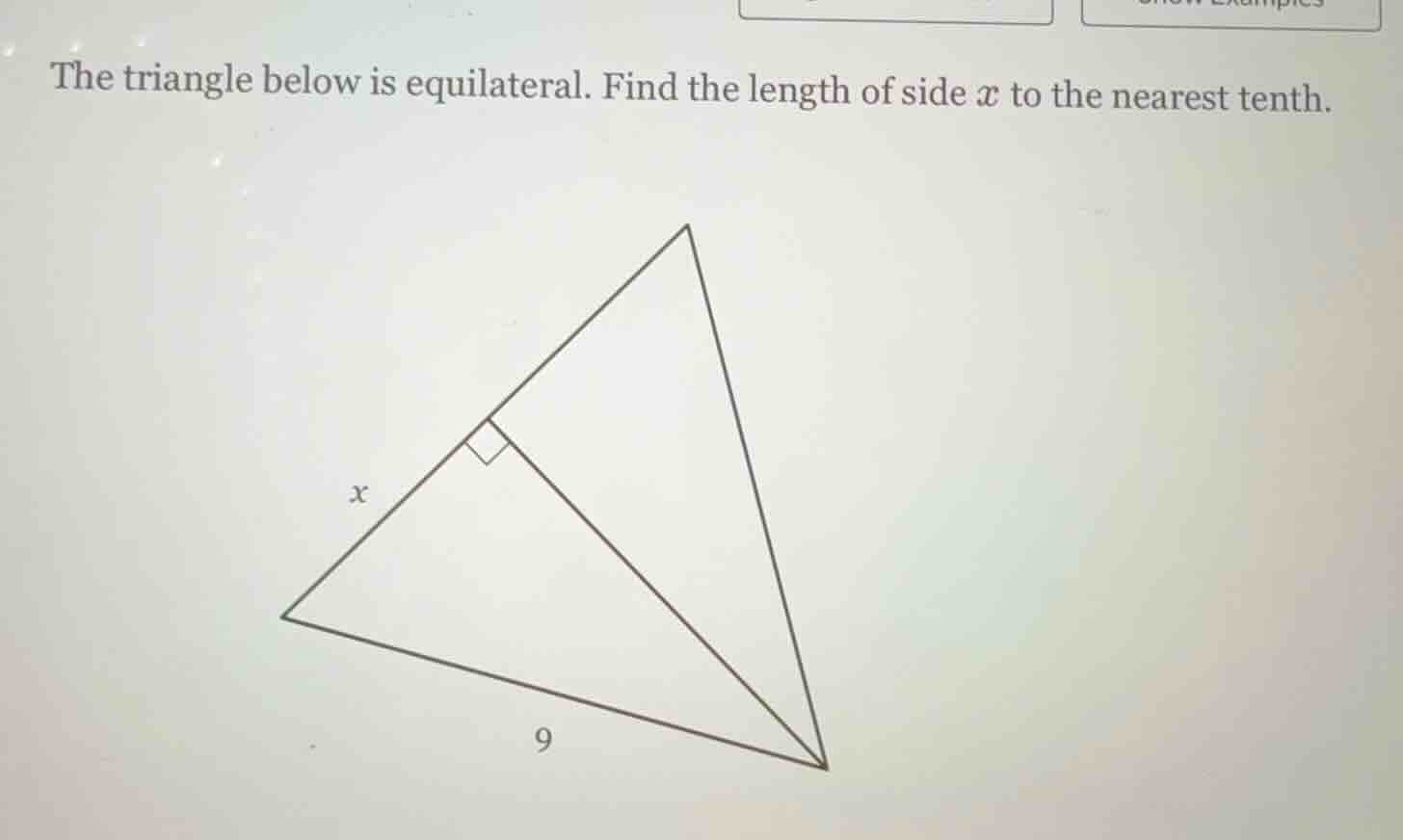
the triangle below is equilateral. find the length of side x to the nearest tenth.
Step1: Recall properties of equilateral triangle
In an equilateral triangle, all sides are equal, and the altitude (the perpendicular segment from a vertex to the opposite side) bisects the base. So the right triangle formed has hypotenuse equal to the side of the equilateral triangle (let's say length \( s = 9 \)) and one leg as \( x \), and the other leg as half of the base (but here, since the altitude is also the median and angle bisector, and we have a right triangle with hypotenuse \( 9 \) and angle \( 30^\circ \) at the vertex? Wait, no, in an equilateral triangle, each angle is \( 60^\circ \). When we draw the altitude, it splits the equilateral triangle into two \( 30 - 60 - 90 \) right triangles. Wait, actually, the side we are looking for \( x \) is adjacent to the \( 60^\circ \) angle? Wait, no, let's correct. In an equilateral triangle with side length \( a \), the altitude \( h \) can be found by \( h=\frac{\sqrt{3}}{2}a \), but here, the right triangle has hypotenuse \( a = 9 \), one angle \( 60^\circ \), and we need to find the adjacent side to the \( 60^\circ \) angle? Wait, no, the angle at the vertex of the equilateral triangle is \( 60^\circ \), and when we draw the altitude, it creates a right angle, so the angles in the right triangle are \( 30^\circ \), \( 60^\circ \), and \( 90^\circ \). The side opposite \( 30^\circ \) is half of the base, but wait, in this case, the side labeled \( 9 \) is equal to the side of the equilateral triangle, so the hypotenuse of the right triangle is \( 9 \), and we need to find the adjacent side to the \( 60^\circ \) angle? Wait, no, actually, in the right triangle, the angle at the vertex (the \( 60^\circ \) angle of the equilateral triangle) is now split? No, wait, the equilateral triangle has all sides equal, so all sides are \( 9 \). The altitude (the perpendicular line) splits the base into two equal parts, but also, the right triangle formed has hypotenuse \( 9 \), one leg \( x \), and the other leg is the altitude. But wait, the angle at the vertex (the angle between the side \( x \) and the hypotenuse \( 9 \)) is \( 60^\circ \)? Wait, no, in an equilateral triangle, each internal angle is \( 60^\circ \). When we draw the altitude from one vertex to the opposite side, it bisects the angle into two \( 30^\circ \) angles? Wait, no, that's for an isoceles triangle with vertex angle \( 60^\circ \), but no, in an equilateral triangle, all angles are \( 60^\circ \), so the altitude will bisect the angle into two \( 30^\circ \) angles? Wait, no, \( 60^\circ \) divided by 2 is \( 30^\circ \), yes. So in the right triangle, we have a \( 30 - 60 - 90 \) triangle, where the hypotenuse is \( 9 \), the angle adjacent to \( x \) is \( 60^\circ \)? Wait, no, let's use trigonometry. Let's denote the angle at the vertex (where the right angle is not) as \( \theta = 60^\circ \), the hypotenuse is \( 9 \), and we need to find the adjacent side to \( \theta \), which is \( x \). So using cosine: \( \cos(\theta)=\frac{\text{adjacent}}{\text{hypotenuse}} \), so \( \cos(60^\circ)=\frac{x}{9} \). Wait, but \( \cos(60^\circ)=\frac{1}{2} \), so \( x = 9\times\cos(60^\circ)=9\times\frac{1}{2}=4.5 \)? Wait, that can't be right, because in a \( 30 - 60 - 90 \) triangle, the sides are in the ratio \( 1 : \sqrt{3} : 2 \), where the side opposite \( 30^\circ \) is the shortest side (let's call it \( a \)), the side opposite \( 60^\circ \) is \( a\sqrt{3} \), and the hypotenuse is \( 2a \). So if the hypotenuse is \( 9 \), then \( 2a = 9 \), so \( a = 4.5 \), which is the side opposite \( 30^\circ \).…

Snap & solve any problem in the app
Get step-by-step solutions on Sovi AI
Photo-based solutions with guided steps
Explore more problems and detailed explanations
\( 4.5 \)