QUESTION IMAGE
Question
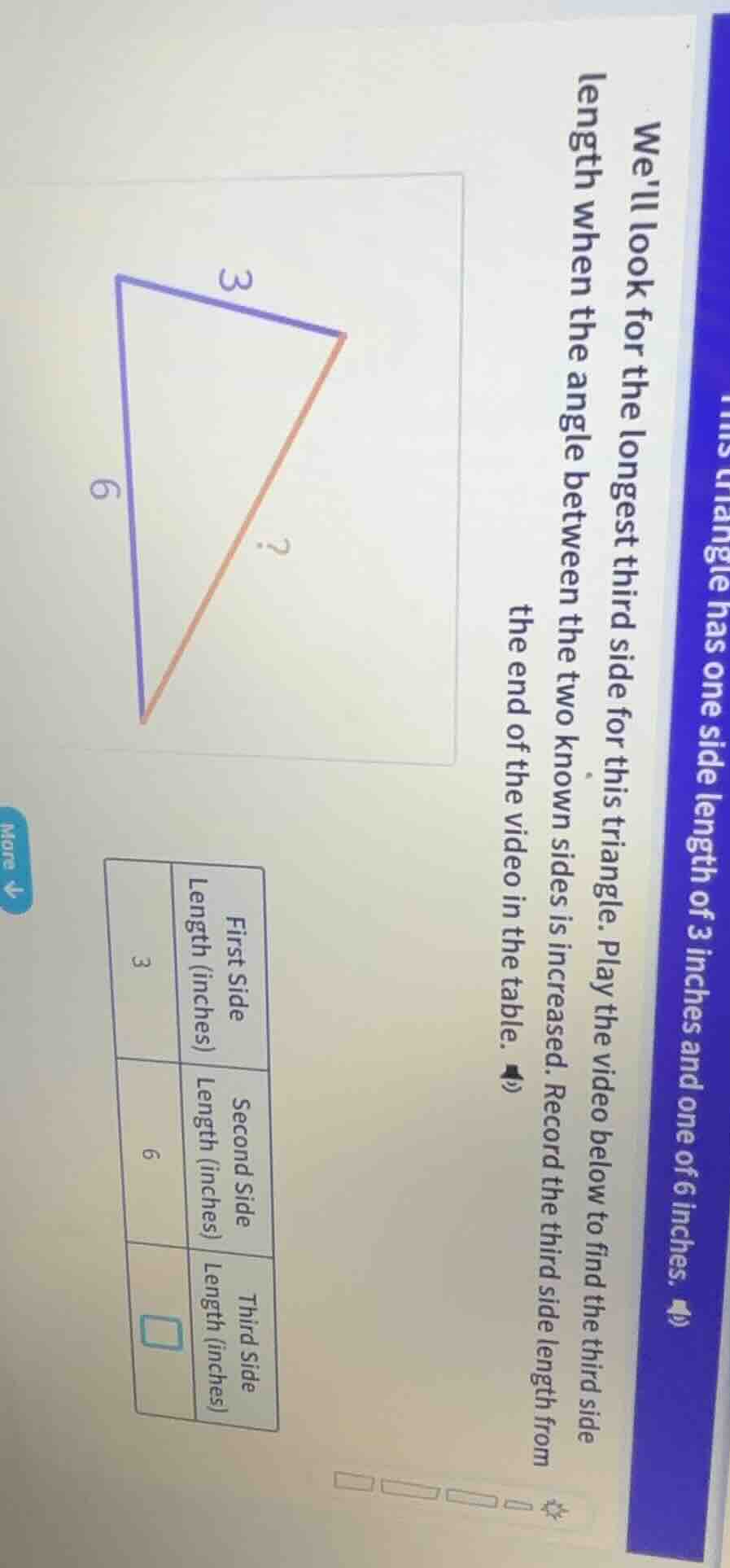
this triangle has one side length of 3 inches and one of 6 inches. well look for the longest third side for this triangle. play the video below to find the third side length when the angle between the two known sides is increased. record the third side length from the end of the video in the table.
first side length (inches): 3
second side length (inches): 6
third side length (inches): blank box
Step1: Recall Triangle Inequality Theorem
The triangle inequality theorem states that for any triangle, the length of the third side \( c \) must satisfy \( |a - b| < c < a + b \), where \( a = 3 \) and \( b = 6 \).
Step2: Calculate the bounds
First, calculate \( a + b \): \( 3 + 6 = 9 \). Then, calculate \( |a - b| \): \( |3 - 6| = 3 \). So the third side \( c \) must be between \( 3 \) and \( 9 \) inches. But since we are looking for the longest possible third side (when the angle between the two known sides is increased, approaching a straight line), the maximum length the third side can approach is just less than \( 3 + 6 = 9 \). However, if we consider the case when the angle is a straight angle (though it would no longer be a triangle), the length would be \( 3 + 6 = 9 \), but as a triangle, the longest possible third side (when the angle is as large as possible without making it degenerate) is just less than \( 9 \). But if we assume the angle is such that it's a triangle with the third side as long as possible, the closest value (if we consider integer lengths or the limit) is approaching \( 9 \), but typically in such problems, when the angle is increased to make the third side longest, we use the law of cosines. Wait, maybe the problem is about when the angle between the two sides is \( 180^\circ \) (degenerate triangle), but since it's a triangle, the maximum length of the third side \( c \) satisfies \( c < 3 + 6 = 9 \), and the minimum is \( c > 6 - 3 = 3 \). But the question says "the longest third side when the angle between the two known sides is increased". As the angle \( \theta \) between the two sides (lengths \( a = 3 \), \( b = 6 \)) increases from \( 0^\circ \) to \( 180^\circ \), the length of the third side \( c \) is given by the law of cosines: \( c^2 = a^2 + b^2 - 2ab\cos\theta \). When \( \theta = 180^\circ \), \( \cos\theta = -1 \), so \( c^2 = 3^2 + 6^2 - 2\times3\times6\times(-1) = 9 + 36 + 36 = 81 \), so \( c = 9 \). But when \( \theta < 180^\circ \), \( c < 9 \). So the longest possible third side (approaching when the triangle is almost degenerate) is \( 9 \) (but as a triangle, it's just less than \( 9 \), but maybe the problem considers the degenerate case for the maximum length, so \( c = 9 \) (though it's not a triangle, but the limit). Wait, maybe the problem is simpler: when you have two sides \( 3 \) and \( 6 \), the longest third side (when the angle between them is increased) is \( 3 + 6 = 9 \) (but as a triangle, it's a degenerate triangle, so the length is \( 9 \) when the angle is \( 180^\circ \)). So the answer should be \( 9 \) (approximating the longest possible length when the angle is increased to make the third side as long as possible, approaching the degenerate case).

Snap & solve any problem in the app
Get step-by-step solutions on Sovi AI
Photo-based solutions with guided steps
Explore more problems and detailed explanations
\( 9 \) (inches, considering the limit as the angle approaches \( 180^\circ \))