QUESTION IMAGE
Question
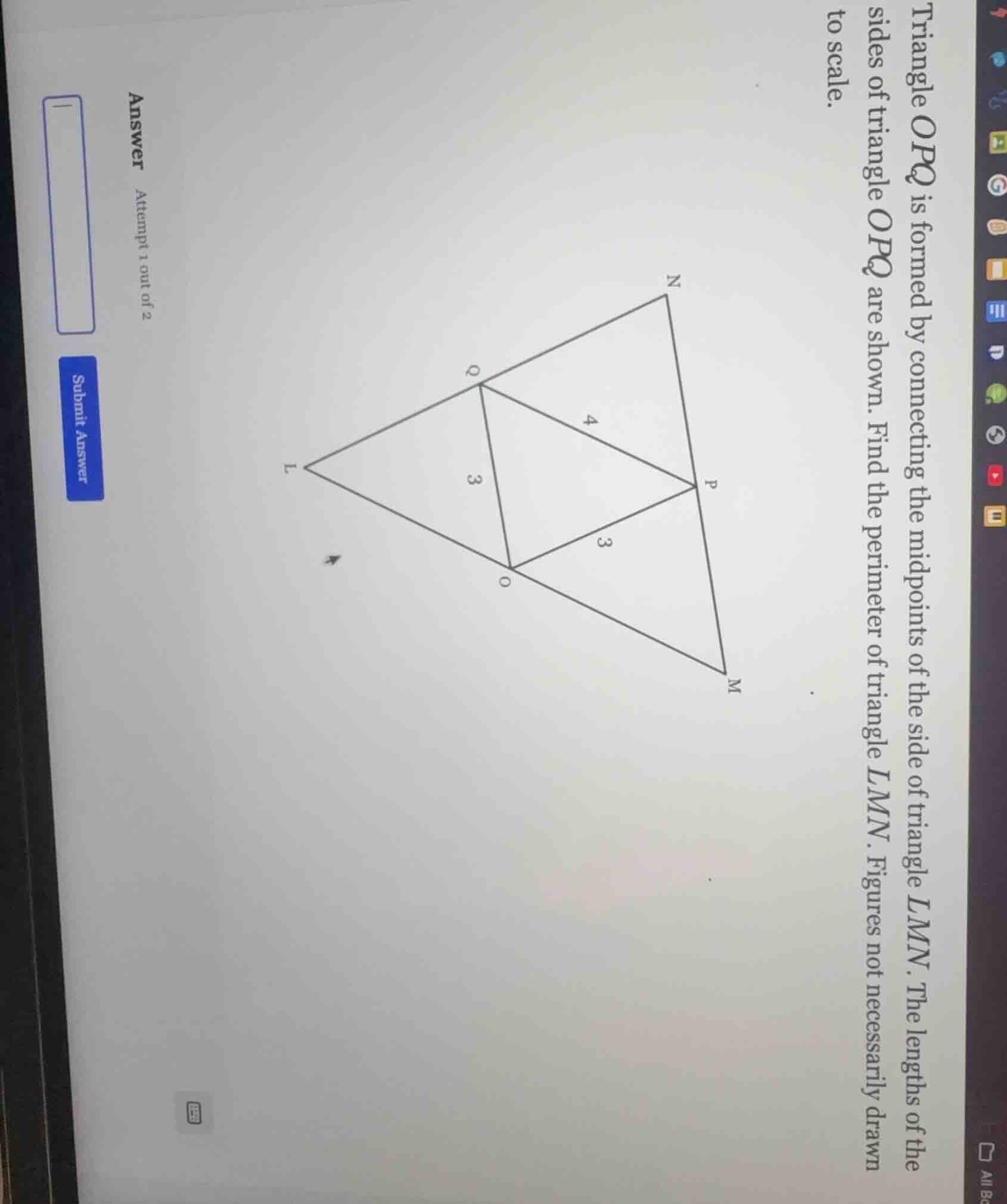
triangle opq is formed by connecting the midpoints of the side of triangle lmn. the lengths of the sides of triangle opq are shown. find the perimeter of triangle lmn. figures not necessarily drawn to scale.
Step1: Recall Midsegment Theorem
The midsegment of a triangle is parallel to the third side and half its length. Since \( O, P, Q \) are midpoints, \( OP \), \( PQ \), \( OQ \) are midsegments.
Step2: Find lengths of \( LM \), \( MN \), \( NL \)
- \( LM = 2 \times PQ = 2\times4 = 8 \)
- \( MN = 2 \times OQ = 2\times3 = 6 \)
- \( NL = 2 \times OP = 2\times3 = 6 \) (Wait, correction: Wait, looking at the triangle, \( OQ = 3 \), \( PQ = 4 \), \( OP = 3 \)? Wait, no, let's re - examine. If \( O, P, Q \) are midpoints, then:
- \( LM = 2\times PQ \). From the diagram, \( PQ = 4 \), so \( LM = 8 \).
- \( MN = 2\times OQ \). \( OQ = 3 \), so \( MN = 6 \).
- \( NL = 2\times OP \). \( OP = 3 \)? Wait, no, maybe I misassigned. Wait, actually, in triangle \( LMN \), \( Q \) is midpoint of \( LN \), \( O \) is midpoint of \( LM \), \( P \) is midpoint of \( MN \). So:
- \( OQ \) is midsegment, so \( OQ=\frac{1}{2}MN \), so \( MN = 2\times OQ = 2\times3 = 6 \)
- \( OP \) is midsegment, so \( OP=\frac{1}{2}LN \), so \( LN = 2\times OP = 2\times3 = 6 \)
- \( PQ \) is midsegment, so \( PQ=\frac{1}{2}LM \), so \( LM = 2\times PQ = 2\times4 = 8 \)
Step3: Calculate perimeter of \( \triangle LMN \)
Perimeter \( = LM + MN + NL=8 + 6+6 = 20 \)? Wait, no, wait, maybe I made a mistake. Wait, let's re - do:
Wait, the sides of \( \triangle OPQ \) are \( OQ = 3 \), \( OP = 3 \), \( PQ = 4 \)? No, maybe the sides of \( \triangle OPQ \) are \( OQ = 3 \), \( PQ = 4 \), \( OP = 3 \). Then:
- \( LM = 2\times PQ = 8 \)
- \( MN = 2\times OQ = 6 \)
- \( LN = 2\times OP = 6 \)
Perimeter \(=8 + 6+6 = 20\)? Wait, no, that can't be. Wait, maybe the sides of \( \triangle OPQ \) are \( OQ = 3 \), \( PQ = 4 \), \( OP = 3 \). Wait, another approach: The perimeter of \( \triangle OPQ \) is \( 3 + 3+4 = 10 \). Since the ratio of perimeters of similar triangles (and \( \triangle OPQ \sim\triangle LMN \) with scale factor \( \frac{1}{2} \)), the perimeter of \( \triangle LMN \) is \( 2\times \) perimeter of \( \triangle OPQ \). Perimeter of \( \triangle OPQ=3 + 3+4 = 10 \)? No, wait, \( OQ = 3 \), \( PQ = 4 \), \( OP = 3 \), so perimeter of \( \triangle OPQ = 3 + 3+4 = 10 \). Then perimeter of \( \triangle LMN = 2\times10 = 20 \)? Wait, no, that's not right. Wait, no, the midsegment theorem says that the ratio of perimeters of two similar triangles (where one is formed by midsegments) is \( 2:1 \). So if \( \triangle OPQ \) has sides \( a = 3 \), \( b = 3 \), \( c = 4 \), perimeter \( P_{OPQ}=3 + 3+4 = 10 \), then perimeter of \( \triangle LMN = 2\times P_{OPQ}=20 \). Wait, but let's check again.
Wait, maybe the sides of \( \triangle OPQ \) are \( OQ = 3 \), \( PQ = 4 \), \( OP = 3 \). Then:
- \( LM = 2\times PQ = 8 \)
- \( MN = 2\times OQ = 6 \)
- \( LN = 2\times OP = 6 \)
Perimeter \(=8 + 6+6 = 20 \).

Snap & solve any problem in the app
Get step-by-step solutions on Sovi AI
Photo-based solutions with guided steps
Explore more problems and detailed explanations
The perimeter of triangle \( LMN \) is \( \boldsymbol{20} \).