QUESTION IMAGE
Question
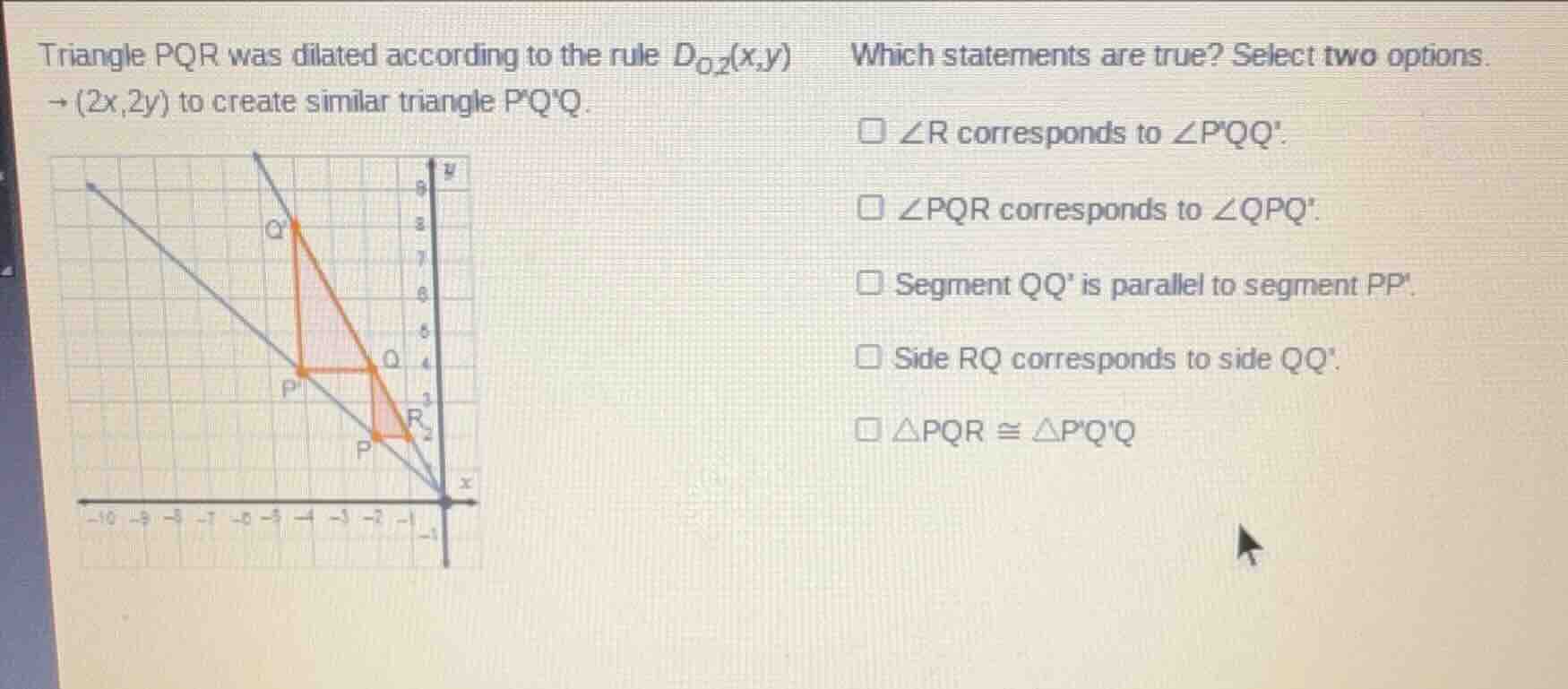
triangle pqr was dilated according to the rule $d_{o,2}(x,y) \to (2x,2y)$ to create similar triangle $pqq$. which statements are true? select two options. $\square$ $\angle r$ corresponds to $\angle pqq$. $\square$ $\angle pqr$ corresponds to $\angle qpq$. $\square$ segment $qq$ is parallel to segment $pp$. $\square$ side $rq$ corresponds to side $qq$. $\square$ $\triangle pqr \cong \triangle pqq$
Brief Explanations
- Check angle correspondence: In a dilation from center \(O\), \(\angle R\) (vertex \(R\) of \(\triangle PQR\)) maps to \(\angle P'QQ'\) (vertex \(Q\) of \(\triangle P'Q'Q\)) as the dilated figure's corresponding angle.
- Check parallel segments: Segments connecting pre-image points to their dilated image points (like \(QQ'\) and \(PP'\)) from the same center of dilation are parallel, since they lie along rays from the dilation center.
- Eliminate false statements:
- \(\angle PQR\) does not correspond to \(\angle QPQ'\) (incorrect vertex mapping).
- Side \(RQ\) does not correspond to \(QQ'\) (incorrect side mapping).
- \(\triangle PQR \cong \triangle P'Q'Q\) is false because dilation creates similarity, not congruence (size changes).

Snap & solve any problem in the app
Get step-by-step solutions on Sovi AI
Photo-based solutions with guided steps
Explore more problems and detailed explanations
- ∠R corresponds to ∠P'QQ'.
- Segment QQ' is parallel to segment PP'.