QUESTION IMAGE
Question
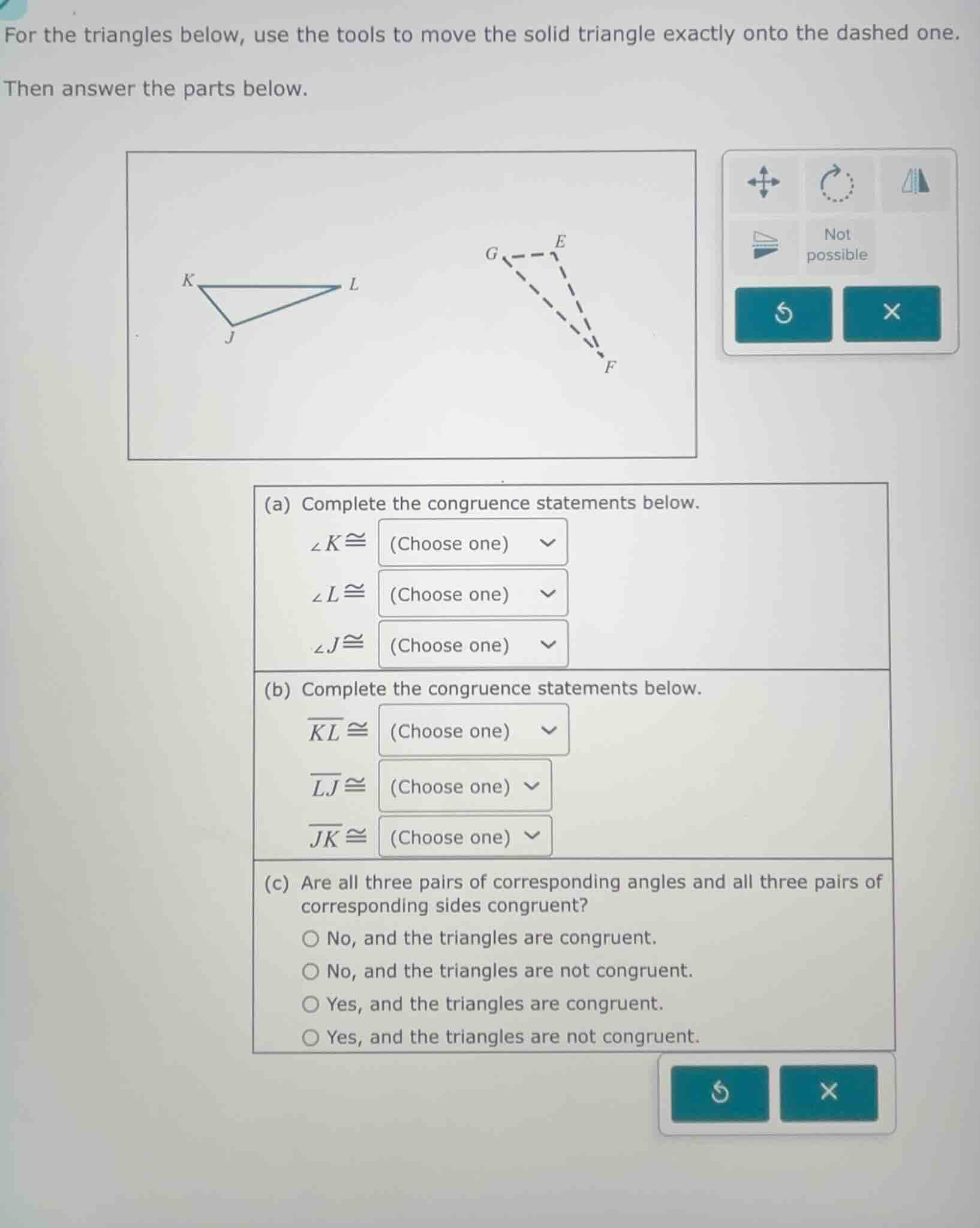
for the triangles below, use the tools to move the solid triangle exactly onto the dashed one. then answer the parts below. (a) complete the congruence statements below. ∠k ≅ (choose one) ∠l ≅ (choose one) ∠j ≅ (choose one) (b) complete the congruence statements below. \\(\overline{kl} \cong\\) (choose one) \\(\overline{lj} \cong\\) (choose one) \\(\overline{jk} \cong\\) (choose one) (c) are all three pairs of corresponding angles and all three pairs of corresponding sides congruent? ∘ no, and the triangles are congruent. ∘ no, and the triangles are not congruent. ∘ yes, and the triangles are congruent. ∘ yes, and the triangles are not congruent.
Part (a)
To determine the congruent angles, we use the fact that when we move the solid triangle (△JKL) onto the dashed triangle (△EFG), the corresponding vertices match. So:
- ∠K corresponds to ∠E, so \( \angle K \cong \angle E \)
- ∠L corresponds to ∠F, so \( \angle L \cong \angle F \)
- ∠J corresponds to ∠G, so \( \angle J \cong \angle G \)
Part (b)
For the congruent sides, we match the corresponding sides based on the vertices:
- \( \overline{KL} \) corresponds to \( \overline{EF} \), so \( \overline{KL} \cong \overline{EF} \)
- \( \overline{LJ} \) corresponds to \( \overline{FG} \), so \( \overline{LJ} \cong \overline{FG} \)
- \( \overline{JK} \) corresponds to \( \overline{GE} \) (or \( \overline{EG} \)), so \( \overline{JK} \cong \overline{EG} \)
Part (c)
By the definition of congruent triangles, if two triangles are congruent, all three pairs of corresponding angles and all three pairs of corresponding sides are congruent. Since we can move the solid triangle onto the dashed one, they are congruent, so all corresponding angles and sides are congruent.

Snap & solve any problem in the app
Get step-by-step solutions on Sovi AI
Photo-based solutions with guided steps
Explore more problems and detailed explanations
s:
(a)
\( \angle K \cong \boldsymbol{\angle E} \)
\( \angle L \cong \boldsymbol{\angle F} \)
\( \angle J \cong \boldsymbol{\angle G} \)
(b)
\( \overline{KL} \cong \boldsymbol{\overline{EF}} \)
\( \overline{LJ} \cong \boldsymbol{\overline{FG}} \)
\( \overline{JK} \cong \boldsymbol{\overline{EG}} \)
(c)
The correct option is:
\( \boldsymbol{\text{Yes, and the triangles are congruent.}} \)