QUESTION IMAGE
Question
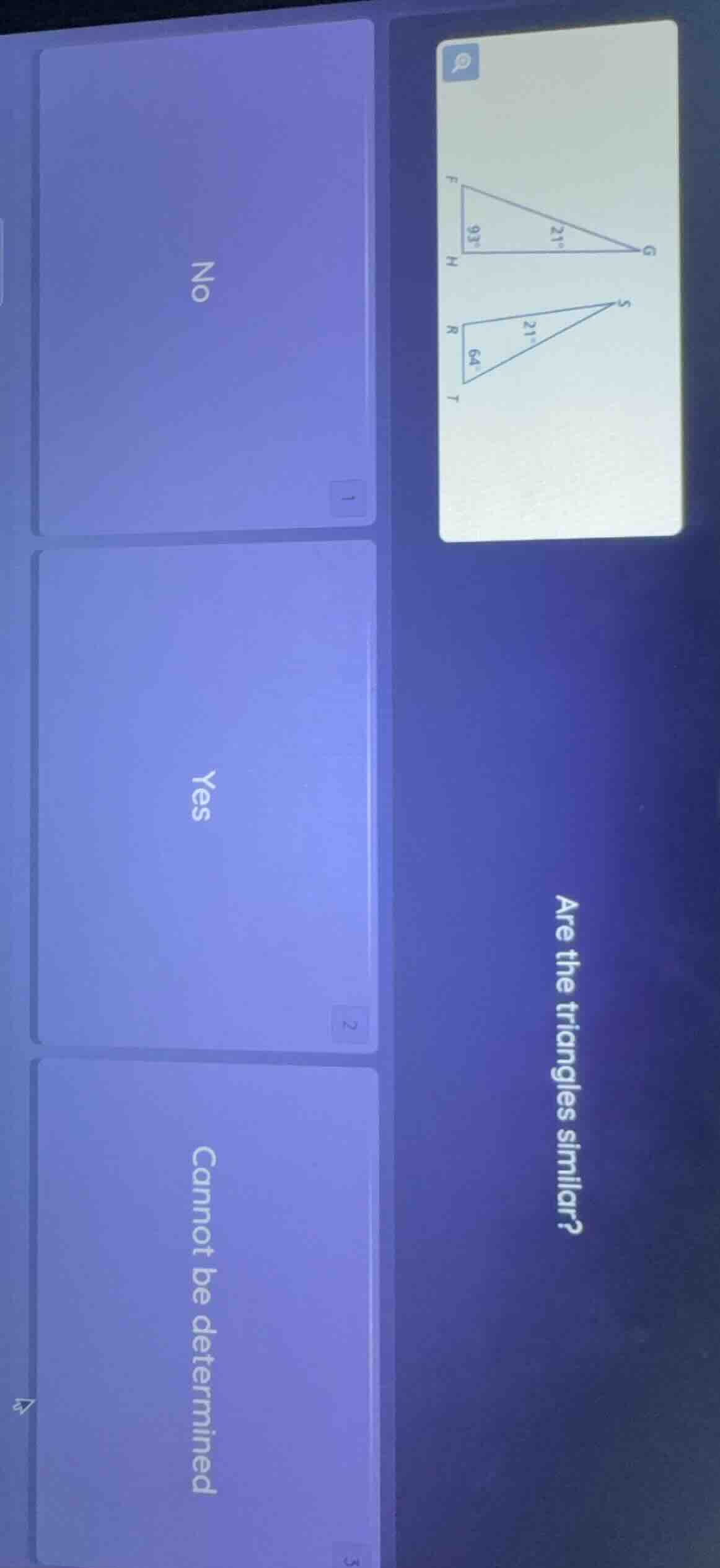
are the triangles similar?
options: no, yes, cannot be determined
Step1: Find the third angle of triangle FHG
The sum of angles in a triangle is \(180^\circ\). For \(\triangle FHG\), we know two angles: \(93^\circ\) and \(21^\circ\). Let the third angle be \( \angle G\). So, \( \angle G=180^\circ - 93^\circ - 21^\circ = 66^\circ\)? Wait, no, wait. Wait, in \(\triangle FHG\), angles are at \(H\) (93°), at \(G\) (21°), so angle at \(F\) is \(180 - 93 - 21 = 66^\circ\)? Wait, no, the second triangle: \(\triangle RTS\) (or \(\triangle RST\)) has angle at \(R\) (64°), angle at \(S\) (21°), so angle at \(T\) is \(180 - 64 - 21 = 95^\circ\)? Wait, no, I must have misread. Wait, the first triangle: vertices F, H, G. Angle at H is 93°, angle at G is 21°, so angle at F is \(180 - 93 - 21 = 66^\circ\). The second triangle: vertices R, T, S. Angle at R is 64°, angle at S is 21°, so angle at T is \(180 - 64 - 21 = 95^\circ\). Wait, that can't be. Wait, maybe I mixed up the angles. Wait, no, let's check again. Wait, the first triangle: angle at H is 93°, angle at G is 21°, so angle at F: \(180 - 93 - 21 = 66^\circ\). Second triangle: angle at R is 64°, angle at S is 21°, so angle at T: \(180 - 64 - 21 = 95^\circ\). Wait, that's not matching. Wait, maybe the first triangle's angles: H is 93°, G is 21°, so F is 66°. Second triangle: R is 64°, S is 21°, so T is 95°. So the angles are not the same. Wait, but maybe I made a mistake. Wait, no, the problem is about similar triangles, which require corresponding angles to be equal. Let's recalculate:
For \(\triangle FHG\):
Angles: \( \angle H = 93^\circ\), \( \angle G = 21^\circ\), so \( \angle F = 180 - 93 - 21 = 66^\circ\).
For \(\triangle RTS\) (assuming vertices R, T, S):
\( \angle R = 64^\circ\), \( \angle S = 21^\circ\), so \( \angle T = 180 - 64 - 21 = 95^\circ\).
Wait, that's not matching. Wait, maybe the second triangle's angle at R is 66°? No, the image shows 64°. Wait, maybe I misread the first triangle's angle. Wait, the first triangle: angle at H is 93°, angle at G is 21°, so angle at F is 66°. The second triangle: angle at R is 64°, angle at S is 21°, so angle at T is 95°. So the angles are 93, 21, 66 and 64, 21, 95. So no two angles are equal except the 21° angle. So the triangles are not similar. Wait, but maybe I made a mistake. Wait, let's check again. Wait, maybe the first triangle's angle at H is 93°, angle at F is 21°? No, the diagram shows angle at G is 21°. Wait, the first triangle: F---H---G? No, the triangle is F, H, G with angle at H: 93°, angle at G: 21°, so angle at F: 66°. Second triangle: R, T, S with angle at R: 64°, angle at S: 21°, so angle at T: 95°. So the angles are 93, 21, 66 and 64, 21, 95. So only one angle (21°) is common, so the triangles are not similar. So the answer is No.
Wait, but maybe I messed up the angle calculations. Let's do it again:
Sum of angles in a triangle is \(180^\circ\).
First triangle (\(\triangle FHG\)):
- Angle at \(H\): \(93^\circ\)
- Angle at \(G\): \(21^\circ\)
- Angle at \(F\): \(180 - 93 - 21 = 66^\circ\)
Second triangle (\(\triangle RTS\)):
- Angle at \(R\): \(64^\circ\)
- Angle at \(S\): \(21^\circ\)
- Angle at \(T\): \(180 - 64 - 21 = 95^\circ\)
So the angles of the first triangle are \(93^\circ\), \(21^\circ\), \(66^\circ\). The angles of the second triangle are \(64^\circ\), \(21^\circ\), \(95^\circ\). The only common angle is \(21^\circ\), so the other angles are not equal. Therefore, the triangles are not similar.

Snap & solve any problem in the app
Get step-by-step solutions on Sovi AI
Photo-based solutions with guided steps
Explore more problems and detailed explanations
No