QUESTION IMAGE
Question
1
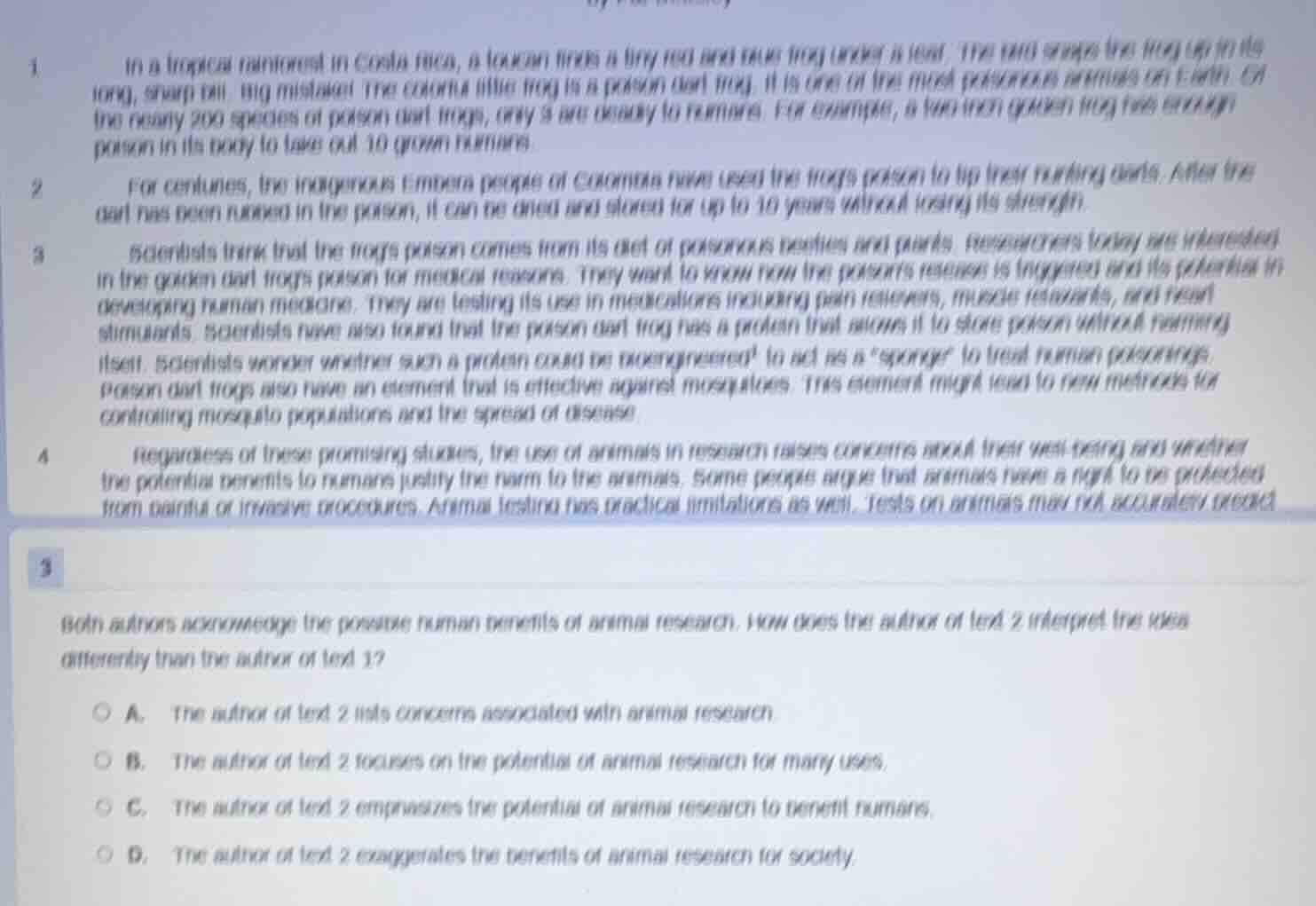
in a tropical rainforest in costa rica, a biologist finds a tiny red and blue frog under a leaf. the frog springs free, flinging out its long, sharp tail. he mislabeled the colorful little frog as a poison dart frog. it is one of the most poisonous animals on earth. of the nearly 200 species of poison dart frogs, only 3 are deadly to humans. for example, a tiny three - colored frog has enough poison in its body to take out 10 grown humans.
2
for centuries, the indigenous embera people of colombia have used the frogs poison to tip their hunting darts. after the dart has been dipped in the poison, it can be dried and stored for up to 10 years without losing its strength.
3
scientists think that the frogs poison comes from its diet of poisonous insects and plants. researchers looking into substances in the poison dart frogs poison for medical reasons. they want to know how the poisons reaction is triggered and the potential in developing human medicine. they are testing its use in medications including pain relievers, muscle relaxants, and heart stimulants. scientists have also found that the poison dart frog has a protein that allows it to store poison without harming itself. scientists wonder whether such a protein could be engineered to act as a \sponge\ to treat human poisonings. poison dart frogs also have an element that is effective against mosquitoes. this element might lead to new methods for controlling mosquito populations and the spread of disease.
4
regardless of these promising studies, the use of animals in research raises concerns about their well - being and whether the potential benefits to humans justify the harm to the animals. some people argue that animals have a right to be protected from painful or invasive procedures. animal testing has practical limitations as well. tests on animals may not accurately predict
3
both authors acknowledge the possible human benefits of animal research. how does the author of text 2 interpret the idea differently than the author of text 1?
a. the author of text 2 lists concerns associated with animal research.
b. the author of text 2 focuses on the potential of animal research for many uses.
c. the author of text 2 emphasizes the potential of animal research to benefit humans.
d. the author of text 2 exaggerates the benefits of animal research for society.
To solve this, we analyze each option:
- Option A: Text 2 (the fourth paragraph) talks about concerns like animal welfare, rights against painful procedures, and practical limitations of animal testing. This shows the author of Text 2 acknowledges human benefits but also raises concerns, differing from a more positive focus on benefits (as in Text 1's focus on medical potential).
- Option B: Text 2 does not focus on the potential for many uses; it focuses on concerns.
- Option C: Text 2 is not emphasizing human benefits but rather the concerns, so this is incorrect.
- Option D: Text 2 does not exaggerate benefits; it highlights limitations and concerns.
So the correct option is A as it accurately describes how Text 2's author interprets the idea differently by raising concerns.

Snap & solve any problem in the app
Get step-by-step solutions on Sovi AI
Photo-based solutions with guided steps
Explore more problems and detailed explanations
A. The author of text 2 raises concerns associated with animal research.