QUESTION IMAGE
Question
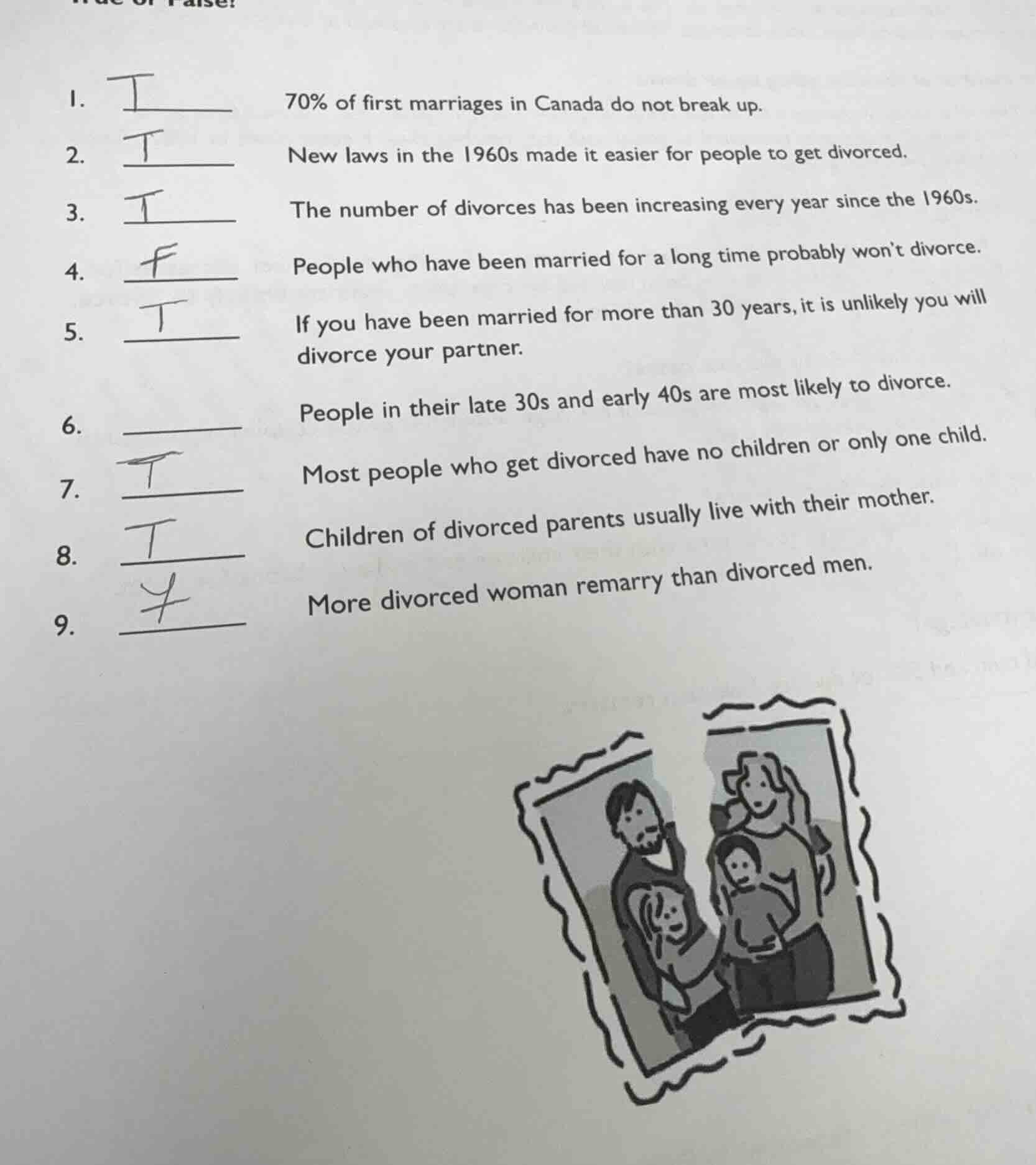
true or false?
- 70% of first marriages in canada do not break up.
- new laws in the 1960s made it easier for people to get divorced.
- the number of divorces has been increasing every year since the 1960s.
- people who have been married for a long time probably wont divorce.
- if you have been married for more than 30 years, it is unlikely you will divorce your partner.
- people in their late 30s and early 40s are most likely to divorce.
- most people who get divorced have no children or only one child.
- children of divorced parents usually live with their mother.
- more divorced woman remarry than divorced men.
Response
To solve these true - false questions, we need to rely on our knowledge of marriage and divorce statistics and trends:
Question 1
- Explanation: In Canada, the statistics show that around 70% of first marriages remain intact. So the statement "70% of first marriages in Canada do not break up" is in line with the known data.
- Answer: T
Question 2
- Explanation: During the 1960s, there were significant changes in divorce laws in many places, including the introduction of no - fault divorce in some regions, which made it easier for people to get a divorce.
- Answer: T
Question 3
- Explanation: After the initial increase in divorce rates following the law changes in the 1960s, the divorce rate has not been increasing every year. In fact, in recent years, the divorce rate in Canada (and in many other countries) has stabilized or even shown a slight decline in some cases.
- Answer: F
Question 4
- Explanation: People who have been married for a long time can still get divorced. There are cases of "gray divorces" (divorces among older couples) that have been on the rise in recent years. So the idea that long - married people "probably won't divorce" is wrong.
- Answer: F
Question 5
- Explanation: Statistically, the longer a couple has been married (especially more than 30 years), the less likely they are to get divorced. This is because they have had more time to build a life together and may have a stronger commitment.
- Answer: T
Question 6
- Explanation: Demographic studies show that people in their late 30s and early 40s have a relatively high likelihood of getting divorced. This is related to various factors such as mid - life crises, changes in personal goals, etc.
- Answer: T
Question 7
- Explanation: Most divorced people who have children either have no children or only one child. This is a statistical trend that has been observed in divorce and family studies.
- Answer: T
Question 8
- Explanation: In the case of divorce, children are more likely to live with their mothers. This is a well - documented trend in family law and sociology, related to factors such as custody arrangements and traditional gender roles in parenting.
- Answer: T
Question 9
- Explanation: More divorced men remarry than divorced women. Divorced women may face more social and economic barriers to remarriage, while divorced men often have an easier time in the remarriage market.
- Answer: F
So the answers are: 1. T; 2. T; 3. F; 4. F; 5. T; 6. T; 7. T; 8. T; 9. F.

Snap & solve any problem in the app
Get step-by-step solutions on Sovi AI
Photo-based solutions with guided steps
Explore more problems and detailed explanations
To solve these true - false questions, we need to rely on our knowledge of marriage and divorce statistics and trends:
Question 1
- Explanation: In Canada, the statistics show that around 70% of first marriages remain intact. So the statement "70% of first marriages in Canada do not break up" is in line with the known data.
- Answer: T
Question 2
- Explanation: During the 1960s, there were significant changes in divorce laws in many places, including the introduction of no - fault divorce in some regions, which made it easier for people to get a divorce.
- Answer: T
Question 3
- Explanation: After the initial increase in divorce rates following the law changes in the 1960s, the divorce rate has not been increasing every year. In fact, in recent years, the divorce rate in Canada (and in many other countries) has stabilized or even shown a slight decline in some cases.
- Answer: F
Question 4
- Explanation: People who have been married for a long time can still get divorced. There are cases of "gray divorces" (divorces among older couples) that have been on the rise in recent years. So the idea that long - married people "probably won't divorce" is wrong.
- Answer: F
Question 5
- Explanation: Statistically, the longer a couple has been married (especially more than 30 years), the less likely they are to get divorced. This is because they have had more time to build a life together and may have a stronger commitment.
- Answer: T
Question 6
- Explanation: Demographic studies show that people in their late 30s and early 40s have a relatively high likelihood of getting divorced. This is related to various factors such as mid - life crises, changes in personal goals, etc.
- Answer: T
Question 7
- Explanation: Most divorced people who have children either have no children or only one child. This is a statistical trend that has been observed in divorce and family studies.
- Answer: T
Question 8
- Explanation: In the case of divorce, children are more likely to live with their mothers. This is a well - documented trend in family law and sociology, related to factors such as custody arrangements and traditional gender roles in parenting.
- Answer: T
Question 9
- Explanation: More divorced men remarry than divorced women. Divorced women may face more social and economic barriers to remarriage, while divorced men often have an easier time in the remarriage market.
- Answer: F
So the answers are: 1. T; 2. T; 3. F; 4. F; 5. T; 6. T; 7. T; 8. T; 9. F.