QUESTION IMAGE
Question
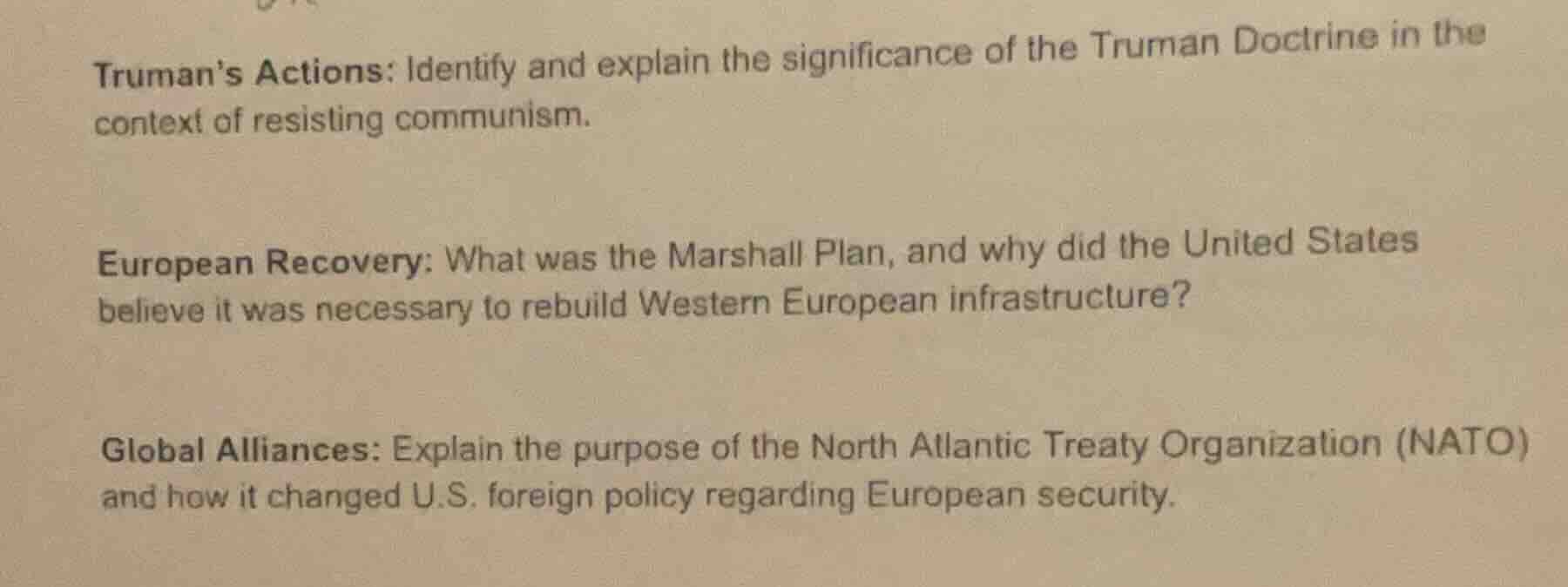
truman’s actions: identify and explain the significance of the truman doctrine in the context of resisting communism.
european recovery: what was the marshall plan, and why did the united states believe it was necessary to rebuild western european infrastructure?
global alliances: explain the purpose of the north atlantic treaty organization (nato) and how it changed u.s. foreign policy regarding european security.
- Truman Doctrine:
Proposed in 1947, it was a U.S. policy promising economic and military aid to nations threatened by communist expansion. Significantly, it formalized the U.S. "containment" strategy against global communism, marking a permanent shift from pre-WWII isolationism to active global intervention to counter Soviet influence.
- Marshall Plan:
Officially the European Recovery Program (1948-1951), it was a U.S. initiative providing ~$13 billion (adjusted for inflation) in economic aid to rebuild Western European economies post-WWII. The U.S. deemed it necessary to stabilize war-ravaged nations: weak economies were seen as fertile ground for communist takeovers, and rebuilding Western Europe also created strong trading partners for the U.S.
- NATO:
Founded in 1949, NATO is a collective defense alliance of North American and European nations, based on the principle of "an attack on one is an attack on all." It changed U.S. foreign policy by establishing a permanent military commitment to European security, replacing temporary WWII-era alliances with a long-term, formal structure to deter Soviet aggression in Europe.

Snap & solve any problem in the app
Get step-by-step solutions on Sovi AI
Photo-based solutions with guided steps
Explore more problems and detailed explanations
- Truman Doctrine: A 1947 U.S. policy of aiding anti-communist nations; it launched the U.S. containment strategy, ending isolationism to counter Soviet expansion.
- Marshall Plan: A 1948-1951 U.S. program providing $13B in aid to rebuild Western Europe. The U.S. saw it as necessary to stabilize economies (to prevent communist gains) and create U.S. trading partners.
- NATO: A 1949 collective defense alliance. Its purpose was to deter Soviet aggression in Europe; it established a permanent U.S. military commitment to European security, replacing temporary wartime alliances.