QUESTION IMAGE
Question
try again
your answer is incorrect.
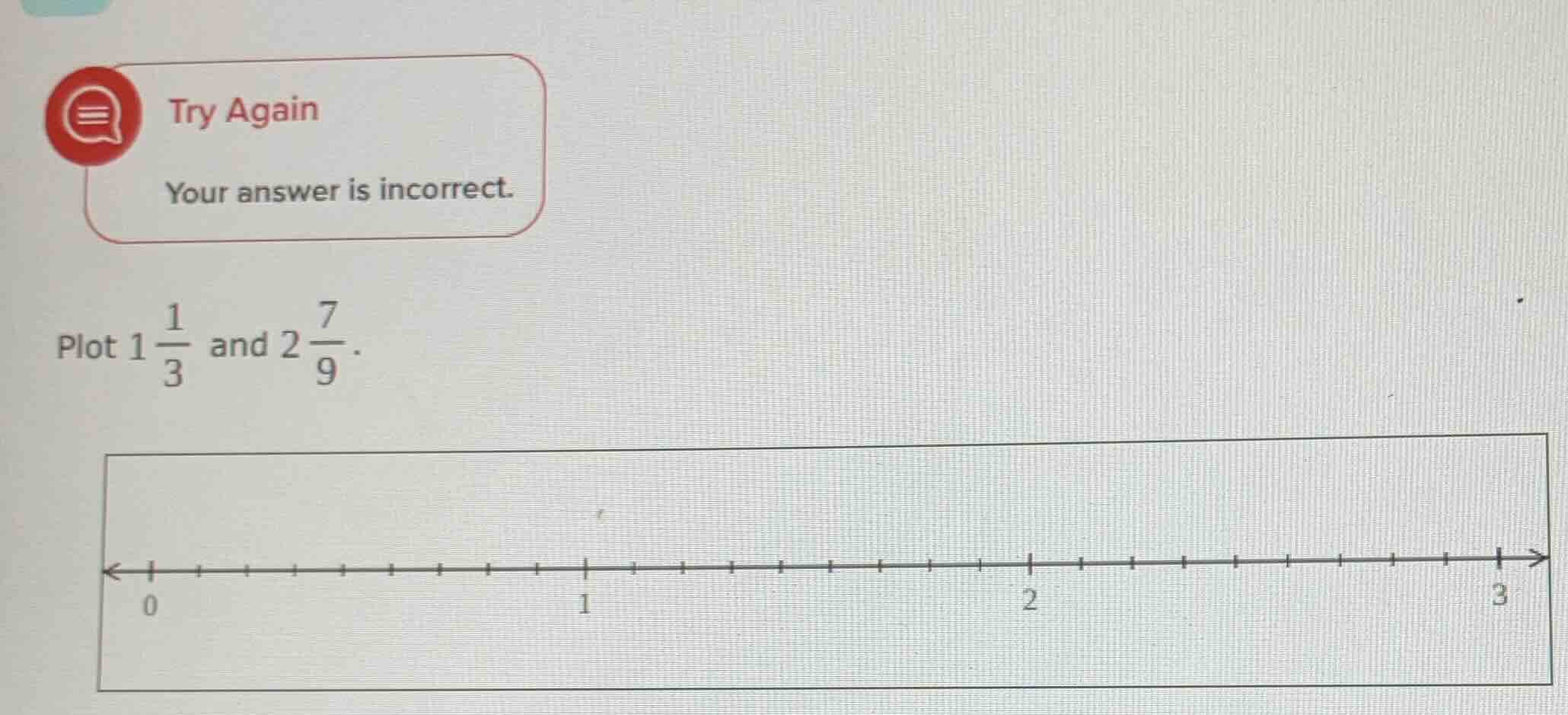
plot $1\frac{1}{3}$ and $2\frac{7}{9}$.
number line from 0 to 3 with ticks
Step1: Analyze the number line
First, we need to determine the length of each small segment on the number line. From 0 to 1, 1 to 2, and 2 to 3, we can see that the number of small segments between two consecutive integers (like 0 and 1, 1 and 2, 2 and 3) needs to be found. Let's assume the number of small segments between 0 and 1 is \( n \). But looking at the fractions, we can convert the mixed numbers to improper fractions with denominator 9 (since the second fraction has denominator 9) to make it easier.
Step2: Convert \( 1\frac{1}{3} \) to ninths
\( 1\frac{1}{3}=\frac{1\times3 + 1}{3}=\frac{4}{3} \). To convert to ninths, multiply numerator and denominator by 3: \( \frac{4\times3}{3\times3}=\frac{12}{9} \)? Wait, no, wait. Wait, \( 1\frac{1}{3}=1+\frac{1}{3} \). The number line: let's count the number of ticks between 0 and 1. Wait, from 0 to 1, how many small ticks? Let's see, the number line has ticks. Let's check the distance between 0 and 1. Let's see, the mixed number \( 1\frac{1}{3} \): \( \frac{1}{3} \) of the interval from 1 to 2? No, wait, \( 1\frac{1}{3} \) is 1 plus \( \frac{1}{3} \). Wait, maybe the number of segments between 0 and 1 is 9? No, wait, \( \frac{1}{3} \) is equal to \( \frac{3}{9} \). Wait, let's re - express:
\( 1\frac{1}{3}=1+\frac{1}{3}=1+\frac{3}{9} \). So from 1, we move 3 ninths (or 1 third) to the right.
\( 2\frac{7}{9}=2+\frac{7}{9} \), so from 2, we move 7 ninths to the right.
Now, let's check the number line. From 0 to 1, how many small ticks? Let's assume that between 0 and 1, there are 9 small ticks? Wait, no, maybe between 0 and 1, the number of intervals is such that each interval is \( \frac{1}{9} \). Wait, no, let's count the ticks. Let's see, from 0 to 1, the number of small ticks (excluding 0 and 1) : Let's look at the number line. Let's see, the distance between 0 and 1: if we have to plot \( 1\frac{1}{3} \) (which is \( 1+\frac{3}{9} \)) and \( 2\frac{7}{9} \) (which is \( 2+\frac{7}{9} \)).
First, \( 1\frac{1}{3} \): 1 is at the 9th tick (if we count from 0, 0 is tick 0, 1 is tick 9? Wait, no, maybe the number of ticks between 0 and 1 is 9. Wait, no, let's think again. Let's take the number line:
- For \( 1\frac{1}{3} \):
\( 1\frac{1}{3}=1+\frac{1}{3} \). The fraction \( \frac{1}{3} \) of the interval from 1 to 2? No, \( 1\frac{1}{3} \) is in the interval [1, 2]. Wait, no, \( 1\frac{1}{3}=1.333\cdots \), and \( 2\frac{7}{9}\approx2.777\cdots \).
Wait, maybe the number of segments between 0 and 1 is 9. Wait, no, let's count the ticks. Let's see, from 0 to 1, the number of small ticks (the little lines) : Let's assume that between 0 and 1, there are 9 small ticks, so each tick represents \( \frac{1}{9} \). But \( \frac{1}{3}=\frac{3}{9} \), so \( 1\frac{1}{3}=1+\frac{3}{9} \), so we start at 1 (the 9th tick from 0) and move 3 ticks to the right (since each tick is \( \frac{1}{9} \)).
For \( 2\frac{7}{9} \), we start at 2 (the 18th tick from 0, since from 0 to 1 is 9 ticks, 1 to 2 is another 9 ticks) and move 7 ticks to the right (since each tick is \( \frac{1}{9} \)).
So to plot \( 1\frac{1}{3} \):
- Locate the integer 1 on the number line.
- Since \( \frac{1}{3}=\frac{3}{9} \), divide the interval between 1 and 2 into 9 equal parts (each part is \( \frac{1}{9} \)) and move 3 parts to the right of 1.
To plot \( 2\frac{7}{9} \):
- Locate the integer 2 on the number line.
- Divide the interval between 2 and 3 into 9 equal parts (each part is \( \frac{1}{9} \)) and move 7 parts to the right of 2.

Snap & solve any problem in the app
Get step-by-step solutions on Sovi AI
Photo-based solutions with guided steps
Explore more problems and detailed explanations
To plot \( 1\frac{1}{3} \): From the number 1 on the number line, move \( \frac{1}{3} \) (or \( \frac{3}{9} \)) of the way towards 2. To plot \( 2\frac{7}{9} \): From the number 2 on the number line, move \( \frac{7}{9} \) of the way towards 3. If we consider the number line with 9 equal segments between each pair of consecutive integers (0 - 1, 1 - 2, 2 - 3), then:
- For \( 1\frac{1}{3} \): Start at 1, then move 3 segments (each of length \( \frac{1}{9} \)) to the right.
- For \( 2\frac{7}{9} \): Start at 2, then move 7 segments (each of length \( \frac{1}{9} \)) to the right.