QUESTION IMAGE
Question
tuesday
instructions: for each problem below that requires an equation, show your work and include your answer with the correct units.
scenario 1
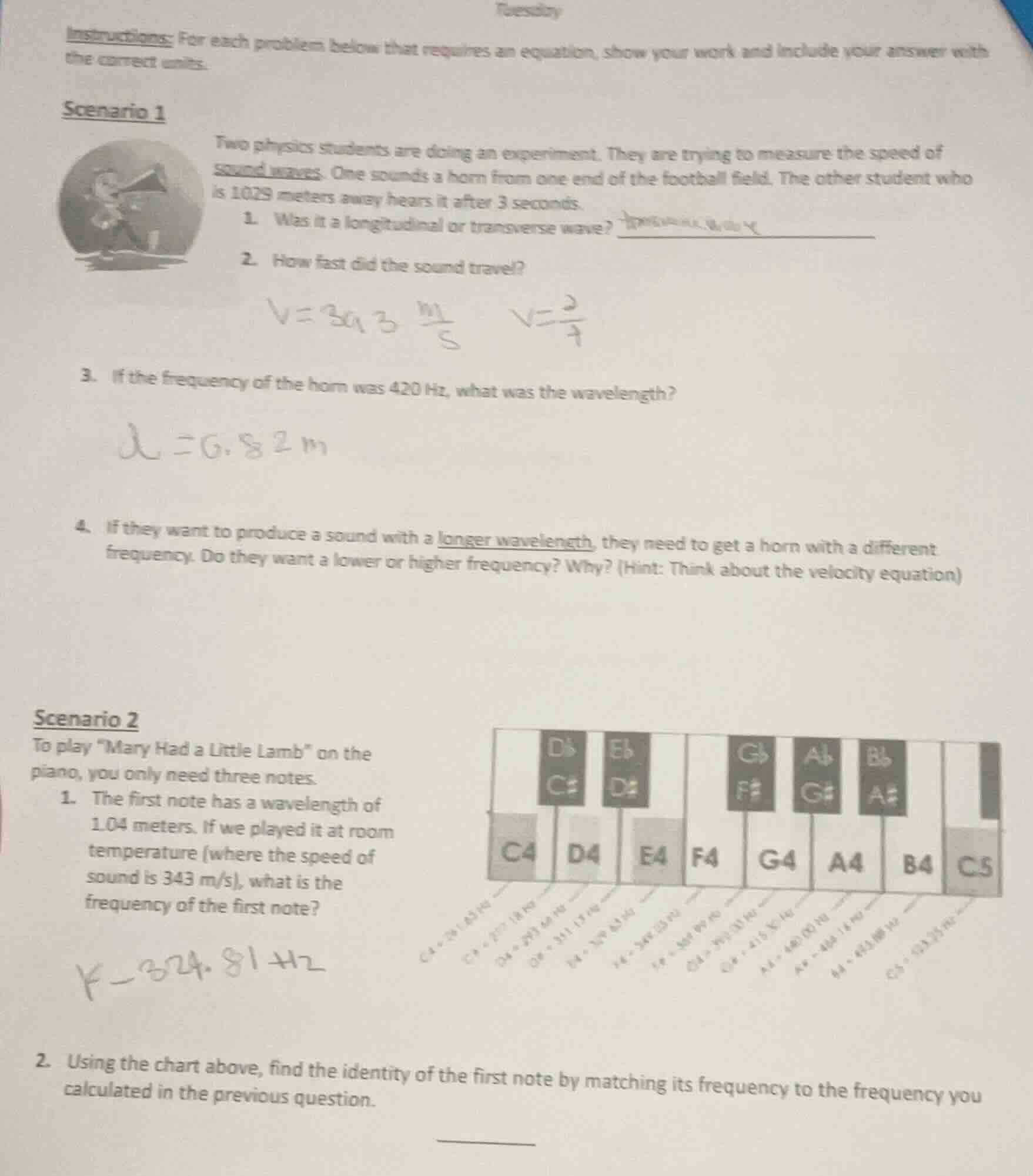
two physics students are doing an experiment. they are trying to measure the speed of sound waves. one sounds a horn from one end of the football field. the other student who is 1029 meters away hears it after 3 seconds.
- was it a longitudinal or transverse wave?
- how fast did the sound travel?
- if the frequency of the horn was 420 hz, what was the wavelength?
- if they want to produce a sound with a longer wavelength, they need to get a horn with a different frequency. do they want a lower or higher frequency? why? (hint: think about the velocity equation)
scenario 2
to play \mary had a little lamb\ on the piano, you only need three notes.
- the first note has a wavelength of 1.04 meters. if we played it at room temperature (where the speed of sound is 343 m/s), what is the frequency of the first note?
- using the chart above, find the identity of the first note by matching its frequency to the frequency you calculated in the previous question.
Step1: Identify wave type
Sound waves are longitudinal because they propagate by compressing and rarefacting the medium (air) parallel to the direction of wave travel.
Step2: Calculate sound speed
Use speed formula $v=\frac{d}{t}$
$v=\frac{1029\ \text{m}}{3\ \text{s}}=343\ \text{m/s}$
Step3: Calculate wavelength
Use wave equation $\lambda=\frac{v}{f}$
$\lambda=\frac{343\ \text{m/s}}{420\ \text{Hz}}\approx0.82\ \text{m}$
Step4: Relate wavelength and frequency
From $v=f\lambda$, at constant $v$, $\lambda\propto\frac{1}{f}$. Longer wavelength needs lower frequency.
Step5: Calculate note frequency
Use $f=\frac{v}{\lambda}$
$f=\frac{343\ \text{m/s}}{1.04\ \text{m}}\approx329.81\ \text{Hz}$
Step6: Match frequency to note
The calculated frequency matches the frequency of E4 (329.63 Hz, close to 329.81 Hz).

Snap & solve any problem in the app
Get step-by-step solutions on Sovi AI
Photo-based solutions with guided steps
Explore more problems and detailed explanations
- Longitudinal wave
- $343\ \text{m/s}$
- $0.82\ \text{m}$
- Lower frequency; because at constant wave speed, wavelength and frequency are inversely proportional, so a longer wavelength requires a smaller frequency.
- $329.81\ \text{Hz}$
- E4