QUESTION IMAGE
Question
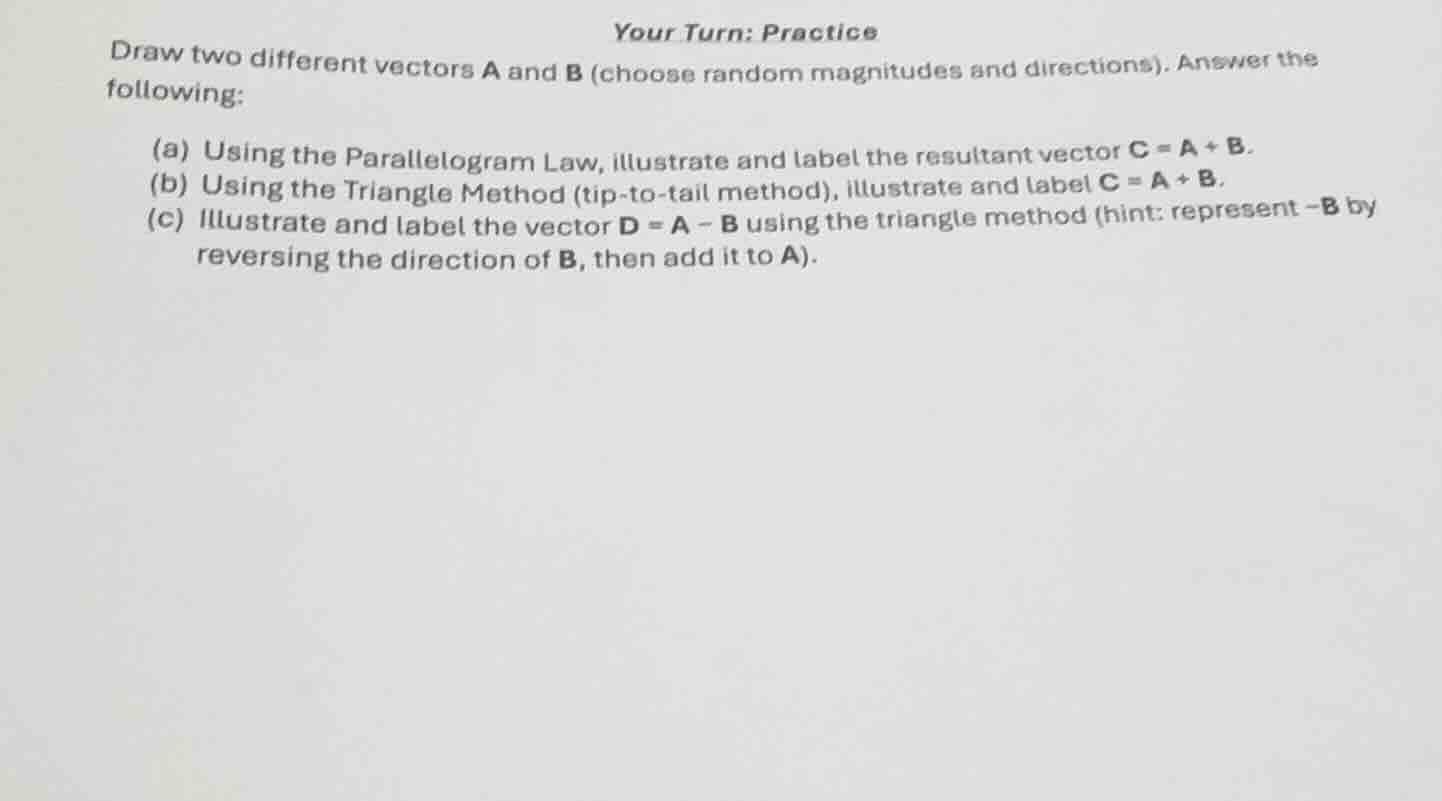
your turn: practice
draw two different vectors a and b (choose random magnitudes and directions). answer the
following:
(a) using the parallelogram law, illustrate and label the resultant vector c = a + b.
(b) using the triangle method (tip-to-tail method), illustrate and label c = a + b.
(c) illustrate and label the vector d = a - b using the triangle method (hint: represent -b by
reversing the direction of b, then add it to a).
First, define two sample vectors: let $\boldsymbol{A}$ be a 3-unit vector pointing right along the x-axis, and $\boldsymbol{B}$ be a 2-unit vector pointing 60° above the x-axis.
(a) Parallelogram Law: Place tails of $\boldsymbol{A}$ and $\boldsymbol{B}$ together. Draw copies of $\boldsymbol{A}$ and $\boldsymbol{B}$ parallel to the original vectors to form a parallelogram. The diagonal from the shared tail to the opposite corner is $\boldsymbol{C} = \boldsymbol{A} + \boldsymbol{B}$.
(b) Triangle (Tip-to-Tail) Method: Place the tail of $\boldsymbol{B}$ at the tip of $\boldsymbol{A}$. Draw a vector from the tail of $\boldsymbol{A}$ to the tip of $\boldsymbol{B}$; this is $\boldsymbol{C} = \boldsymbol{A} + \boldsymbol{B}$.
(c) Triangle Method for $\boldsymbol{D} = \boldsymbol{A} - \boldsymbol{B}$: First, create $-\boldsymbol{B}$, a 2-unit vector pointing 60° below the x-axis (reverse direction of $\boldsymbol{B}$). Place the tail of $-\boldsymbol{B}$ at the tip of $\boldsymbol{A}$. Draw a vector from the tail of $\boldsymbol{A}$ to the tip of $-\boldsymbol{B}$; this is $\boldsymbol{D} = \boldsymbol{A} + (-\boldsymbol{B}) = \boldsymbol{A} - \boldsymbol{B}$.

Snap & solve any problem in the app
Get step-by-step solutions on Sovi AI
Photo-based solutions with guided steps
Explore more problems and detailed explanations
(a) Parallelogram Law Illustration:
- Draw $\boldsymbol{A} = 3\hat{i}$ (tail at origin, tip at (3,0)).
- Draw $\boldsymbol{B} = 2\cos60^\circ\hat{i} + 2\sin60^\circ\hat{j} = \hat{i} + \sqrt{3}\hat{j}$ (tail at origin, tip at (1, ~1.732)).
- Draw a copy of $\boldsymbol{A}$ starting at the tip of $\boldsymbol{B}$, and a copy of $\boldsymbol{B}$ starting at the tip of $\boldsymbol{A}$ to form a parallelogram.
- The diagonal from the origin to the intersection of the copied vectors is $\boldsymbol{C} = \boldsymbol{A} + \boldsymbol{B} = 4\hat{i} + \sqrt{3}\hat{j}$ (tip at (4, ~1.732)), labeled as $\boldsymbol{C}$.
(b) Triangle Method Illustration:
- Draw $\boldsymbol{A} = 3\hat{i}$ (tail at origin, tip at (3,0)).
- Draw $\boldsymbol{B} = \hat{i} + \sqrt{3}\hat{j}$ with its tail at (3,0), tip at (4, ~1.732).
- Draw a vector from the origin to (4, ~1.732), labeled as $\boldsymbol{C} = \boldsymbol{A} + \boldsymbol{B}$.
(c) Triangle Method for $\boldsymbol{D} = \boldsymbol{A} - \boldsymbol{B}$:
- Draw $\boldsymbol{A} = 3\hat{i}$ (tail at origin, tip at (3,0)).
- Draw $-\boldsymbol{B} = -\hat{i} - \sqrt{3}\hat{j}$ with its tail at (3,0), tip at (2, ~-1.732).
- Draw a vector from the origin to (2, ~-1.732), labeled as $\boldsymbol{D} = \boldsymbol{A} - \boldsymbol{B}$.