QUESTION IMAGE
Question
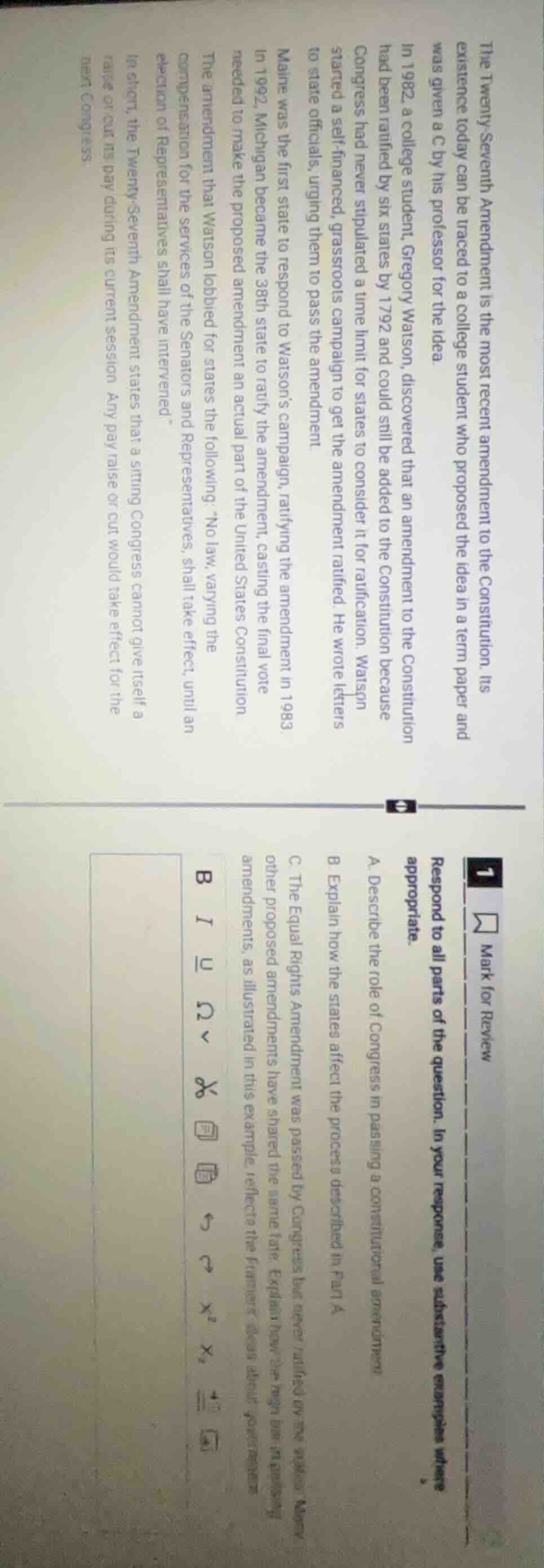
the twenty-seventh amendment is the most recent amendment to the constitution. its existence today can be traced to a college student who proposed the idea in a term paper and was given a c by his professor for the idea.
in 1982, a college student, gregory watson, discovered that an amendment to the constitution had been ratified by six states by 1792 and could still be added to the constitution because congress had never stipulated a time limit for states to consider it for ratification. watson started a self-financed, grassroots campaign to get the amendment ratified. he wrote letters to state officials, urging them to pass the amendment.
maine was the first state to respond to watsons campaign, ratifying the amendment in 1983. in 1992, michigan became the 38th state to ratify the amendment, casting the final vote needed to make the proposed amendment an actual part of the united states constitution.
the amendment that watson lobbied for states the following: no law, varying the compensation for the services of the senators and representatives, shall take effect, until an election of representatives shall have intervened
in short, the twenty-seventh amendment states that a sitting congress cannot give itself a raise or cut its pay during its current session. any pay raise or cut would take effect for the next congress.
1 mark for review
respond to all parts of the question. in your response, use substantive examples where appropriate.
a. describe the role of congress in passing a constitutional amendment
b. explain how the states affect the process described in part a
c. the equal rights amendment was passed by congress but never ratified by the states. many other proposed amendments have shared the same fate. explain how the difficulty in passing amendments, as illustrated in this example, reflects the framers ideas about power in government
Part A
Congress holds the power to propose constitutional amendments, which is the first formal step in the amendment process. As shown with the 27th Amendment, Congress first proposed the amendment in 1789 (as part of the original 12 amendments sent to states). Congress also sets the framework for ratification; in this case, it did not impose a time limit for state ratification, which allowed the amendment to be ratified over 200 years later. Additionally, Congress plays a role in verifying that the ratification requirements (3/4 of states) are met, which finalized the 27th Amendment's addition to the Constitution.
Part B
States are the final arbiters of ratifying constitutional amendments, as 3/4 of state legislatures (or state ratifying conventions) must approve an amendment for it to be added to the Constitution. For the 27th Amendment, states held the power to act on the proposal over decades: six states ratified it by 1792, and then Maine became the 38th (and final required) ratifying state in 1983, followed by Michigan confirming the count. Without state approval, even a congressional proposal cannot become part of the Constitution. This process ensures that amendments have broad, cross-state support before being enshrined in the Constitution.
Part C
The Framers designed the amendment process to be deliberate and require broad consensus, balancing federal and state power, which is reflected in the fate of proposed amendments. For the 27th Amendment, the slow, multi-decade ratification shows that the Framers wanted amendments to have sustained, widespread support rather than being rushed through. For the Equal Rights Amendment (ERA), which was proposed by Congress in 1972 but failed to get 3/4 state ratification (even with extended time limits), this reflects the Framers' intent that amendments cannot pass without broad state buy-in. The process ensures that only amendments with enduring, cross-regional support become part of the Constitution, preventing hasty changes that do not reflect the will of most states and the public.

Snap & solve any problem in the app
Get step-by-step solutions on Sovi AI
Photo-based solutions with guided steps
Explore more problems and detailed explanations
Part A
Congress has two key roles: 1) It proposes constitutional amendments (it first put forward the 27th Amendment in 1789 as part of 12 initial proposals). 2) It establishes ratification rules; for the 27th Amendment, it did not set a time limit, allowing states to ratify over centuries, and verifies when the 3/4 state ratification threshold is met to finalize the amendment's adoption.
Part B
States control the final ratification step: an amendment becomes part of the Constitution only if 3/4 of states approve it. For the 27th Amendment, states took over 200 years to reach this threshold, with Maine (1983) and Michigan (1992) completing the required 38 ratifications. Without state approval, the congressional proposal would not have become law, giving states the power to block or enact proposed amendments.
Part C
This reflects the Framers' intent to create a deliberate, consensus-driven amendment process that balances federal and state power. The 27th Amendment's slow ratification shows that amendments can be adopted if they gain sustained cross-state support over time. The ERA's failure to be ratified (despite congressional approval) shows that the Framers ensured amendments cannot pass without broad state buy-in, preventing hasty, narrow changes to the Constitution and ensuring only amendments with widespread, enduring support are enshrined.