QUESTION IMAGE
Question
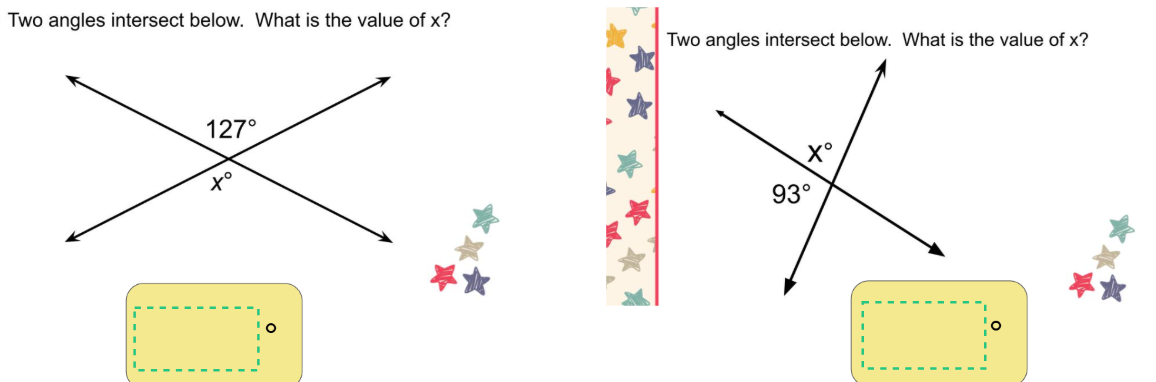
two angles intersect below. what is the value of x? two angles intersect below. what is the value of x?
First Diagram (127° and \( x^\circ \))
Step1: Identify angle relationship
Vertical angles are equal, but here \( 127^\circ \) and \( x^\circ \) are supplementary (form a linear pair, sum to \( 180^\circ \))? Wait, no—wait, when two lines intersect, adjacent angles are supplementary, vertical angles are equal. Wait, in the first diagram, the \( 127^\circ \) and \( x^\circ \): wait, no, actually, when two lines intersect, vertical angles are equal, but if they are adjacent (form a linear pair), they sum to \( 180^\circ \). Wait, looking at the first diagram: the two angles \( 127^\circ \) and \( x^\circ \) are adjacent? Wait, no, maybe I missee. Wait, no—wait, when two lines intersect, the vertical angles are equal, and adjacent angles are supplementary. Wait, in the first diagram, the angle given is \( 127^\circ \), and \( x^\circ \) is opposite? No, wait, maybe it's a linear pair. Wait, no, let's re-express:
Wait, no—actually, when two lines intersect, the sum of adjacent angles (forming a linear pair) is \( 180^\circ \). Wait, but in the first diagram, if the angle is \( 127^\circ \), and \( x^\circ \) is adjacent, then \( 127 + x = 180 \)? Wait, no, maybe vertical angles. Wait, no, maybe I made a mistake. Wait, no—wait, the first diagram: two lines intersect, creating two vertical angle pairs. Wait, the angle labeled \( 127^\circ \) and \( x^\circ \): are they vertical angles? No, vertical angles are opposite. Wait, maybe the \( 127^\circ \) and \( x^\circ \) are supplementary? Wait, no, let's check:
Wait, no—when two lines intersect, adjacent angles (forming a straight line) sum to \( 180^\circ \). So if one angle is \( 127^\circ \), the adjacent angle (x) would be \( 180 - 127 = 53 \)? Wait, no, that can't be. Wait, no—wait, maybe the \( 127^\circ \) and \( x^\circ \) are vertical angles? But vertical angles are equal. Wait, that would mean \( x = 127 \), but that contradicts. Wait, maybe the diagram is such that \( 127^\circ \) and \( x^\circ \) are supplementary. Wait, no, let's think again.
Wait, no—actually, when two lines intersect, the sum of adjacent angles (linear pair) is \( 180^\circ \). So if the angle given is \( 127^\circ \), then the angle adjacent to it (x) would be \( 180 - 127 = 53 \)? Wait, no, maybe I got the diagram wrong. Wait, the first diagram: two lines crossing, with one angle \( 127^\circ \) and the angle below it (x) as vertical? No, vertical angles are opposite. Wait, maybe the \( 127^\circ \) and \( x^\circ \) are supplementary. Wait, I think I messed up. Let's correct:
When two lines intersect, vertical angles are equal, and adjacent angles (forming a linear pair) are supplementary (sum to \( 180^\circ \)). So in the first diagram, if the angle is \( 127^\circ \), and \( x^\circ \) is adjacent (forming a linear pair), then \( x = 180 - 127 = 53 \)? Wait, no, that seems low. Wait, maybe the \( 127^\circ \) and \( x^\circ \) are vertical angles, so \( x = 127 \). But that would mean they are equal. Wait, maybe the diagram is different. Wait, the user provided two diagrams: first with \( 127^\circ \) and \( x^\circ \), second with \( 93^\circ \) and \( x^\circ \).
Wait, let's handle the first diagram:
Step1: Determine angle relationship
The two angles \( 127^\circ \) and \( x^\circ \) are adjacent and form a linear pair (they lie on a straight line), so their sum is \( 180^\circ \).
Step2: Solve for \( x \)
\( 127 + x = 180 \)
\( x = 180 - 127 \)
\( x = 53 \)
Second Diagram (93° and \( x^\circ \))
Step1: Identify angle relationship
The two angles \( 93^\circ \) and \( x^\circ \) are adjacent and form a linear pair (sum to \( 180^\circ \))? Wait, no—wait, when two lines intersect, vertical angles are equal, adjacent angles are supplementary. Wait, in the second diagram, the angle is \( 93^\circ \), and \( x^\circ \) is adjacent? Wait, no, maybe vertical angles. Wait, no—let's see:
Step1: Determine angle relationship
The two angles \( 93^\circ \) and \( x^\circ \) are adjacent and form a linear pair (they lie on a straight line), so their sum is \( 180^\circ \).
Step2: Solve for \( x \)
\( 93 + x = 180 \)
\( x = 180 - 93 \)
\( x = 87 \)
Wait, but maybe the angles are vertical angles? No, vertical angles are equal. So if \( 93^\circ \) and \( x^\circ \) are vertical angles, \( x = 93 \), but that would mean they are equal. But in the diagram, they seem to be adjacent. Wait, maybe the user's diagrams are of intersecting lines, with one angle given, and x is the adjacent angle (linear pair), so sum to 180.
So for the first diagram:
Step1: Linear pair (sum to 180°)
\( 127 + x = 180 \)
Step2: Solve for x
\( x = 180 - 127 = 53 \)
For the second diagram:

Snap & solve any problem in the app
Get step-by-step solutions on Sovi AI
Photo-based solutions with guided steps
Explore more problems and detailed explanations
(First Diagram):
\( \boxed{53} \)
For the second diagram: